Safety & handling
Physical
- Colour
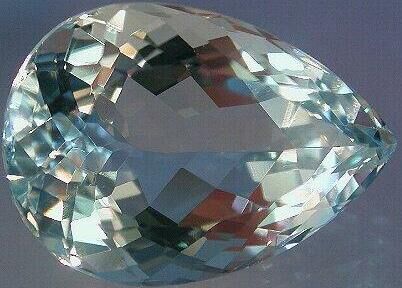
- “electro-optical” green · (blue-green)
The broad UV-Vis-NIR absorption bands at 427 and 610 nm are characteristic of V3+ (and a minor amount of Cr3+). Charge transfer between Fe2+ and Fe3+ may also contribute to the 610 nm band, which is superimposed on the absorption bands of V3+ and Cr3+. These factors primarily contribute to the blue-green coloration of beryl. The absorption induced by V3+ in the visible violet-blue region exhibits stronger intensity and a greater tendency towards the blue region compared to Cr3+. Consequently, the resultant vanadium-bearing beryl acquires the yellow-green hue (induced by V) overlaid with the light blue (induced by charge transfer between Fe2+-Fe3+ pairs), resulting in the so-called “electro-optical” green (blue-green) beryl. [[1]]
Chemical composition
- Impurities
- Fe
- V
- Cr
- Ba
- Ca
- Cu
- Zn
- K
Literature, links & citation
- 2025Hong, Yunlong; Zhang, Yu; Shao, Xinyi; Mu, Yanyi; Yu, Yuemiao (2025) Gemological Characteristics and Coloration Mechanism of Vanadium-Bearing Beryl from Nigeria. Minerals, 15 (6). doi:10.3390/min15060557DOI: 10.3390/min15060557
Entry last updated
@misc{mineral2026,
  author    = {Mineral Index editorial board},
  title     = {Vanadium-bearing beryl — Mineral Index},
  year      = {2026},
  url       = {https://mineralindex.org/minerals/vanadium-bearing-beryl-472129}
}