History
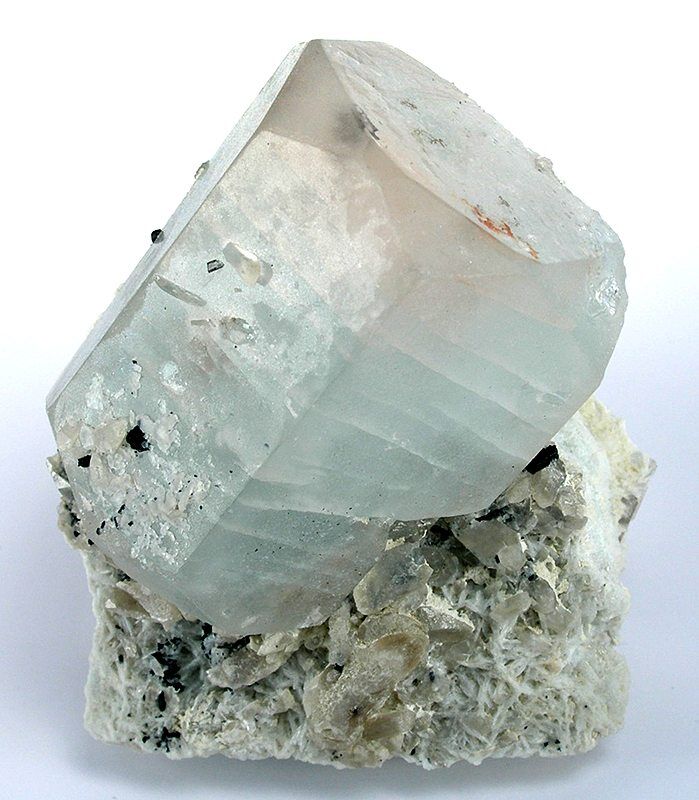
The name aquamarine is a small piece of Latin set in plain sight: aqua — water — joined to marina — of the sea. The compound describes the pale blue-green tint that distinguishes this variety of beryl from its sibling gems.
Long before the word existed, the stone itself was prized. Ancient Greek lapidaries cut it into intaglios — gems carved with a sunken design, used as seal stones. Roman writers credited it with healing virtues — a reputation often tied to a small visual trick. A polished aquamarine almost vanishes when dropped into water. Sailors carried small pieces as charms against shipwreck, believing the stones came from the treasure hoards of mermaids. The lore travelled east as well as west. Chinese craftsmen worked aquamarine into seals and small figurines. Japanese carvers fashioned it into netsuke — the small toggles that once fastened pouches to a kimono sash.
The name in its modern form is later. The first appearance of "Aquamarina" in print comes in Anselmus Boetius De Boot's Gemmarum et Lapidum Historia, published in Latin in 1609. The English antiquary Thomas Nicols picked it up half a century later, in A Lapidary History or History of Precious Stones (Cambridge, 1652). He noted there that the name was used by the Italians for blue-green varieties of beryl. From that point the term spread through European jewellery and mineralogical writing, displacing older catch-all names for blue beryl.
Industrial & practical applications
Aquamarine's modern life is almost entirely lapidary. The stone is cut and set into rings, earrings, necklaces and bracelets — and that is the whole of its commerce.
The colour the market wants is a clean, pale-to-medium blue, and most rough does not arrive that way. Many crystals carry a greenish or yellow undertone — the contribution of ferric iron (Fe³⁺) in the lattice. Gentle heating between 400 °C and 500 °C drives those tones off, leaving behind the pure blue of ferrous iron (Fe²⁺). The treatment is stable and effectively permanent.
Supply is concentrated, then diffuse. Brazil is the chief producer, with mines across the states of Minas Gerais, Espírito Santo and Bahia; the Urals in Russia, Madagascar, Pakistan's Skardu region and several African countries — Mozambique, Zambia, Nigeria, Namibia, Tanzania, Kenya — fill out the rest of the world's output. The headline specimens come from the Brazilian fields. One transparent crystal recovered there weighed 110 kg. Another, found near Pedra Azul in Minas Gerais around 1980, started as a rough piece of roughly 27 kg. The German lapidary Bernd Munsteiner carved it into the Dom Pedro obelisk — at 10,363 carats the largest cut aquamarine in the world. It is now held by the Smithsonian's National Museum of Natural History.
In the calendar of jewellery, aquamarine is the birthstone of March.
Where it forms, where it's found
- Geological setting
pegmatites
Varieties
Physical
- Lustre
- Vitreous - Resinous
- Colour
- Blue
Brazilian aquamarine, systematically investigating its compositional characteristics, coloration mechanisms, and chromatic properties. Experimental results demonstrate that this batch of aquamarine exhibits sodium-rich, magnesium-rich, potassium-rich, and low-vanadium features, classifying as high-alkali low-vanadium beryl. Aquamarine with higher Fe content shows bluer coloration. Different substitution degrees of TFe for Al change the color of aquamarine. A small amount of TFe substituting for Al, and a large amount of TFe forming Fe3+-Fe2+, make the aquamarine color bluer. [[1]]
- Streak
- White
- Cleavage
Imperfect
Optical
- Luminescence
- Non-fluorescent
Synonyms
- Acquamarina
- Acvamarin
- Água-marinha
- Aguamarina
- Aigue-marine
- Aigue-marine de Sibérie
- Akuamarin
- Akuamarina
- Akvamariin
- Akvamariini
- Akvamarin
- Akvamarín
- Akvamarinas
- Akvamarīns
- Akwamaryn
- Aquamarijn
- Aquamarin
- Aquamarina
- Augamariña
- Ngọc berin
Group, growth & confusion
Literature, links & citation
- 2014Fridrichová, Jana; Bačík, Peter; Rusinová, Petra; Miglierini, Marcel; Bizovská, Valéria; Antal, Peter (2014) Crystal-chemical effects of heat treatment on aquamarines and yellow beryl from Thanh Hoa Province, Vietnam, in Abstract Book. 4th Central-European Mineralogical Conference (CEMC), 23-26 April 2014, Skalský Dvůr (Česká republika), Masaryk University . 39
- 2017Danielle Gomides Alkmim, Frederico Ozanan Tomaz de Almeida, Fernando Soares Lameiras (2017): FTIR study of aquamarines after gamma irradiation, heat treatment and electrodiffusion. Revista Escolad de Minas, Int. Eng. J. (Ouro Preto), 70, 289-292. [http://www.scielo.br/pdf/remi/v70n3/2448-167X-remi-70-03-0289.pdf]
- 2019Andersson, Lars Olov (2019) Comments on Beryl Colors and on Other Observations Regarding Iron-containing Beryls. The Canadian Mineralogist, 57 (4) 551-566 doi:10.3749/canmin.1900021DOI: 10.3749/canmin.1900021
- 2023Cui, Shiyuan, Xu, Bo, Shen, Jiaqi, Miao, Zhuang, Wang, Zixuan (2023) Gemology, Spectroscopy, and Mineralogy Study of Aquamarines of Three Different Origins. Crystals, 13 (10) doi:10.3390/cryst13101478DOI: 10.3390/cryst13101478
- 2025Zhang, Zheng; Zu, Endong; He, Xiaohu; Wang, Zixuan; Wang, Die; Sun, Yicong; Wang, Yigeng; Yang, Siqi (2025) Chromogenic Mechanism and Chromaticity Study of Brazilian Aquamarine. Crystals, 15 (9). doi:10.3390/cryst15090775DOI: 10.3390/cryst15090775
Entry last updated
@misc{mineral2026,
  author    = {Mineral Index editorial board},
  title     = {Aquamarine — Mineral Index},
  year      = {2026},
  url       = {https://mineralindex.org/minerals/aquamarine-289}
}