Where it forms, where it's found
- Type locality
- Vuoriyarvi alkaline-ultrabasic massif
- Northern Karelia
- Murmansk Oblast
- Russia
6recorded occurrences
Physical
Optical
- Optical type
- Biaxial (+) · 2V measured = 20°
- Refractive index
- 1.649 – 1.759
- Surface relief
- High
- Principal indices
- nα 1.649 · nβ 1.655 · nγ 1.759
- Dispersion
- Weak, r < v.
- Extinction
- Z = c; X = b.
- Luminescence
- Non-fluorescent
- UV response
- Not fluorescent.
- Notes
Negative elongation.
Δ = 0Δmax
PPLpleochroism per grain
XPLindependent extinctions · rotate the stage
PPLpleochroism only · colour blends on rotation
XPLinterference colour · extinct every 90°
Retardation1100 nm
Order2nd order
XPL colour
Crystallography
- Cell parameters
- a = 14.692(4) Å · b = 14.164(4) Å · c = 7.859(3) Å
- Cell angles
- β = 117.87(2) °
- Ratio a:b:c
- 1 : 0.964 : 0.535
- Parting
- Weak parting perpendicular to the elongation.
- Type-locality form
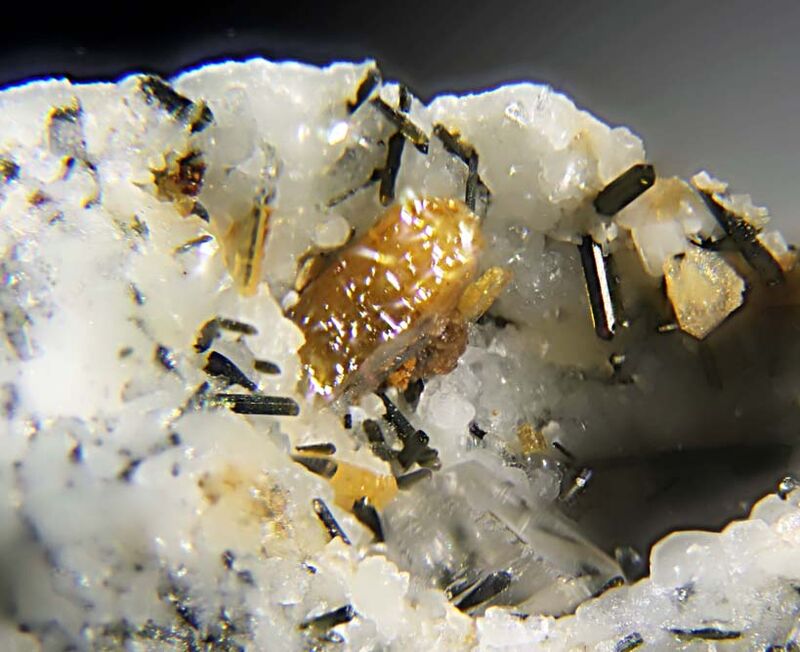
Tabular crystals up to 3 mm long, showing {h01} and pinacoids (001) and (100).
Chemical composition
Synonyms
- IMA1995-031
- Vuoriyarviet-K
In other languages
- German
- IMA 1995-031 · Vuorijärvit · Vuoriyarvit-K
- Italian
- Vuoriyarvite-K
Classification
Strunz
10th ed.9.CE.30b
- 9SilicatesClass
- 9.CCyclosilicatesDivision
- 9.CE[Si4O12]8- 4-membered single rings (vierer-Einfachringe), without insular complex anionsGroup
- 9.CE.30bVuoriyarvite-KSpecies
Group, growth & confusion
Literature, links & citation
Citations
- 1969Perrault, G., Vicat, J., Sang, N. (1969) UK-19-1 et UK- 19-2, [nenadkevichite] deux nouveau silicates hydrates de niobium du Mont St-Hilaire, P.Q.. The Canadian Mineralogist, 10, 143-144.
- 1994Rastsvetaeva, Ramiza K.; Tamazyan, Rafael A.; Pushcharovsky, Dmitriy Yu.; Nadezhina, Tamara N. (1994) Crystal structure and microtwinning of K-rich nenadkevichite. European Journal of Mineralogy, 6 (4). 503-509 doi:10.1127/ejm/6/4/0503DOI: 10.1127/ejm/6/4/0503
- 1998Jambor, John L., Grew, Edward S., Roberts, Andrew C. (1998) New mineral names. American Mineralogist, 83 (11) 1347-1352
- 1998Subbotin, V.V., Voloshin, A.V., Pakhomovskii, Y.A., Bakhchisaraitsev, A.Y., Pushcharovsky, D.Y., Rastsvetaeva, R.K., Nadezhina, T.N. (1998) Vuoriyarvite (K,Na)2(Nb,Ti)2Si4O12(O,OH)2·4H2O - a new mineral from carbonatites of the Vuoriyarvi Massif, Kola Peninsula. Doklady Earth Sciences, 358, 73-75.
- 2002Chukanov, Nikita V., Pekov, Igor V., Khomyakov, Alexander P. (2002) Recommended nomenclature for labuntsovite-group minerals. European Journal of Mineralogy, 14 (1) 165-173 doi:10.1127/0935-1221/2002/0014-0165 DOI: 10.1127/0935-1221/2002/0014-0165
Cite this entry
Entry last updated
@misc{mineral2025,
  author    = {Mineral Index editorial board},
  title     = {Vuoriyarvite-K — Mineral Index},
  year      = {2025},
  url       = {https://mineralindex.org/minerals/vuoriyarvite-k-7359}
}