Where it forms, where it's found
- Geological setting
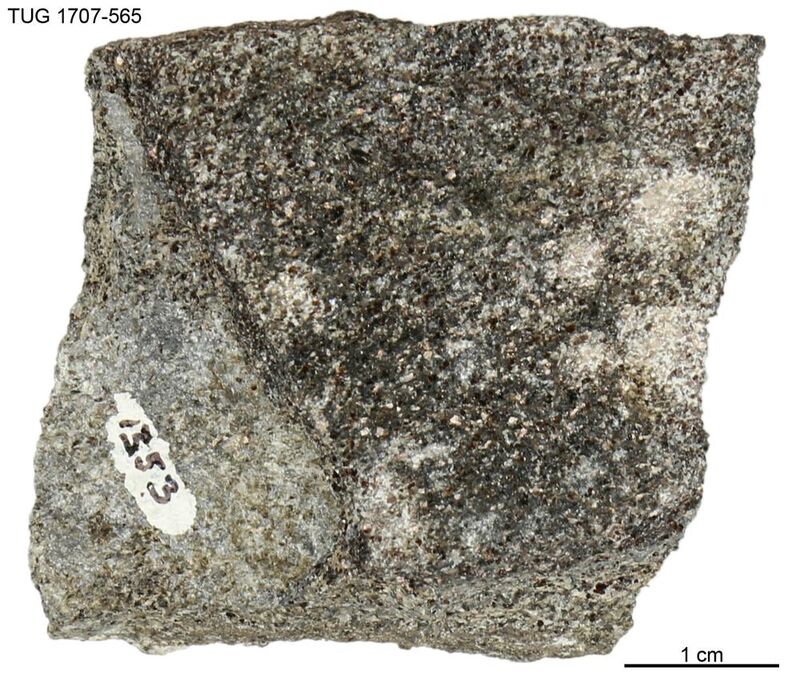
metasomatic mineral on fracture surfaces within vesuvianite/wollastonite rock
- Type locality
- Commercial Quarry
- Sky Blue Hill
- Crestmore quarries
- Crestmore
- Jurupa Valley
- Riverside County
- California
- USA
34.0236°, -117.3847°
2recorded occurrences
Safety & handling
Physical
Optical
- Optical type
- Uniaxial (+)
- Refractive index
- 1.855 – 1.875
- Surface relief
- Very high
- Principal indices
- nω 1.855 · nε 1.875
- Pleochroism
- Weak
sky blue (E) to lighter sky blue (O), E > O
Δ = 0Δmax
PPLpleochroism per grain
XPLindependent extinctions · rotate the stage
PPLpleochroism only · colour blends on rotation
XPLinterference colour · extinct every 90°
Retardation200 nm
Order1st order
XPL colour
Crystallography
- Space group
- #100
- Cell parameters
- a = 9.8953(9) Å · c = 10.2054(7) Å
- Unit cell volume
- 865.4 ų
- Z
- 1
- Type-locality form
hexagonal tablets and prisms, up to 0.5 mm in size
Chemical composition
Synonyms
- IMA2015-124
- Wayneburnhamiet
In other languages
- German
- IMA 2015-124 · Wayneburnhamit
Classification
Strunz
10th ed.9.BG.25
- 9SilicatesClass
- 9.BSorosilicatesDivision
- 9.BGSorosilicates with mixed SiO4 and Si2O7 groups; cations in octahedral [6] and greater coordinationGroup
- 9.BG.25WayneburnhamiteSpecies
Group, growth & confusion
Literature, links & citation
Citations
- 1976SAMANTA, S. C., HUMMEL, F. A. (1976) Phase Equilibria in the System CaO-PbO-SiO2. Journal of the American Ceramic Society, 59 (3). 157-160 doi:10.1111/j.1151-2916.1976.tb09456.xDOI: 10.1111/j.1151-2916.1976.tb09456.x
- 1998Jak, Evgueni, Hayes, Peter C., Liu, Naigang (1998) Experimental study of phase equilibria in the systems PbOx-CaO and PbOx-CaO-SiO2. Metallurgical and Materials Transactions B, 29 (3). 541-553 doi:10.1007/s11663-998-0088-9DOI: 10.1007/s11663-998-0088-9
- 2016Hålenius, U., Hatert, F., Pasero, M., Mills, S. J. (2016) New minerals and nomenclature modifications approved in 2016, CNMNC Newsletter no 31. Mineralogical Magazine, 80 (4) 691-697 doi:10.1180/minmag.2016.080.083DOI: 10.1180/minmag.2016.080.083
- 2016Kampf, Anthony R., Housley, Robert M., Rossman, George R. (2016) Wayneburnhamite, Pb9Ca6(Si2O7)3(SiO4)3, an apatite polysome: The Mn-free analog of ganomalite from Crestmore, California. American Mineralogist, 101 (11) 2423-2429 doi:10.2138/am-2016-5844 DOI: 10.2138/am-2016-5844
- 2017(2017) Wayneburnhamite. Handbook of Mineralogy. Mineralogical Society of America
Cite this entry
Entry last updated
@misc{mineral2025,
  author    = {Mineral Index editorial board},
  title     = {Wayneburnhamite — Mineral Index},
  year      = {2025},
  url       = {https://mineralindex.org/minerals/wayneburnhamite-47781}
}