Where it forms, where it's found
- Geological setting
Magnesian skarns in the contact aureole of the Tazheran alkalic massif.
- Type locality
- Tazheranskii Massif
- Russia
52.8417°, 106.7156°
5recorded occurrences
Physical
Optical
- Optical type
- Biaxial (+)
- Refractive index
- 1.799 – 1.855
- Surface relief
- Very high
- Principal indices
- nα 1.799 · nβ 1.822 · nγ 1.855
- Pleochroism
- Strong
X pale green with bluish tint, Y dark green, nearly opaque, Z reddish-brown, absorption Y>Z>X.
- Dispersion
- r > v medium
Δ = 0Δmax
PPLpleochroism per grain
XPLindependent extinctions · rotate the stage
PPLpleochroism only · colour blends on rotation
XPLinterference colour · extinct every 90°
Retardation560 nm
Order2nd order
XPL colour
Crystallography
- Space group
- Pbam
- Cell parameters
- a = 9.26(1) Å · b = 12.25(1) Å · c = 3.01(1) Å
- Ratio a:b:c
- 1 : 1.323 : 0.325
- Z
- 4
- Type-locality form
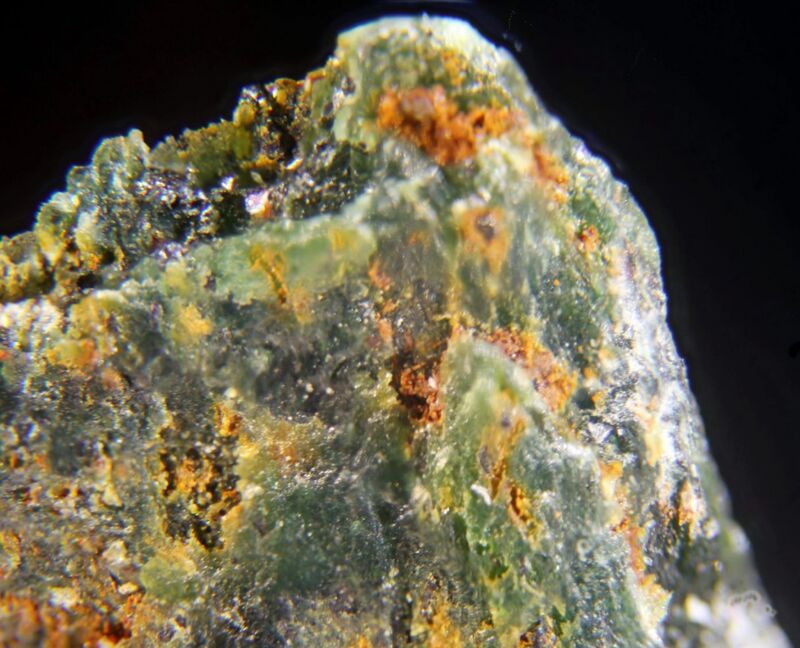
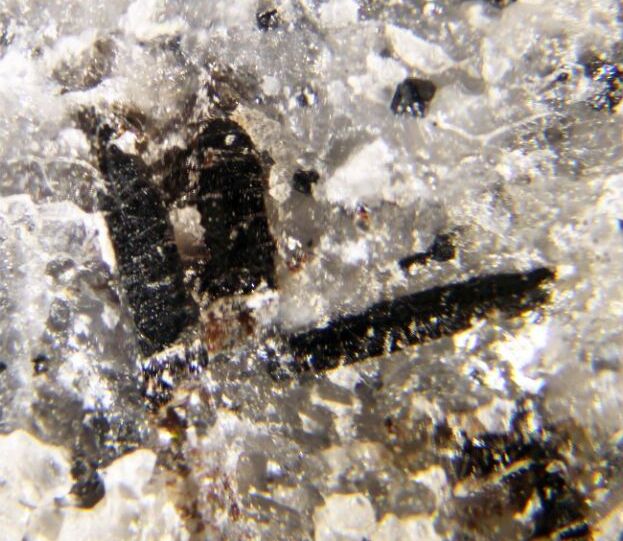
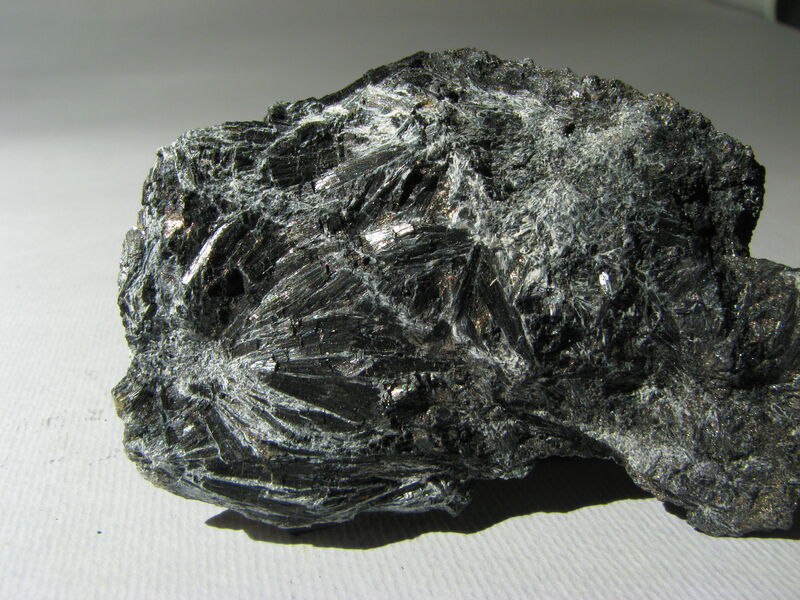
Prismatic crystals 1 to 20 mm long and 0.1 to 5 mm wide.
Crystal structure
Chemical composition
Synonyms
- Asoproit
- Azoproiet
- Azoproitt
- IMA1970-021
In other languages
- French
- azoproïte
- German
- Azoproit · IMA 1970-021
- Italian
- Azoproite
Classification
Strunz
10th ed.6.AB.30
- 6BoratesClass
- 6.AMonoboratesDivision
- 6.ABBO3, with additional anions; 1(D) + OH, etc.Group
- 6.AB.30AzoproiteSpecies
Dana
8th ed.24.02.01.03
- 24Anhydrous BoratesClass
- 24.02A2BO2[XO3]Type
- 24.02.01Ludwigite Group (Space Group: Pbam)Group
- 24.02.01.03AzoproiteSpecies
CIM
—9.6.2
- 9BoratesClass
- 9.6Borates of Ti, Sn and TaGroup
- 9.6.2AzoproiteSpecies
Group, growth & confusion
Literature, links & citation
Citations
- 1970Konev, A.A., Lesedeva, V.S., Kashaev, A.A., Ushchapovskaya, Z.F. (1970) Azoproite, a new mineral of the ludwigite group. Zapiski Vsesoyuznogo Mineralogicheskogo Obshchestva: 99(2): 225-231.
- 1971Fleischer, Michael (1971) New Mineral Names. American Mineralogist, 56 (1-2) 358-362
- 2005(2005) Azoproite. Handbook of Mineralogy. Mineralogical Society of America
- 2011Frost, Ray L. (2011) Raman spectroscopy of selected borate minerals of the pinakiolité group. Journal of Raman Spectroscopy, 42 (3). 540-543 doi:10.1002/jrs.2745DOI: 10.1002/jrs.2745
- 2017Bilohuščin, Vladimír, Uher, Pavel, Koděra, Peter, Milovská, Stanislava, Mikuš, Tomáš, Bačík, Peter (2017) Evolution of borate minerals from contact metamorphic to hydrothermal stages: Ludwigite-group minerals and szaibélyite from the Vysoká – Zlatno skarn, Slovakia. Mineralogy and Petrology, 111 (4) 643-658 doi:10.1007/s00710-017-0518-yDOI: 10.1007/s00710-017-0518-y
Cite this entry
Entry last updated
@misc{mineral2025,
  author    = {Mineral Index editorial board},
  title     = {Azoproite — Mineral Index},
  year      = {2025},
  url       = {https://mineralindex.org/minerals/azoproite-442}
}