Where it forms, where it's found
- Geological setting
Granite pegmatite.
Granitic and alkali pegmatites.
- Type locality
- Beryllonite locality
- Sugarloaf Mountain
- Stoneham
- Oxford County
- Maine
- USA
44.2686°, -70.9242°
Safety & handling
Physical
- Hardness
- 1Talc
- 2Gypsum
- 3Calcite
- 4Fluorite
- 5Apatite
- 6Orthoclase
- 7Quartz
- 8Topaz
- 9Corundum
- 10Diamond
- Lustre
- Vitreous
- Transparency
- Transparent · Translucent
- Colour
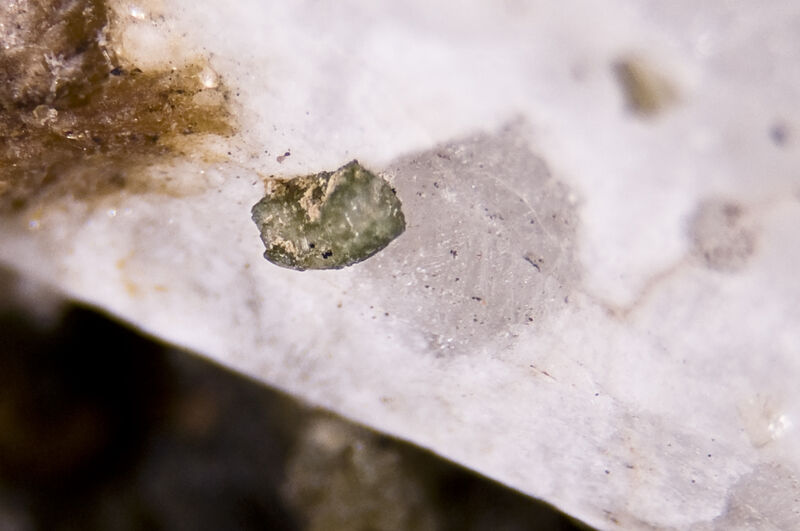
- Colourless · white · rarely pale light yellow · colourless in transmitted light.
- Streak
- White
- Tenacity
- brittle
- Cleavage
- Perfect
On (010) perfect; on (100) good but interrupted; on (101) poor; on (001), in traces.
- Fracture
- Irregular/Uneven
- Density
- 2.77 g/cm³
Optical
- Optical type
- Biaxial (-) · 2V measured = 68°
- Refractive index
- 1.552 – 1.561
- Surface relief
- Moderate
- Principal indices
- nα 1.552 · nβ 1.5579 · nγ 1.561
- Birefringence
- 0.009
- Pleochroism
- Non-pleochroic
- Dispersion
- weak to distinct r < v
- Extinction
- XYZ = bac
- UV response
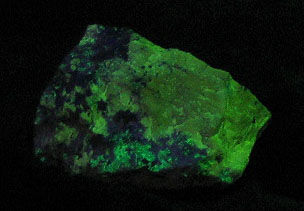
- Not fluorescent.
- Notes
Fluid inclusions common.
Crystallography
- Space group
- P21/c
- Cell parameters
- a = 8.178(3) Å · b = 7.818(3) Å · c = 14.114(6) Å
- Cell angles
- β = 90 °
- Ratio a:b:c
- 1 : 0.956 : 1.726
- Z
- 12
- Morphology
Crystals tabular (010) to short prismatic [010]. Crystals are frequently very complex, especially in the zones [100] and [010]. Faces in the zone [010] near (100) may be united in oscillatory combination. Crystal faces often dull or roughened, or, in some cases, delicately etched. Crystals frequently exhibit a columnar structure due to the presence of hollow canals and fluid cavities arranged parallel to [010].
- Twinning
On plane (101), as both contact and penetration twins; repeated at times, or in pseudo-hexagonal stellate forms; also polysynthetic (110) and (100).
- Type-locality form
Isolated crystals from about 0.5-2.5 cm in size, short prismatic or tabular showing many faces.
- Comment
Marked orthorhombic pseudo-symmetry.
Chemical composition
Synonyms
- Beryllonita
In other languages
- German
- Beryllonit
- Spanish
- Berilonita
- Italian
- Berillonite
- Japanese
- ベリロナイト
- Russian
- Бериллонит
- Arabic
- الفوسفات
Classification
8.AA.10
- 8Phosphates, Arsenates, VanadatesClass
- 8.APhosphates, etc. without additional anions, without H2ODivision
- 8.AAWith small cations (some also with larger ones)Group
- 8.AA.10BerylloniteSpecies
38.01.05.01
- 38Anhydrous Normal Phosphates, Arsenates, and VanadatesClass
- 38.01ABXO4Type
- 38.01.05— unnamed intermediate level —Group
- 38.01.05.01BerylloniteSpecies
19.3.2
- 19PhosphatesClass
- 19.3Phosphates of Be and MgGroup
- 19.3.2BerylloniteSpecies
Group, growth & confusion
Literature, links & citation
- 1888Dana, E.S. (1888) Preliminary notice of beryllonite, a new mineral. American Journal of Science: 136: 290-291.
- 1889Dana, Edward Salisbury and Wells, H.L. (1889) Description of the new mineral, beryllonite. American Journal of Science: 37: 23-32.
- 1889Dana, Edward S.; Wells, Horace L. (1889) Beryllonit, ein neues Berylliumphosphat. Zeitschrift für Kristallographie, 15 (1-6). 275-284 doi:10.1524/zkri.1889.15.1.275DOI: 10.1524/zkri.1889.15.1.275
- 1892Dana, Edward Salisbury; Dana, James Dwight (1892) A System of Mineralogy (6th ed.). John Wiley & Sons, Inc.
- 1907Gaubert, P. (1907) Sur les indices de réfraction de quelques minéraux. Bulletin de la Société française de Minéralogie: 30: 104-108 (108).
Entry last updated
@misc{mineral2026,
  author    = {Mineral Index editorial board},
  title     = {Beryllonite — Mineral Index},
  year      = {2026},
  url       = {https://mineralindex.org/minerals/beryllonite-644}
}