Where it forms, where it's found
- Geological setting
Granite pegmatite.
- Type locality
- Los Aleros pegmatite
- El Trapiche
- Coronel Pringles Department
- San Luis Province
- Argentina
-32.9453°, -66.0028°
33recorded occurrences
Physical
Optical
- Optical type
- Biaxial (+) · 2V measured = 25 – 45° · 2V calc = 54°
- Refractive index
- 1.685 – 1.723
- Surface relief
- High
- Principal indices
- nα 1.685 – 1.708 · nβ 1.688 – 1.711 · nγ 1.700 – 1.723
- Birefringence
- 0.020
- Pleochroism
- Non-pleochroic
- Dispersion
- r > v strong
- Extinction
- X = b; Z ∧ c = -36°
- UV response
- Not fluorescent.
Δ = 0Δmax
PPLpleochroism per grain
XPLindependent extinctions · rotate the stage
PPLpleochroism only · colour blends on rotation
XPLinterference colour · extinct every 90°
Retardation200 nm
Order1st order
XPL colour
Crystallography
- Space group
- P21/c
- Cell parameters
- a = 8.797(3) Å · b = 11.758(4) Å · c = 6.170(2) Å
- Cell angles
- β = 99.31(2) °
- Ratio a:b:c
- 1 : 1.337 : 0.701
- Z
- 4
- Type-locality form
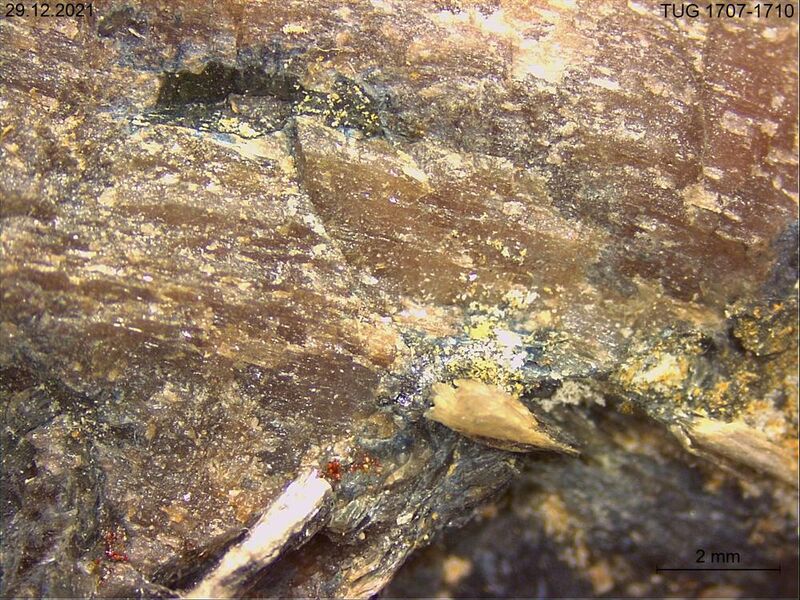
Rough prismatic crystals up to 30 cm long, interlaminated with lithiophilite.
Crystal structure
Chemical composition
Synonyms
- Beusiet
- IMA1968-012
In other languages
- German
- Beusit · IMA 1968-012
- Italian
- Beusite
- Chinese
- 磷铁锰矿
Classification
Strunz
10th ed.8.AB.20
- 8Phosphates, Arsenates, VanadatesClass
- 8.APhosphates, etc. without additional anions, without H2ODivision
- 8.ABWith medium-sized cationsGroup
- 8.AB.20BeusiteSpecies
Dana
8th ed.38.03.03.02
- 38Anhydrous Normal Phosphates, Arsenates, and VanadatesClass
- 38.03(AB)3(XO4)2Type
- 38.03.03— unnamed intermediate level —Group
- 38.03.03.02BeusiteSpecies
CIM
—19.12.39
- 19PhosphatesClass
- 19.12Phosphates of MnGroup
- 19.12.39BeusiteSpecies
Group, growth & confusion
Literature, links & citation
Citations
- —Černý, P., Selway, J.B., Ercit, T.S., Breaks, F.W., Anderson, A.J., Anderson, S.D. (1998) Graftonite – beusite in granitic pegmatites of the Superior Province: a study in contrasts. The Canadian Mineralogist: 36: 367-376.
- —Smeds, S.A., Uher, P., Černý, P., Wise, M.A., Gustafsson, L., Penner, P. (1998) Graftonite – beusite in Sweden: primary phases, products of exsolution, and distribution in zoned populations of granitic pegmatites. The Canadian Mineralogist: 36: 377-394.
- 1950Beus, A.A. (1950) Magniophilite and mangankoninckite, two new minerals from pegmatites. Doklady Akademii Nauk SSSR: 73: 1267–1279.
- 1960Brooks, J.H., Shipway, C.H. (1960) Mica Creek pegmatites, Mount Isa, North-western Queensland. Queensland Government Mining Journal: 61(708): 511–522.
- 1968Hurlbut, C. S., Aristarain, and L. F. (1968) Beusite, a new mineral from Argentina, and the graftonite-beusite series. American Mineralogist, 53 (11-12) 1799-1814
Cite this entry
Entry last updated
@misc{mineral2025,
  author    = {Mineral Index editorial board},
  title     = {Beusite — Mineral Index},
  year      = {2025},
  url       = {https://mineralindex.org/minerals/beusite-653}
}