Where it forms, where it's found
- Geological setting
Complex granite pegmatite.
Complex granitic pegmatites.
- Type locality
- Melvin Mountain
- Grafton
- Grafton County
- New Hampshire
- USA
43.6020°, -71.8959°
Physical
- Hardness
- 1Talc
- 2Gypsum
- 3Calcite
- 4Fluorite
- 5Apatite
- 6Orthoclase
- 7Quartz
- 8Topaz
- 9Corundum
- 10Diamond
- Transparency
- Translucent
- Colour
- Usually reddish brown · occasionally light brown · rarely salmon-pink · nearly colorless in transmitted light.
May be dark brown due to alteration.
- Streak
- White to faintly pink, when unaltered.
- Tenacity
- brittle
- Cleavage
- Distinct/Good
On (010), good; on (100), poor, but not eaily observed.
- Fracture
- Irregular/Uneven · Sub-Conchoidal
- Density
- 3.67 g/cm³
Optical
- Optical type
- Biaxial (+) · 2V measured = 20 – 60° · 2V calc = 56°
- Refractive index
- 1.695 – 1.736
- Surface relief
- High
- Principal indices
- nα 1.695 – 1.709 · nβ 1.699 – 1.714 · nγ 1.719 – 1.736
- Birefringence
- 0.026
- Pleochroism
- Weak
X = Colourless Y = Colourless Z = Pink
- Dispersion
- relatively weak to r>>v
- Extinction
- X = b, Z ∧ c = 36°.
- UV response
- Not fluorescent.
Crystallography
- Space group
- #14
- Cell parameters
- a = 8.87 Å · b = 11.57 Å · c = 6.17 Å
- Cell angles
- β = 99.2 °
- Ratio a:b:c
- 1 : 1.304 : 0.696
- Z
- 4
- Morphology
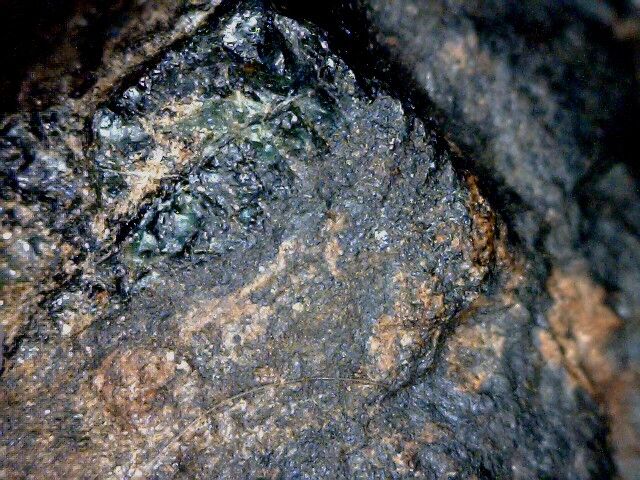
Generally found as parallel lamellae in triphylite or occasionally with other primary phosphates in granite pegmatite. Morphological "crystals" are essentially unknown. Pseudomorphs of heterosite after graftonite "crystals" are stout prismatic; also occurs as rough composite crystals of graftonite in triphylite.
- Epitaxy
As coarsely laminated intergrowths with Triphylite, both phases mutually oriented with graftonite (010) [100] parallel to triphylite (102) [010].
- Type-locality form
Crystals and fragments, displaying a weathered appearance and consisting of alternating layers of dark and light material - the light material being graftonite and the dark being triphylite.
- Comment
American Mineralogist 67:826 (1982) structure; Neutron diffraction indicates three distinct cation sites
Chemical composition
Synonyms
- Graftoniet
- Repossite
In other languages
- French
- graftonite
- German
- Graftonit
- Spanish
- Graftonita
- Italian
- Graftonite
- Arabic
- غرافتونيت
Classification
8.AB.20
- 8Phosphates, Arsenates, VanadatesClass
- 8.APhosphates, etc. without additional anions, without H2ODivision
- 8.ABWith medium-sized cationsGroup
- 8.AB.20GraftoniteSpecies
38.03.03.01
- 38Anhydrous Normal Phosphates, Arsenates, and VanadatesClass
- 38.03(AB)3(XO4)2Type
- 38.03.03— unnamed intermediate level —Group
- 38.03.03.01GraftoniteSpecies
19.12.36
- 19PhosphatesClass
- 19.12Phosphates of MnGroup
- 19.12.36GraftoniteSpecies
Group, growth & confusion
Literature, links & citation
- —Černý, P., Selway, J.B., Ercit, T.S., Breaks, F.W., Anderson, A.J., Anderson, S.D. (1998) Graftonite – beusite in granitic pegmatites of the Superior Province: a study in contrasts. The Canadian Mineralogist: 36: 367-376.
- —Smeds, S.A., Uher, P., Černý, P., Wise, M.A., Gustafsson, L., Penner, P. (1998) Graftonite – beusite in Sweden: primary phases, products of exsolution, and distribution in zoned populations of granitic pegmatites. The Canadian Mineralogist: 36: 377-394.
- —Parker, R.L., de Quervain, R., Weber, F. (1939) Über einige neue und seltene Mineralien der Schweizeralpen. Schweizerische Mineralogische und Petrographische Mitteilungen, 19, 293-306. https://www.e-periodica.ch/cntmng?pid=smp-001%3A1939%3A19%3A%3A784
- 1900Penfield, S. L. (1900): On graftonite, a new mineral from Grafton, New Hampshire, and its intergrowth with triphylite. The American Journal of Science. 159, 20-32
- 1921Larsen, Esper S. (1921) The microscopic determination of the nonopaque minerals. Bulletin 679. US Geological Survey doi:10.3133/b679 DOI: 10.3133/b679
Entry last updated
@misc{mineral2026,
  author    = {Mineral Index editorial board},
  title     = {Graftonite — Mineral Index},
  year      = {2026},
  url       = {https://mineralindex.org/minerals/graftonite-1735}
}