History
The name brookite honors a wool merchant who, in his spare hours, became one of England's most respected crystallographers. Henry James Brooke (1771–1857) trained no microscope on minerals professionally — his living came from textiles — yet he described twelve new species and wrote two foundational books on the subject.
In 1825 the French mineralogist Armand Lévy attached Brooke's name to a brown titanium oxide he was describing from north Wales. The type specimen came from Twll Maen Grisial, a crevice in the diabase — a dark, fine-grained volcanic rock — of Fron Olau near Prenteg in Gwynedd. Through the 19th century that Welsh locality produced some of the finest brookite ever found.
Brooke himself was a fellow of the Royal Society, the Geological Society of London and the Linnean Society. He authored A Familiar Introduction to Crystallography and co-authored An Elementary Introduction to Mineralogy in 1852. The twelve minerals he described include several still familiar to collectors today — annabergite, autunite, caledonite, childrenite, linarite and thomsonite among them.
The mineral itself filled in a chemical puzzle. Titanium dioxide (TiO₂) had already been recognised in two crystal forms — rutile (tetragonal, the common type) and anatase (also tetragonal, but built differently). Brookite gave the trio a third member, this one orthorhombic — a crystal class in which the three axes are all of different lengths and meet at right angles. A fourth natural polymorph, the monoclinic akaogiite, was identified much later under high-pressure conditions.
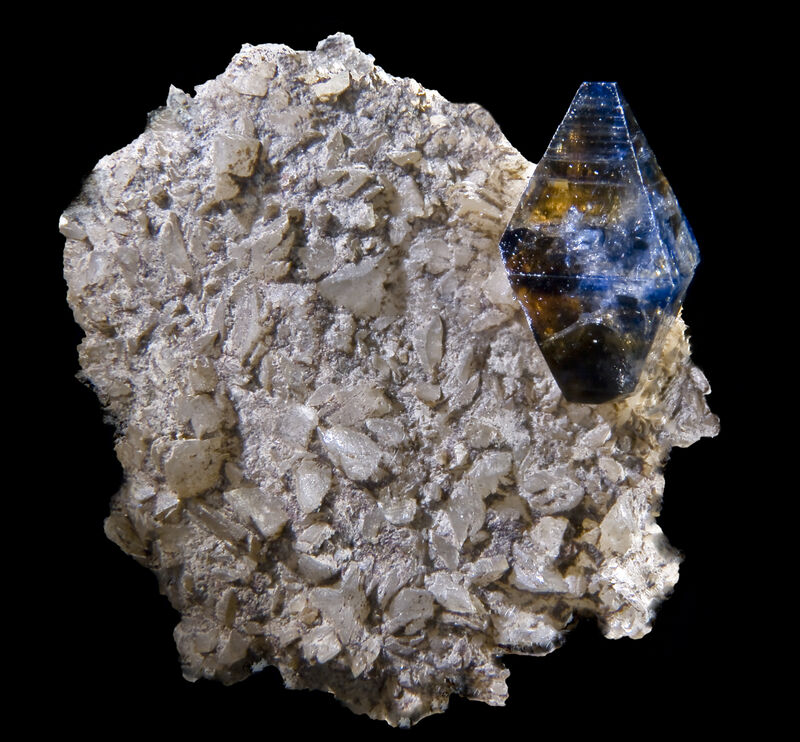
Beyond Wales, brookite became a classic mineral of the alpine clefts — narrow fractures in metamorphic rock where slow-growing crystals line the walls. The species is widespread in such veins through the Alps and turns up more locally in gneiss and schist, two banded metamorphic rocks formed under heat and pressure. The American collecting tradition centres on Magnet Cove in Arkansas, where the dark variety once called arkansite is in fact brookite.
Industrial & practical applications
Brookite has no industrial use of its own. It is also the least thermally stable of the common titanium dioxide polymorphs — minerals sharing one chemistry but built on different crystal frameworks. Heat brookite past about 750 °C and it converts to rutile, one of its two cousins in the polymorph family.
What remains is collector demand and a small research literature. Sharp brown crystals from the alpine clefts of Europe, and the dark arkansite variety from Magnet Cove in Arkansas, are sought after on the specimen market. Laboratory work on synthetic brookite continues to probe its photocatalytic activity — its ability to drive chemical reactions under light.
Where it forms, where it's found
- Geological setting
Hydrothermal vein
An accessory mineral in alpine veins in gneiss and schist; in contact metamorphic zones and hydrothermal veinlets; a common detrital mineral.
- Type locality
- Twll Maen Grisial
- Fron Olau
- Prenteg
- Dolbenmaen
- Gwynedd
- Wales
- UK
52.9481°, -4.1131°
Varieties
Physical
- Hardness
- 1Talc
- 2Gypsum
- 3Calcite
- 4Fluorite
- 5Apatite
- 6Orthoclase
- 7Quartz
- 8Topaz
- 9Corundum
- 10Diamond
- Lustre
- Metallic · Adamantine
- Transparency
- Transparent · Translucent · Opaque
- Colour
- Brown · yellowish brown · reddish brown · dark brown to iron-black · yellowish brown to dark brown in transmitted light
- Streak
- White to greyish white or yellowish white
- Tenacity
- brittle
- Cleavage
- Poor/Indistinct
on (120), in traces on (001)
- Fracture
- Irregular/Uneven · Sub-Conchoidal
- Density
- 4.08 g/cm³
Optical
- Optical type
- Biaxial (+) · 2V measured = 28° · 2V calc = 12 – 20°
- Refractive index
- 2.5831 – 2.7004
- Surface relief
- Very high
- Principal indices
- nα 2.5831 · nβ 2.5843 · nγ 2.7004
- Birefringence
- 0.1173
- Pleochroism
- Weak
Yellow, red, orange to brown
- Dispersion
- r > v, very strong, with crossed axial dispersion
- Extinction
- Parallel
- UV response
- Not fluorescent in ultraviolet
Crystallography
- Cell parameters
- a = 5.4558 Å · b = 9.1819 Å · c = 5.1429 Å
- Ratio a:b:c
- 1 : 1.683 : 0.943
- Z
- 8
- Morphology
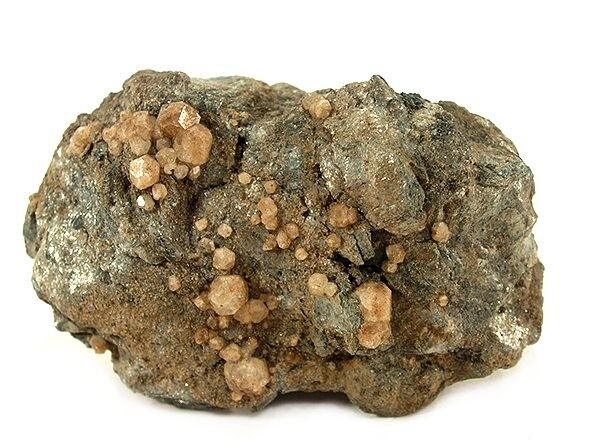
Crystals typically tabular on (010), striated parallel to [001] and elongated; pyramidal (111) or pseudohexagonal with (120) and (111) equally developed; also prismatic on [001] with (120) prominent; rarely tabular on (001) or pseudo-pyramidal.
- Twinning
On (120), uncertain
- Epitaxy
Rutile (110) [001] parallel to brookite (120) [001]. Rutile (110) [001] parallel to brookite (111) [001].
- Type-locality form
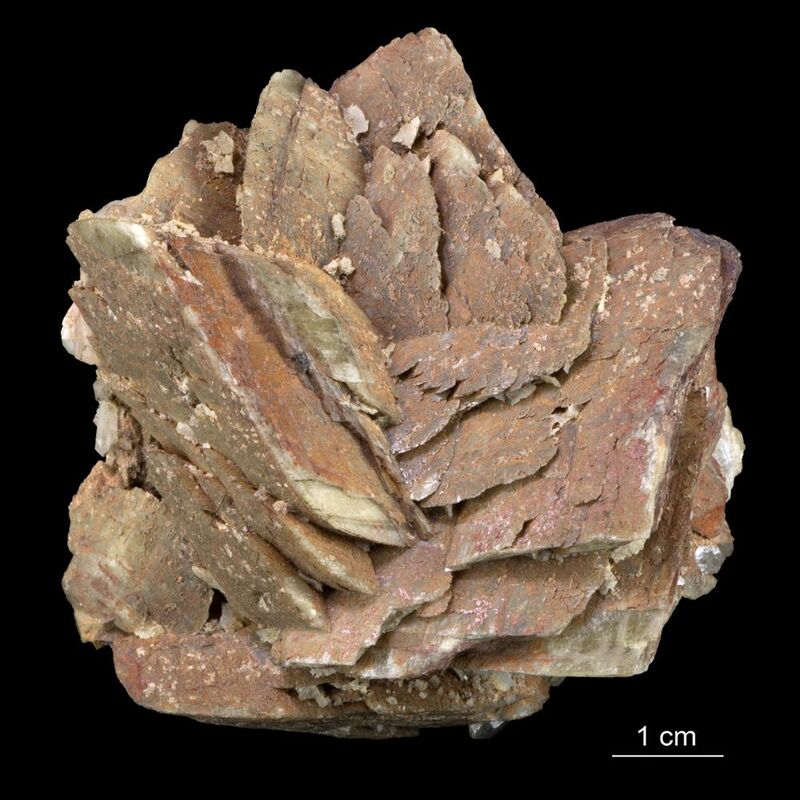
Bladed red to brown transparent to translucent bladed crystals with longitudinal striations.
- Comment
Space Group: Pcab
Chemical composition
- Impurities
- Fe
- Ta
- Nb
Synonyms
- Arkansit
- Arkansita
- Jurinit
- Jurinita
- Jurinite
- Pyromelane
In other languages
- French
- arkansite · brookite · eumanite · jurinite · pyromélane
- German
- Arkansit · Brookit
- Spanish
- Brookita
- Italian
- Brookite
- Portuguese
- brookita · Brookite
- Japanese
- ブルカイト · ブルッカイト · 板チタン石
- Chinese
- 板鈦礦 · 板钛矿
- Russian
- Брукит
- Arabic
- بروكيت
Classification
4.DD.10
- 4OxidesClass
- 4.DMetal: Oxygen = 1:2 and similarDivision
- 4.DDWith medium-sized cations; frameworks of edge-sharing octahedraGroup
- 4.DD.10BrookiteSpecies
04.04.05.01
- 04Simple OxidesClass
- 04.04AX2Type
- 04.04.05— unnamed intermediate level —Group
- 04.04.05.01BrookiteSpecies
7.9.4
- 7Oxides and HydroxidesClass
- 7.9Oxides of TiGroup
- 7.9.4BrookiteSpecies
Group, growth & confusion
Literature, links & citation
- 1825Levy, M. (1825) An account of a new mineral. The Annals of Philosophy: 9: 140-142.
- 1825Haidinger, W. (1825) Beschreibung mehrerer neuer oder bisher nur unvollkommen bekannter Mineralien. Annalen der Physik, 5, 157-177 (162).
- 1850Kokscharow, N. (1850) Ueber Brookit-Krystalle vom Ural. Annalen der Physik, 155(3), 454-464.
- 1858Des Cloizeaux (1858) Annales minéralogiques: 14: 361.
- 1884Zepharovich, V. von (1884) Ueber Brookit, Wulfenit und Skolezit. Zeitschrift für Krystallographie, Mineralogie und Petrographie, 8 (1-6). 577-592 doi:10.1524/zkri.1884.8.1.577DOI: 10.1524/zkri.1884.8.1.577
Entry last updated
@misc{mineral2026,
  author    = {Mineral Index editorial board},
  title     = {Brookite — Mineral Index},
  year      = {2026},
  url       = {https://mineralindex.org/minerals/brookite-787}
}