History
Caledonite carries the old name of the country that produced it. Caledonia was the Latin name the Romans gave to Scotland, and the mineral was named for the Scottish ground where it first came to light.
The story begins in the lead mines of Leadhills and Wanlockhead, a rich ore district in southern Scotland. Early in the 19th century the British mineralogist Henry James Brooke examined a blue-green crust from those mines. In 1820 he described it as a "cupreous sulphato-carbonate of lead". The long chemical mouthful simply meant a lead carbonate-sulfate carrying copper.
The tidier name arrived in 1832. The French mineralogist François Sulpice Beudant gave the species its modern name, Caledonite, after its Scottish home. He named two of its mining companions in the same stroke — leadhillite and lanarkite — all three drawn from the same Leadhills ores.
The mineral itself is a secondary one. It forms when air and water slowly alter primary lead and copper ores near the surface. That is why it turns up as small, richly coloured blue-green crystals rather than in bulk. Well-formed crystals remain scarce. Beyond the Scottish type district, the finest have come from the Mammoth-St. Anthony Mine at Tiger, Arizona, and from a few California mines such as the Reward Mine.
Industrial & practical applications
Caledonite has no industrial use. It contains both copper and lead, yet it is a secondary mineral — one that forms in thin surface crusts as primary ores weather — and it never gathers in deposits large enough to mine for either metal. The metals it holds are simply locked up in too small a quantity, in too rare a mineral, to be worth extracting.
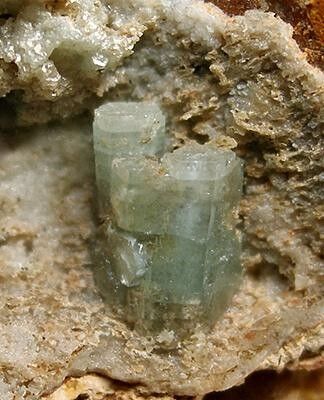
What value it has is to collectors. When it grows into full crystals, caledonite shows a deep blue-green colour reminiscent of other secondary copper minerals. Good specimens are sought for cabinets and museum collections. It also appears in the scientific record as a representative of its rare species. But it does no work in industry, in the laboratory, or in daily life.
Where it forms, where it's found
- Geological setting
A rare mineral found in the oxidized zones of copper-lead deposits as a secondary mineral.
- Type locality
- Leadhills
- South Lanarkshire
- Scotland
- UK
55.4171°, -3.7620°
Safety & handling
Physical
- Hardness
- 1Talc
- 2Gypsum
- 3Calcite
- 4Fluorite
- 5Apatite
- 6Orthoclase
- 7Quartz
- 8Topaz
- 9Corundum
- 10Diamond
- Lustre
- Vitreous
- Transparency
- Transparent · Translucent
- Colour
- Dark blue to bluish-green · light bluish green in transmitted light.
- Streak
- Greenish-blue to bluish-white, paler than the sample.
- Tenacity
- brittle
- Cleavage
- Perfect
Perfect on (010); incomplete on (100) and (101).
- Fracture
- Irregular/Uneven
- Density
- 5.75 g/cm³
Optical
- Optical type
- Biaxial (-) · 2V measured = 85° · 2V calc = 84°
- Refractive index
- 1.818 – 1.909
- Surface relief
- Very high
- Principal indices
- nα 1.818 · nβ 1.866 · nγ 1.909
- Pleochroism
- Weak
- Dispersion
- very weak r < v
Crystallography
- Space group
- #34
- Cell parameters
- a = 20.085(3) Å · b = 7.141(1) Å · c = 6.563(1) Å
- Ratio a:b:c
- 1 : 0.356 : 0.327
- Unit cell volume
- 941.2 ų
- Z
- 2
- Morphology
Prismatic crystals, elongated [001], often striated and with vicinal faces in the [001] zone. Crystals often tiny and aggregated into divergent groups; coatings; rarely massive.
- Twinning
None reported.
- Comment
a = 7.14, b = 20.06, c = 6.55 (Palache and Richmond 1939). a = 20.089(7), b = 7.146(3), c = 6.560(5) (Giacovazzo et al 1973). a = 20.085(3), b = 7.141(1), c = 6.563(1) (Schofield et al. 2009, at 293 K).
Chemical composition
Synonyms
- Cupreous Sulfatocarbonate of Lead
- Cupreous Sulphate-Carbonate of Lead
- Halbasurblei
- Halbazurblei
- Kaledonit
- Kupferhaltiges schwefelkohlensaures Blei
- Plomb sulfato-carbonaté cuprifère
- Prismatischer Kupferbleispat
In other languages
- French
- Calédonite
- German
- Caledonit
- Spanish
- Caledonita
- Italian
- caledonite
- Portuguese
- caledonita
- Japanese
- カレドニア鉱
Classification
7.BC.50
- 7SulfatesClass
- 7.BSulfates (selenates, etc.) with additional anions, without H2ODivision
- 7.BCWith medium-sized and large cationsGroup
- 7.BC.50CaledoniteSpecies
32.03.02.01
- 32Compound SulfatesClass
- 32.03Anhydrous Compound Sulfates containing Hydroxyl or HalogenType
- 32.03.02— unnamed intermediate level —Group
- 32.03.02.01CaledoniteSpecies
12.2.15
- 12Carbonates with other anionsClass
- 12.2Carbonates with sulphateGroup
- 12.2.15CaledoniteSpecies
Group, growth & confusion
Literature, links & citation
- 1801Haüy, René Just (1801) Traité de Minéralogie (1st ed.) Vol. 3. Chez Louis, Paris.
- 1820Brooke (1820) Edinburgh Philosophical Journal, Edinburgh: 3: 117 (as Cupreous Sulfatocarbonate of Lead).
- 1821Leonhard, K.C. (1821) Handbuch der Oryktognosie. First edition (1821); second edition (1826), Heidelberg: 254 (as Kupferhaltiges schwefelkohlensaures Blei).
- 1823Breithaupt, August (1823) Vollständige Charakteristik des Mineral-Systems (1st ed.). Arnoldischen Buchhandlung.
- 1832Beudant, François-Sulpice (1832) Traité élémentaire de minéralogie. Deuxiéme Edition [Elementary Treatise on Mineralogy. Second Edition] (2nd ed.) Vol. 2 - Tome II [Volume II]. Chez Verdière.
Entry last updated
@misc{mineral2026,
  author    = {Mineral Index editorial board},
  title     = {Caledonite — Mineral Index},
  year      = {2026},
  url       = {https://mineralindex.org/minerals/caledonite-865}
}