History
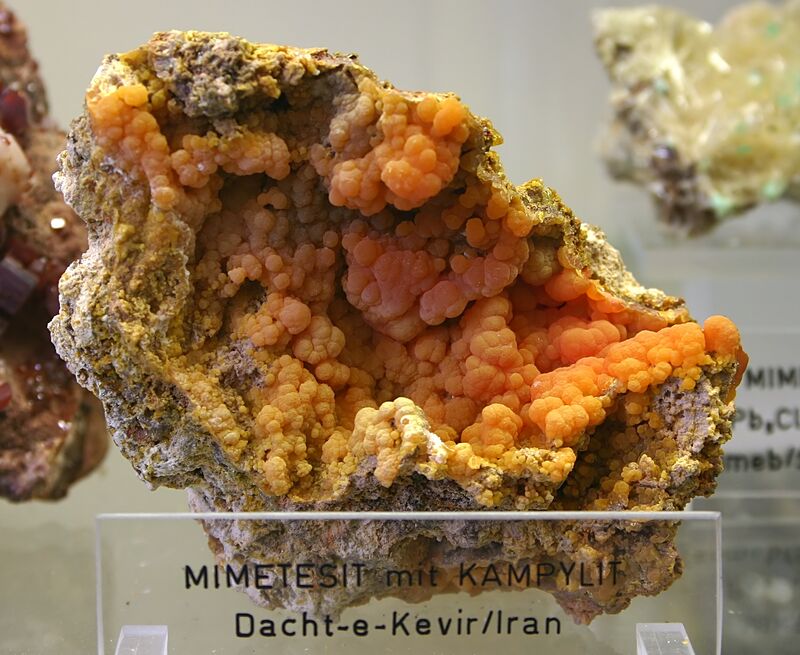
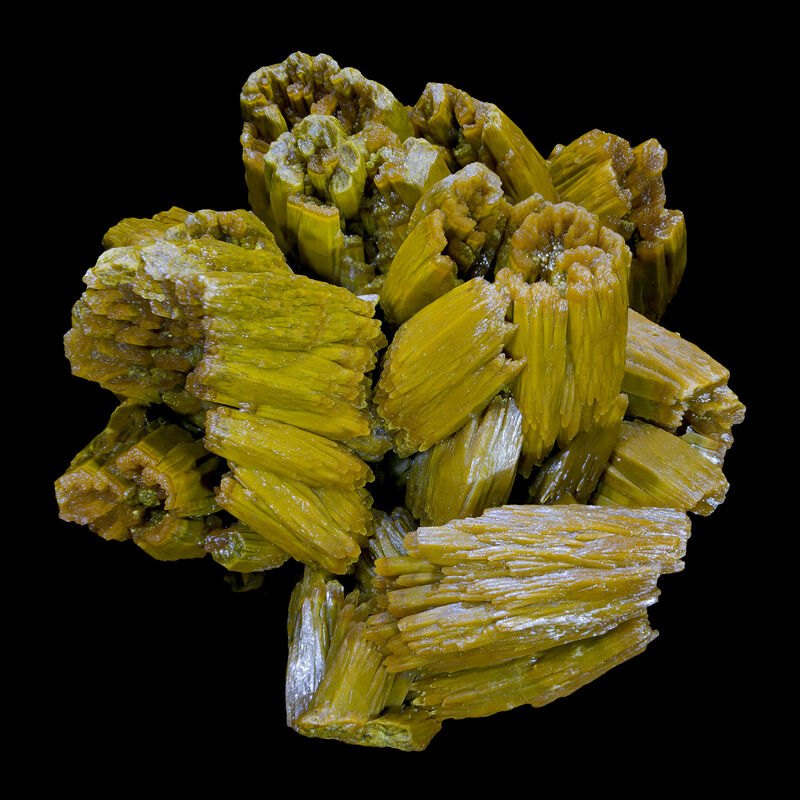
The name mimetite is a confession of resemblance. It comes from the Greek mimētēs — imitator — and was bestowed because the mineral looks so much like another it could be mistaken for it. The object of the imitation is pyromorphite, a lead phosphate chloride with the same crystal architecture; mimetite simply puts arsenic where pyromorphite puts phosphorus. The two are apatite-group cousins, share the same barrel-shaped crystal habit, and span the same colour range from olive green to honey yellow to orange-brown.
Mimetite was recognised as a distinct mineral in 1832. Three years later, in 1835, the French mineralogist François Sulpice Beudant published the name, citing the resemblance to pyromorphite as his motivation. It is one of the rare mineral names that openly admits the species was almost mistaken for another.
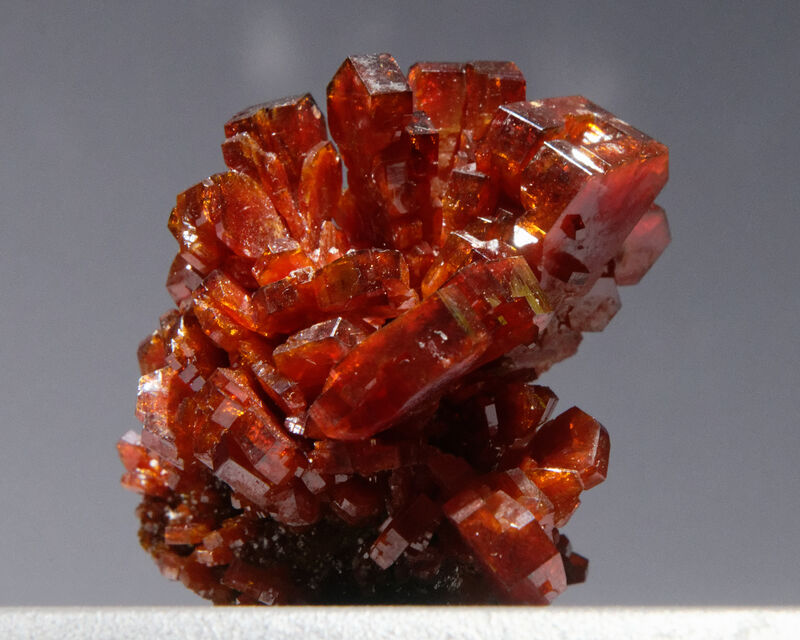
The most famous specimens carry their own nickname. Campylite — from the Greek for bent or curved — is the barrel-shaped, curve-faced variety of mimetite that came out of the Dry Gill Mine in the Caldbeck Fells of Cumberland, in northern England. By the 19th century, Drygill campylites were a fixture of every serious mineral collection in Europe — a rusty-orange crust of barrel crystals on a dark matrix, instantly recognisable. The mine has long been closed, but its specimens still surface at auction and in museum cases.
Two other regions define the modern collector market. The Tsumeb mine in Namibia produced yellow prisms from its oxidised lead orebody, and Mexican mines — most famously Mapimí in Durango — yielded the saturated orange and yellow specimens that fetch the highest prices today.
Industrial & practical applications
Mimetite has no significant industrial application of its own. It is a minor and sporadic ore of lead — occasionally smelted when it occurs in workable quantity alongside other lead minerals — but the arsenic locked into its structure is an environmental liability rather than an asset, and dedicated mining of mimetite for lead is not economic anywhere today.
Its most consequential modern role is environmental. Mimetite is a widespread secondary mineral in the oxidising zone of lead deposits, where it forms naturally as galena and other primary ores weather. Because the mineral is poorly soluble in water, it locks both lead and arsenic into a stable solid that resists release back into pore water. Soil scientists exploit this. Adding phosphate to lead-and-arsenic-contaminated soil drives mimetite to crystallise out of pore solutions, dropping the dissolved metals to very low levels and curbing plant uptake. Mimetite is stable across the pH range of natural waters, even in the presence of dissolved carbonate and sulfate ions. The same mechanism operates without human help — natural precipitation of mimetite or its hydroxyl analogue is recognised as a natural attenuation pathway for arsenic in contaminated soils.
The mineral's other modern role is on display in mineral cases. Campylite from old English workings, yellow prisms from Tsumeb in Namibia, and saturated orange masses from Mexican mines remain prized collector specimens — and command the strongest prices the species ever sees.
Where it forms, where it's found
- Geological setting
It is a secondary mineral found in the oxidized zones of lead mineral deposits, and in other settings where lead and arsenic occur together.
- Type locality
- Treue Freundschaft Mine
- Johanngeorgenstadt
- Erzgebirgskreis
- Saxony
- Germany
50.4404°, 12.7138°
Varieties
Safety & handling
Physical
- Hardness
- 1Talc
- 2Gypsum
- 3Calcite
- 4Fluorite
- 5Apatite
- 6Orthoclase
- 7Quartz
- 8Topaz
- 9Corundum
- 10Diamond
- Lustre
- Resinous to sub-adamantine
- Transparency
- Transparent · Translucent
- Colour
- Pale-yellow · yellowish-brown · orangish-yellow · orangish-red · red · green · white · colorless · colourless or faintly tinted in transmitted light.
- Streak
- White
- Tenacity
- brittle
- Cleavage
- Poor/Indistinct
In traces on (101).
- Fracture
- Irregular/Uneven · Sub-Conchoidal
- Density
- 7.24 g/cm³
Optical
- Optical type
- Uniaxial (-)
- Refractive index
- 2.128 – 2.147
- Surface relief
- Very high
- Principal indices
- nω 2.147 · nε 2.128
- Pleochroism
- Weak
Visible in tinted material in transmitted light.
- UV response
- May fluoresce reddish yellow under SW and LW
- Notes
May be anomalously biaxial - . Sectored
Crystallography
- Space group
- #108
- Cell parameters
- a = 10.250(2) Å · c = 7.454(1) Å
- Z
- 2
- Morphology
Typically in simple prisms [0001], barrel-shaped, showing (100) and (1000); also equant, rarely tabular (0001), or pyramidal. Frequently as rounded, barrel-shaped forms; spindle-shaped, or with cavernous basal terminations; globular, stalactic, reniform and granular. Branching groups of prismatic crystals in sub-parallel position, tapering down to a point. Acicular at times.
- Twinning
Very rarely on (112).
- Comment
On synthetic material.
Chemical composition
- Impurities
- Ca
- F
- Cr
- V
Synonyms
- Arsenate of Lead
- Arsenikalisches Bleyerz
- Arsenikbleispath
- Arsensaures Blei
- Bleiarsenapatit
- Flockenerz
- Gorlandit
- Gorlandita
- Gorlandite
- Mimetene
- Mimetèse
- Mimetesita
- Mimetesite
- Mimtesit
- Mimtesita
- Mimtesite
- Minera plumbi Viridis (of Wallerius)
- Petterdite (of Twelvetrees)
- Plomb arseniaté
- Plomb vert arsenical
- Plumbum arsenico mineralisatum
- Traubenblei
In other languages
- French
- Mimétite
- German
- Arsenikbleispath · Bellit · Belmontit · Bleiarsenapatit · Gorlandit · Mimetesit · Traubenblei
- Spanish
- Mimetesita · Mimetita
- Italian
- Mimetite
- Portuguese
- mimetita · Mimetite
- Japanese
- ミメット鉱
- Chinese
- 砷鉛礦 · 砷铅矿
- Simplified Chinese
- 砷铅矿
- Traditional Chinese
- 砷鉛礦
- Russian
- Арсенопироморфит · Миметизит · Миметит
Classification
8.BN.05
- 8Phosphates, Arsenates, VanadatesClass
- 8.BPhosphates, etc., with additional anions, without H2ODivision
- 8.BNWith only large cations, (OH, etc.):RO4 = 0.33:1Group
- 8.BN.05MimetiteSpecies
41.08.04.02
- 41Anhydrous Phosphates, Etc.containing Hydroxyl or HalogenClass
- 41.08A5(XO4)3ZqType
- 41.08.04Pyromorphite GroupGroup
- 41.08.04.02MimetiteSpecies
22.2.10
- 22Phosphates, Arsenates or Vanadates with other AnionsClass
- 22.2Phosphates, arsenates or vanadates with chlorideGroup
- 22.2.10MimetiteSpecies
Group, growth & confusion
 AlforsiteBa5(PO4)3ClMineral—
 ChlorapatiteCa5(PO4)3ClMineral—
- FluoralforsiteBa5(PO4)3FMineral—
 FluorapatiteCa5(PO4)3FMineral—
- FluorpyromorphitePb5(PO4)3FMineral—
 HydroxylapatiteCa5(PO4)3OHMineral—
- HydroxylpyromorphitePb5(PO4)3(OH)Mineral—
 JohnbaumiteCa5(AsO4)3(OH)Mineral—
- PieczkaiteMn5(PO4)3ClMineral—
- PliniusiteCa5(VO4)3FMineral—
 AdamiteZn2(AsO4)(OH)Mineral—
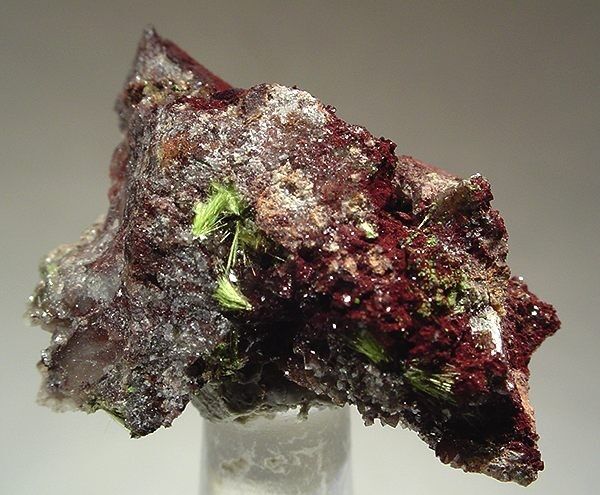 Agardite-(La)LaCu2+6(AsO4)3(OH)6 · 3H2OMineral—
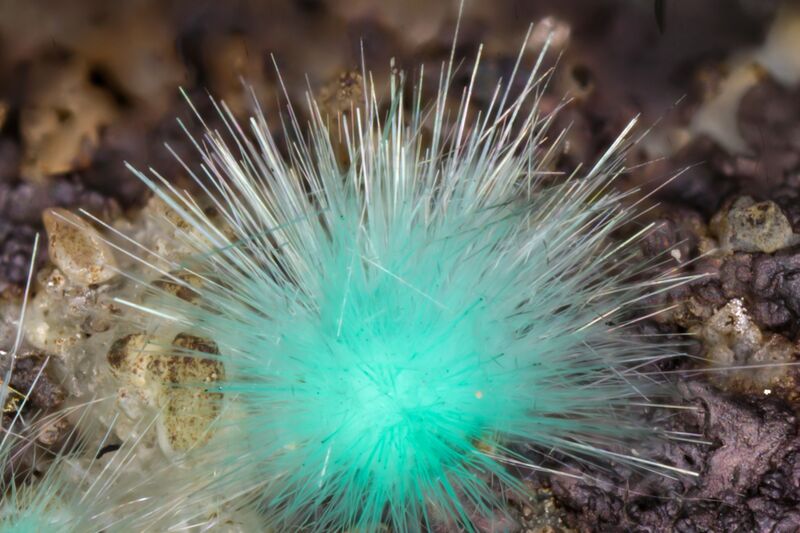 Agardite-(Y)YCu2+6(AsO4)3(OH)6 · 3H2OMineral—
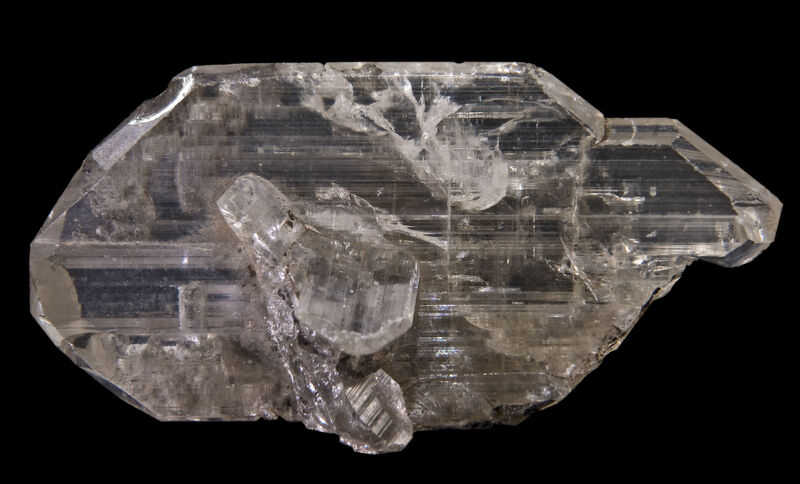 AnglesitePb(SO4)Mineral—
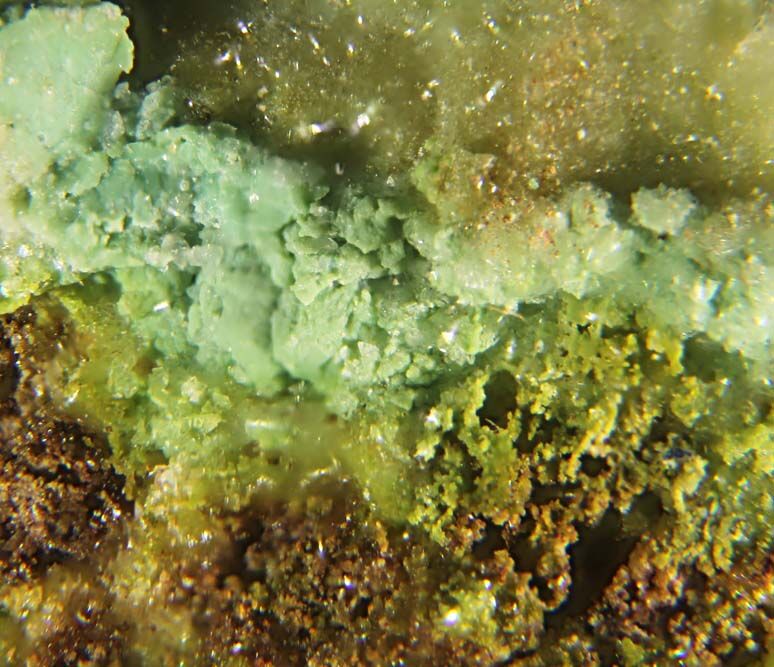 ArsenogorceixiteBaAl3(AsO4)(AsO3OH)(OH)6Mineral—
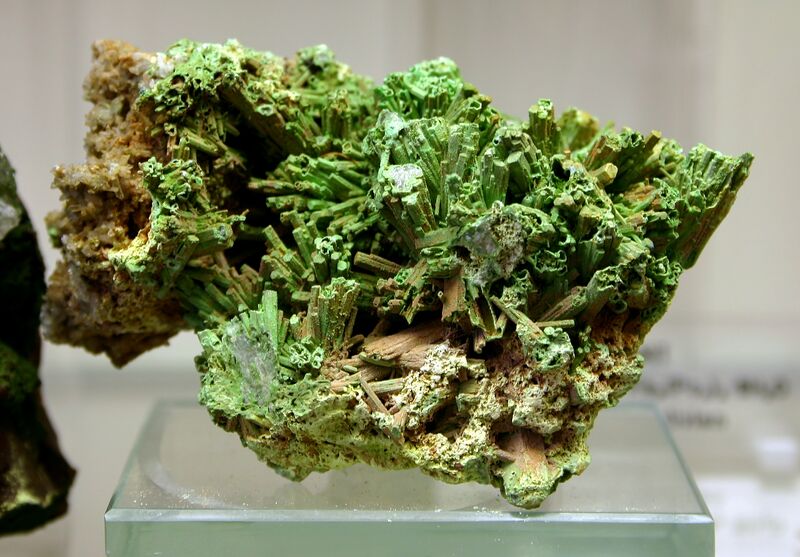 BayldoniteCu3PbO(AsO3OH)2(OH)2Mineral—
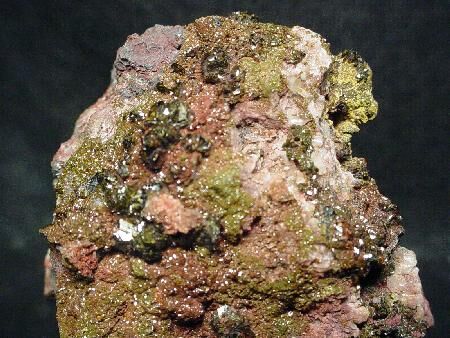 BeudantitePbFe3+3(AsO4)(SO4)(OH)6Mineral—
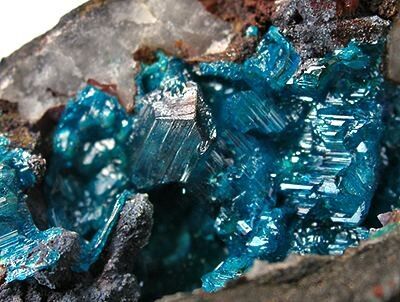 CaledoniteCu2Pb5(SO4)3(CO3)(OH)6Mineral—
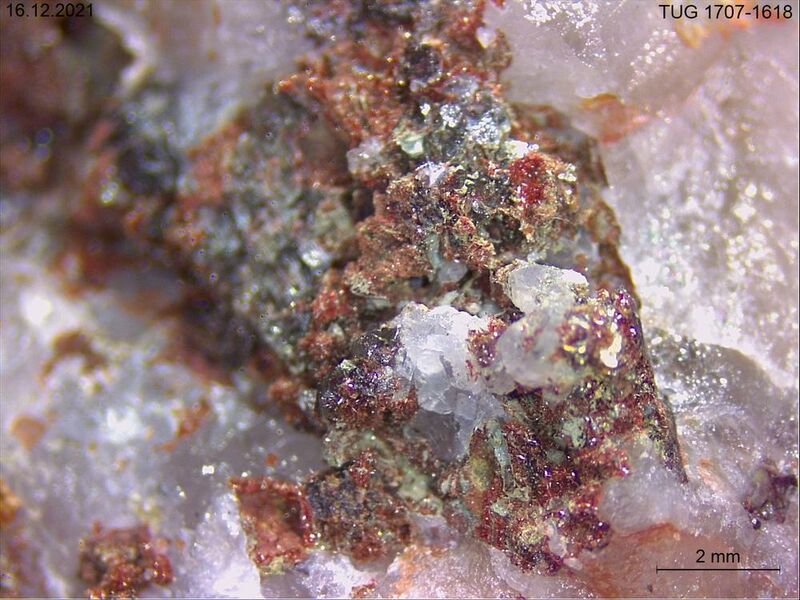 CarminitePbFe3+2(AsO4)2(OH)2Mineral—
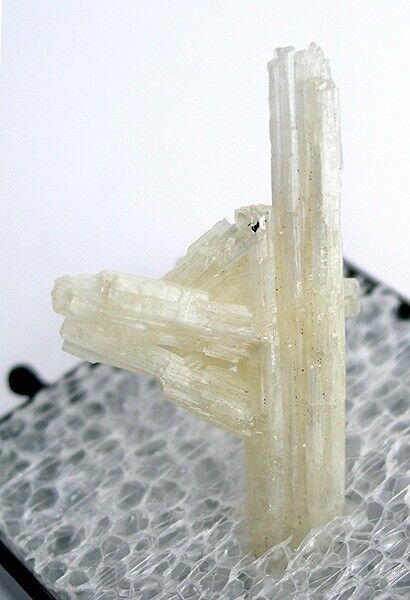 CerussitePb(CO3)Mineral—
Literature, links & citation
- 1748Wallerius, J.G. (1748) Mineralogia, eller Mineralriket. Stockholm: 296 (as Plumbum arsenico mineralisatum).
- 1787Proust (1787) Le Journal de physique et le radium, Paris: 30: 394 (as Plomb vert arsenical).
- 1789Fourcroy (1789) Mem. Ac. Sc., Paris (as Plomb vert arsenical).
- 1794Lenz, D.G. (1794) Versuch einer vollständigen Anleitung zur Kenntniss der Mineralien. 2 volumes, Leipzig: 2: 224 (as Arsenikalisches Bleyerz).
- 1825Mohs, Frederick; Haidinger, William (1825) Treatise on Mineralogy Vol. 2.
Entry last updated
@misc{mineral2026,
  author    = {Mineral Index editorial board},
  title     = {Mimetite — Mineral Index},
  year      = {2026},
  url       = {https://mineralindex.org/minerals/mimetite-2714}
}