History
The name chabazite hides an old copying mistake. It traces to a poem listing twenty stones, ascribed to Orpheus — the legendary founder of an ancient Greek mystery cult. One of those stones was khalazios, a name that likely came from khalaza, the Greek word for hail, because the stone looked like a hailstone.
In 1792 the French naturalist Louis-Augustin Bosc d'Antic reached for that old word to name the mineral. He picked up a garbled version, khabazios in place of khalazios, and coined the name chabasie from it. The spelling later drifted to the form used today. Another reading is gentler: it takes the root word as chabazios, meaning tune or melody, and dates the naming to 1788. The meaning and the year both remain unsettled.
For most of its history, chabazite named a single mineral. That changed in 1997, when an international committee rewrote the rules for naming zeolites — a family of minerals with open, cage-like crystal frameworks. Chabazite turned out to be not one mineral but a series: the same framework holding different metals in its cavities. The committee split it by which metal dominates, adding a suffix to mark each one. The calcium-dominant member became chabazite-Ca, the most common of the set. Telling the members apart by eye is impossible; only a chemical analysis settles which metal is in the lead.
Industrial & practical applications
Chabazite's crystal is riddled with channels too small to see, yet wide enough to trap gas molecules one at a time. It belongs to the zeolites — minerals built on exactly this kind of open, sieve-like framework. That structure does the work behind every use the mineral has.
The clearest example is gas cleaning. Natural chabazite-rich tuff, a soft volcanic rock, is mined at Bowie, Arizona. Processed into an adsorbent, it strips hydrogen chloride from hydrogen streams, water from chlorine, and carbon dioxide from stack-gas emissions. Chabazite shrugs off acid where many materials corrode. It withstands continuous cycling in acid environments, which lets it pull water and carbon dioxide out of sour natural gas. In one process the same Bowie chabazite removed water, hydrogen sulfide, and carbon dioxide from low-grade natural gas under swings of pressure.
The structure also swaps ions. Aluminum in the framework leaves negatively charged sites. Dissolved sodium, potassium, magnesium, and calcium then readily replace one another in the cavities — the basis for using chabazite in water softeners. That same grip on metal ions has been put to nuclear cleanup: natural chabazite from Bowie took up radioactive cesium from contaminated water at the damaged reactor at Three Mile Island, Pennsylvania.
A word of caution separates the mineral from its industrial namesakes. The framework chabazite is built on, labelled CHA, can be grown in a laboratory at compositions never found in nature. Two such synthetic materials, SSZ-13 and SAPO-34, dominate high-value modern chemistry. They turn methanol into the building blocks of plastics. Loaded with copper, they scrub nitrogen oxides from diesel exhaust. Those are achievements of manufactured CHA solids, not of the mined mineral.
Where it forms, where it's found
- Geological setting
Triassic porphyrite.
In vugs in volcanic rocks, hydrothermal veins, in altered bedded tuff deposits from the alteration of glass.
- Type locality
- Col de Lares
- San Nicolò Valley
- San Giovanni di Fassa
- Trento Province
- Trentino-Alto Adige/Südtirol
- Italy
46.4188°, 11.7350°
Varieties
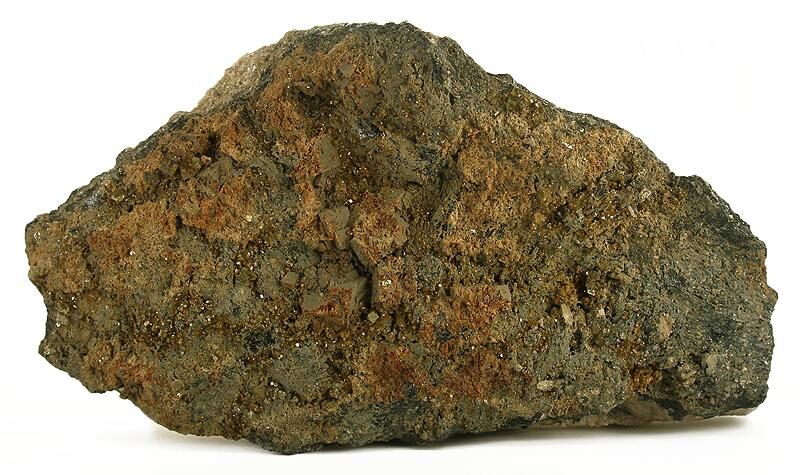
Physical
Optical
- Optical type
- Biaxial (+/-) · 2V measured = 32° · 2V calc = 36°
- Refractive index
- 1.478 – 1.493
- Principal indices
- nα 1.478 – 1.487 · nβ 1.48 – 1.4895 · nγ 1.48 – 1.493
- Dispersion
- none
- Notes
Or uniaxial, commonly shows birefringent panelling in six sections.
Crystallography
- Cell parameters
- a = 9.425 Å · b = 9.42 Å · c = 9.42 Å
- Cell angles
- α = 94.25 ° · β = 94.2 ° · γ = 94.25 °
- Ratio a:b:c
- 1 : 0.999 : 0.999
- Z
- 2
- Morphology
Pseudorhombohedral crystals, tabular. Forms include: Common (101), (021), (110), (012), (214), (113) Rare {12 1 14}, (201), (102) Also (100), (001), (023) that Tschernich (1992) describes as rough surfaces composed of tiny rhombohedra.
- Twinning
About [0001], interpenetrant, simple and repeated, common, contact on (101).
- Type-locality form
Rhombohedral white transparent crystals.
- Comment
Calligaris et al. (1982) give space group R-3m, a = 9.421(4), α = 94.20(1)°.
Chemical composition
Synonyms
- Chabasita-Ca
- Chabasite-Ca
In other languages
- French
- Adipite · Chabazite-Ca
- German
- Chabasit-Ca
- Italian
- cabasite-Ca · Chabazite-Ca
Classification
9.GD.10
- 9SilicatesClass
- 9.GTektosilicates with zeolitic H2O; zeolite familyDivision
- 9.GDChains of 6-membered rings – tabular zeolitesGroup
- 9.GD.10Chabazite-CaSpecies
77.01.02.01
- 77Tectosilicates ZeolitesClass
- 77.01Zeolite group - True zeolitesType
- 77.01.02Chabazite and related speciesGroup
- 77.01.02.01Chabazite-CaSpecies
Group, growth & confusion
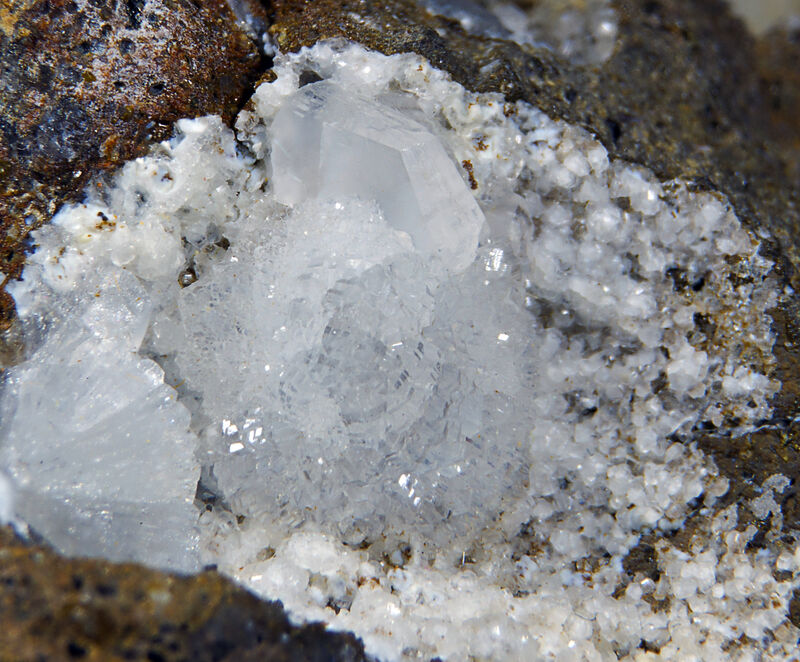
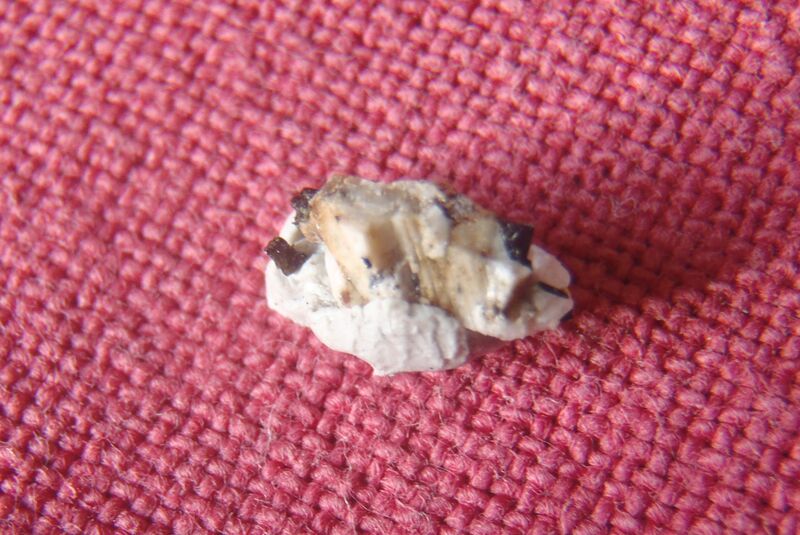
Literature, links & citation
- 1792Bosc d’Antic, L.-A.-G. (1792): Mémoire sur la chabazie [sic]. Journal d’Histoire Naturelle, 2, 181-184.
- 1842Wiser, D.F. (1842): Glimmer, Stilbit, Diopsid, Cabazit, etc. Neues Jahrbuch für Mineralogie, Geognosie, Geologie und Petrefakten-Kunde, 1842, 217-226.
- 1962Smith, J. V. (1962) Crystal structures with a chabazite framework. I. Dehydrated Ca-chabazite. Acta Crystallographica, 15 (9) 835-845 doi:10.1107/s0365110x62002236DOI: 10.1107/s0365110x62002236
- 1963Smith, J. V., Rinaldi, F., Glasser, L. S. D. (1963) Crystal structures with a chabazite framework. II. Hydrated Ca-chabazite at room temperature. Acta Crystallographica, 16 (1) 45-53 doi:10.1107/s0365110x63000074DOI: 10.1107/s0365110x63000074
- 1970Passaglia, Elio (1970) The crystal chemistry of chabazites. American Mineralogist, 55 (7-8) 1278-1301
Entry last updated
@misc{mineral2026,
  author    = {Mineral Index editorial board},
  title     = {Chabazite-Ca — Mineral Index},
  year      = {2026},
  url       = {https://mineralindex.org/minerals/chabazite-ca-6854}
}