Where it forms, where it's found
- Geological setting
Secondary veinlets in massive ore in a metamorphosed Pre-Cambrian sedimentary Zn-Fe-Mn deposit.
- Type locality
- Buckwheat pit
- Franklin Mine
- Franklin
- Sussex County
- New Jersey
- USA
41.1147°, -74.5872°
3recorded occurrences
Safety & handling
Physical
- Hardness
- 1Talc
- 2Gypsum
- 3Calcite
- 4Fluorite
- 5Apatite
- 6Orthoclase
- 7Quartz
- 8Topaz
- 9Corundum
- 10Diamond
- Transparency
- Transparent · Translucent
- Colour
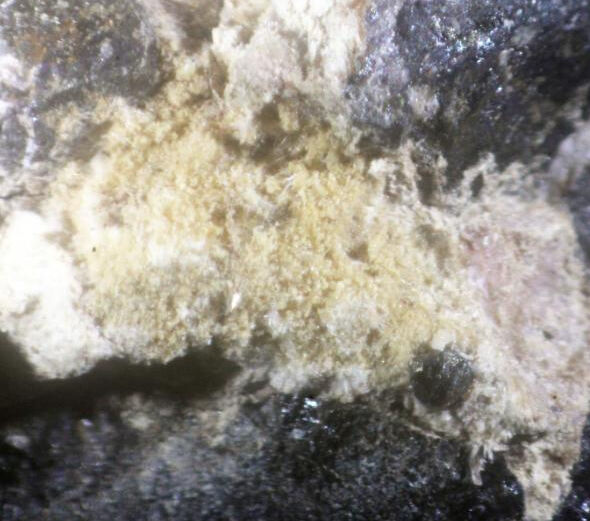
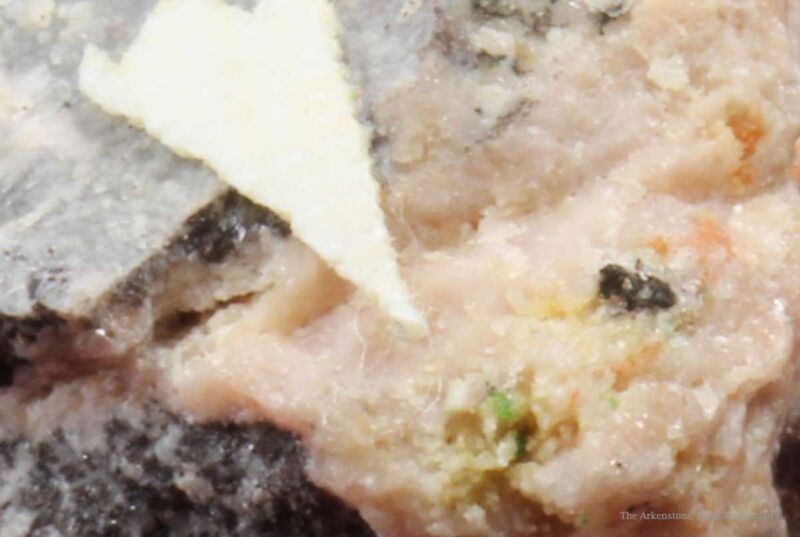
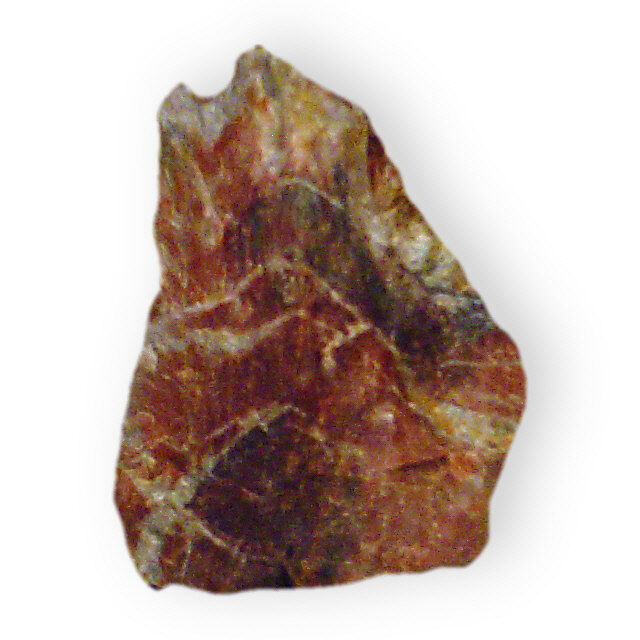
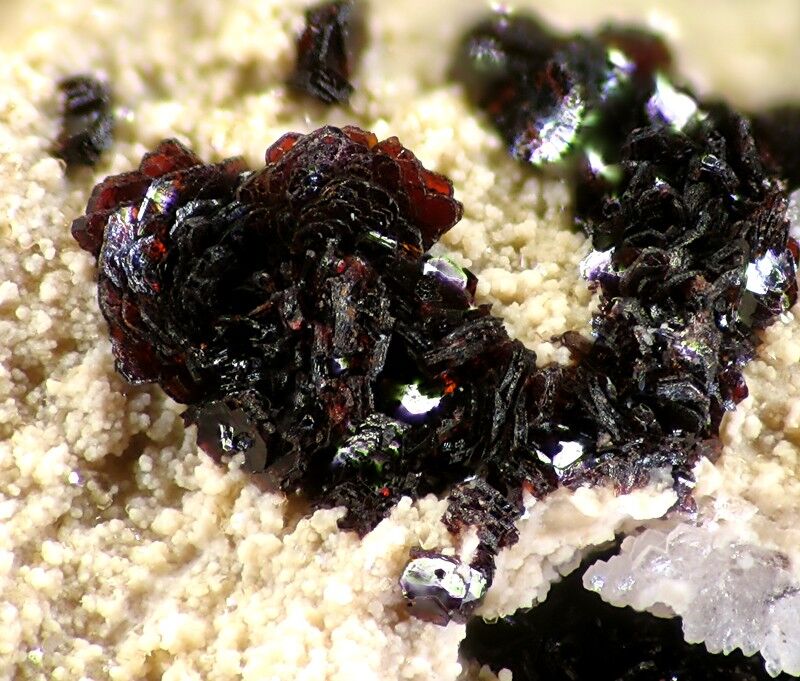
- Usually colorless to white · also light gray-green (natural light) · pink to light purplish red (strong artificial light)
White material common at the Sterling Mine and Franklin.
- Streak
- Colorless
- Tenacity
- brittle
- Cleavage
- Distinct/Good
On (100), good.
- Fracture
- Splintery
- Density
- 3.46 g/cm³
Optical
- Optical type
- Biaxial (-) · 2V measured = 81 – 85° · 2V calc = 84°
- Refractive index
- 1.682 – 1.697
- Surface relief
- High
- Principal indices
- nα 1.682 · nβ 1.690 · nγ 1.697
- Birefringence
- 0.015
- Dispersion
- r > v, relatively strong
- UV response
- Not fluorescent in UV.
Δ = 0Δmax
PPLpleochroism per grain
XPLindependent extinctions · rotate the stage
PPLpleochroism only · colour blends on rotation
XPLinterference colour · extinct every 90°
Retardation150 nm
Order1st order
XPL colour
Crystallography
- Space group
- C2/m
- Cell parameters
- a = 22.973 Å · b = 3.287 Å · c = 7.310 Å
- Cell angles
- β = 106.18 °
- Ratio a:b:c
- 1 : 0.143 : 0.318
- Z
- 2
- Morphology
Usually acicular. Crystals may be long prismatic [010] and deeply striated [010], with etched and dull terminal faces. Face (100) is relatively smooth while {h0l} faces are uneven or warped.
- Type-locality form
Usually in acicular, white crystals. Sometimes in somewhat rod-like crystals with an acute rhombic cross-section and definite pyramidal terminations. Rarely may be pale grayish green when crystals are rod-like.
Crystal structure
Chemical composition
Synonyms
- Chlorophoeniciet
- Chlorophoenicita
- Chlorophönizit
In other languages
- German
- Chlorophoenicit
- Italian
- Clorofenicite · clorophoenicite
Classification
Strunz
10th ed.8.BE.35
- 8Phosphates, Arsenates, VanadatesClass
- 8.BPhosphates, etc., with additional anions, without H2ODivision
- 8.BEWith only medium-sized cations, (OH, etc.):RO4 > 2:1Group
- 8.BE.35ChlorophoeniciteSpecies
Dana
8th ed.41.01.01.01
- 41Anhydrous Phosphates, Etc.containing Hydroxyl or HalogenClass
- 41.01(AB)m(XO4)pZq, where m:p > 4:1Type
- 41.01.01Phoenicite GroupGroup
- 41.01.01.01ChlorophoeniciteSpecies
CIM
—20.3.17
- 20Arsenates (also arsenates with phosphate, but without other anions)Class
- 20.3Arsenates of Zn, Cd or HgGroup
- 20.3.17ChlorophoeniciteSpecies
Group, growth & confusion
Literature, links & citation
Citations
- 1924Foshag, W. F., Gage, R. B. (1924) Chlorophoenicite, a new mineral from Franklin Furnace, New Jersey (preliminary description) Journal of the Washington Academy of Sciences, 14 (15) 362-363
- 1925Foshag, W.F. (1925) New minerals: new species. American Mineralogist, 10, 39-41.
- 1927Foshag, W.F. (1927) New Mineral Names. American Mineralogist, 12 (10). 379-380
- 1927Foshag, William F., Berman, Harry, Gage, Robert B. (1927) The occurrence and properties of chlorophoenicite, a new arsenate from Franklin, New Jersey. Proceedings of the United States National Museum, 70 (2669). 1-6 doi:10.5479/si.00963801.70-2669.1DOI: 10.5479/si.00963801.70-2669.1
- 1935Palache, Charles (1935) The minerals of Franklin and Sterling Hill, Sussex County, New Jersey. Professional Paper 180. US Geological Survey 135 pp. doi:10.3133/pp180 DOI: 10.3133/pp180
Cite this entry
Entry last updated
@misc{mineral2025,
  author    = {Mineral Index editorial board},
  title     = {Chlorophoenicite — Mineral Index},
  year      = {2025},
  url       = {https://mineralindex.org/minerals/chlorophoenicite-946}
}