History
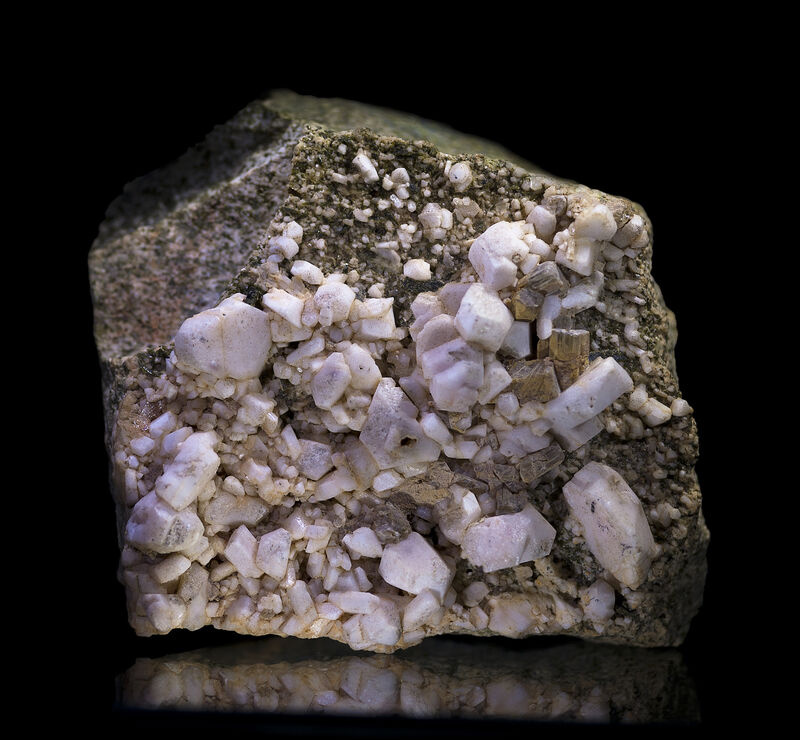
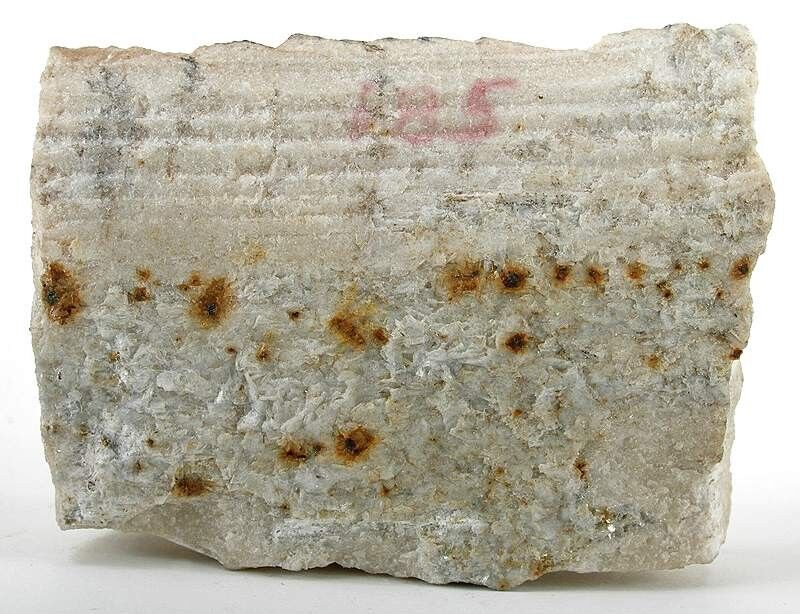
Cleavelandite is not a separate mineral species but a distinctive form of albite, the sodium end of the plagioclase feldspar family — a group of common rock-forming minerals built around sodium, calcium, aluminium and silica. What sets cleavelandite apart is its habit: thin, lamellar, slightly warped plates that grow stacked together, often as cream-white aggregates lining the cavities of granitic pegmatites. The history below is the story of how that habit came to carry a name of its own.
The ground that supplied the first scientifically described specimens was a pegmatite outcrop in Chesterfield, Massachusetts — still the type locality today. The Clark Ledge pegmatite, on what was then the Joseph Clark farm, was discovered around 1811 by Dr. David Hunt of Northampton, Massachusetts. The vein carried green, red and blue tourmalines along with beryl, set in white feldspar and quartz, and it became one of the first American sources of gem tourmaline.
A few years later, the man whose name the variety would carry was finishing the book that made his reputation. Parker Cleaveland (1780–1858) was an American chemist and mineralogist who taught at Bowdoin College in Maine for more than fifty years. In 1816 he wrote An Elementary Treatise on Mineralogy and Geology — the first mineralogy textbook authored by a US citizen — although it only reached readers in January 1817. The book unified European schools of thought for an American readership and went through a popular second edition in 1822, work that later earned Cleaveland the nickname of "Father of American Mineralogy".
The variety itself was first formally described in 1817 by the German mineralogist Johann Friedrich Ludwig Hausmann, who called it kieselspath. Two years earlier, in 1815, the Swedish-Finnish mineralogist Hans Peter Eggertz had already noted granular and radiated forms of albite that were probably the same material. Neither name took hold.
The name cleavelandite itself was coined in 1823 by the English crystallographer Henry J. Brooke, in a short paper in the Annals of Philosophy. Brooke had been examining specimens of the albite and siliceous spar that accompanied tourmaline from Chesterfield, and concluded that the two names referred to one species. Rather than choose between them, he proposed a new name: Cleavelandite, "out of respect to the Professor of Natural Philosophy in Bowdoin College, United States".
Definitions of cleavelandite have tightened over the years. In 1936, the American mineralogist Harold Lattimore Alling redefined it as a triclinic mineral, distinguishing it from ordinary albite and from a high-temperature form then called analbite. In 1968 the mineralogist Fisher studied specimens from Chesterfield itself and proposed that the name be restricted to "warped platy masses of mineral with lamellae parallel to (010)" — that is, to the thin sheets that split along a particular internal plane of the crystal structure — and lacking other well-defined crystal faces. That strict reading would exclude many specimens commonly sold as cleavelandite, including the splayed bladed aggregates grown into open cavities at the type locality. Current usage is looser, and the varietal name now covers both the warped masses and the cavity-hosted crystal sprays.
Industrial & practical applications
Cleavelandite has no industrial role of its own. Albite — the parent mineral species — feeds the ceramics and glass industries as a flux, but those mills crush massive granite and pegmatite ore without separating out the lamellar variety. Anything ground for industry is sold simply as feldspar.
Where cleavelandite earns its name is in two narrower settings.
The first is the collector specimen market. Cream-white blades of cleavelandite arranged around a brightly coloured tourmaline, beryl or lepidolite are among the most photographed objects in mineral dealing. The Pederneira mine in São José da Safira in Minas Gerais, Brazil, and the historic gem pegmatites of the Pala district in San Diego County, California, both produce tourmaline specimens whose matrix is dominated by cleavelandite. The variety is rarely the main attraction; it is the white stage on which the colour sits.
The second is as a field indicator for gem-bearing pegmatites. Geologists prospecting for tourmaline, beryl and lithium minerals read the mineral assemblage of a pegmatite for clues to its inner structure. The classic suite — quartz, microcline, cleavelandite, lithium-rich micas such as lepidolite, and coloured tourmaline — points to the upper, gem-bearing zone of a fractionated body of rock, where the last and most chemically evolved fluids crystallised. Pockets within that zone, called miarolitic cavities, are the open spaces in which gem crystals grow freely. Where cleavelandite blades line the cavity walls, the pegmatite has reached the stage where tourmaline and other gem minerals are most likely to appear.
Where it forms, where it's found
- Geological setting
Granite pegmatites, Late-stage vugs in granite
- Type locality
- Clark Ledge pegmatite locality
- Chesterfield
- Hampshire County
- Massachusetts
- USA
42.4206°, -72.8924°
Physical
Optical
- UV response
- Frequent fluoresces red SWUV
Crystallography
- Morphology
Platy
Chemical composition
Synonyms
- Cleavelandit
- Cleavelandita
- Clevelandit
- Clevelandita
- Clevelandite
Group, growth & confusion
Literature, links & citation
- —Manual of Mineralogy after James D. Dana, 1977, by C. Klein & C.S. Hurlbut, Jr.
- 1994King, Vandall T., Foord, Eugene E. (1994) Mineralogy of Maine Vol. 1 - Descriptive mineralogy. Maine Geological Survey.
- 1997Gaines, Richard V.; Skinner, H. Catherine W.; Foord, Eugene E.; Mason, Brian; Rosenzweig, Abraham; King, Vandall T. (1997) Dana's New Mineralogy (8th ed.). Wiley-Interscience. 1872 pp.
- 2000King, Vandall T. (2000) Mineralogy of Maine Vol. 2 - Mining History, Gems, and Geology. Maine Geological Survey.
Entry last updated
@misc{mineral2026,
  author    = {Mineral Index editorial board},
  title     = {Cleavelandite — Mineral Index},
  year      = {2026},
  url       = {https://mineralindex.org/minerals/cleavelandite-7688}
}