Where it forms, where it's found
- Geological setting
Lithium-rich pegmatite.
In lithium-rich pegmatites, often as graphic intergrowths with albite derived from alteration of spodumene.
- Type locality
- Fillow Quarry
- Branchville
- Redding
- Fairfield County
- Connecticut
- USA
41.2678°, -73.4392°
Physical
- Hardness
- 1Talc
- 2Gypsum
- 3Calcite
- 4Fluorite
- 5Apatite
- 6Orthoclase
- 7Quartz
- 8Topaz
- 9Corundum
- 10Diamond
- Transparency
- Transparent · Translucent
- Colour
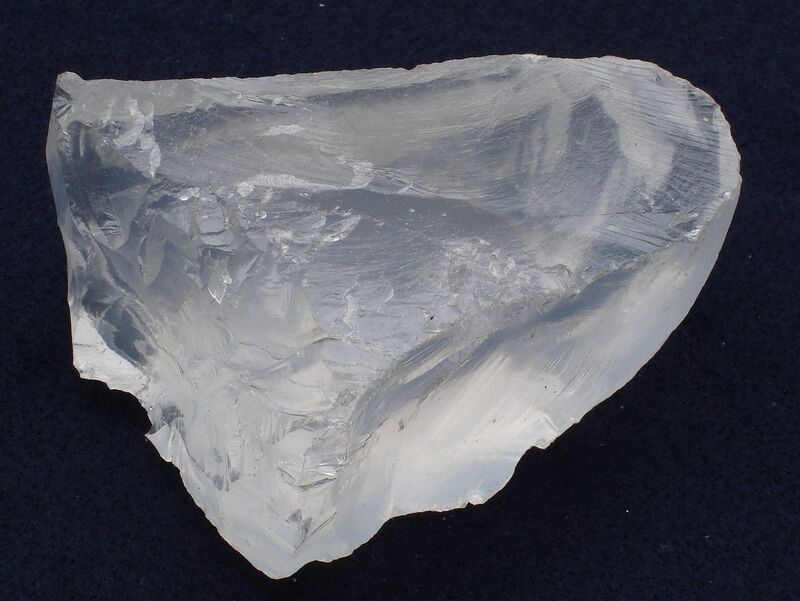
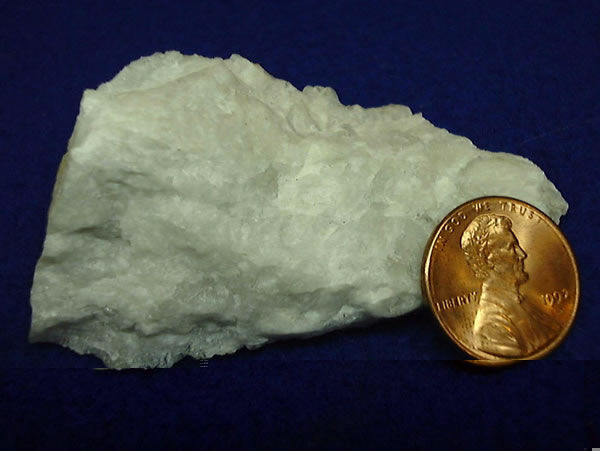
- Colorless · white · pale tan · pale gray
- Streak
- White
- Tenacity
- brittle
- Cleavage
- Poor/Indistinct
Poor on (100) and (0001).
Pure masses from Bikita show conchoidal fracture.
- Fracture
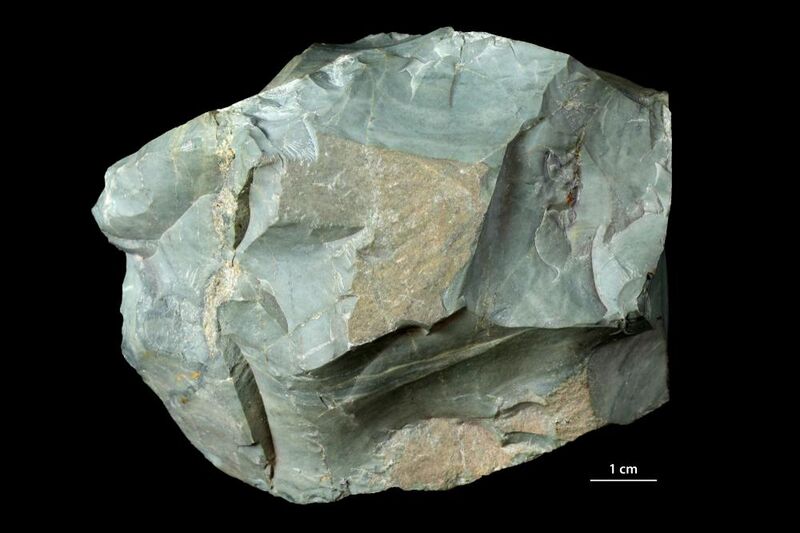
- Irregular/Uneven · Conchoidal
- Density
- 2.657 g/cm³
Optical
- Optical type
- Uniaxial (+)
- Refractive index
- 1.57 – 1.587
- Surface relief
- Moderate
- Principal indices
- nω 1.57 – 1.573 · nε 1.583 – 1.587
- UV response
- Magenta-red or orange under SW UV. Generally fluorescent (both natural and synthetic), however, Haapaluoma eucryptite is not fluorescent. The fluorescence of Tanco eucryptite fades rapidly after the larger grains have been crushed and disappears completely in powdered material (Cerny 1972).
Crystallography
- Space group
- R-3
- Cell parameters
- a = 13.48 Å · c = 9.01 Å
- Z
- 18
- Morphology
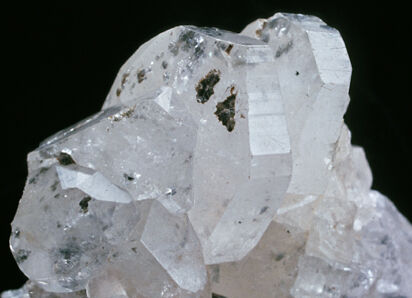
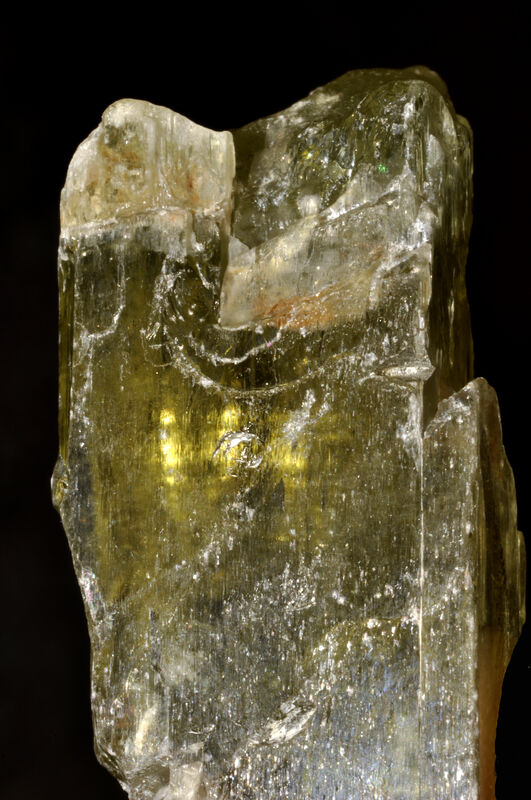
Usually massive, rarely in equant euhedral crystals with (100), (0001), and (110). (Bikita: Hurlbut, 1962). More complex crystals found at Kings Mountain, North Carolina, USA.
- Twinning
Some eucryptite samples are polysynthetically twinned, with alternating thin and broad twin lamellae. Sometimes possible to recognize the twinning with the naked eye. The angle between the optic axes of two adjacent crystals is about 74° and the angle between the composition plane of the crystals and the optic axis 37°.
- Type-locality form
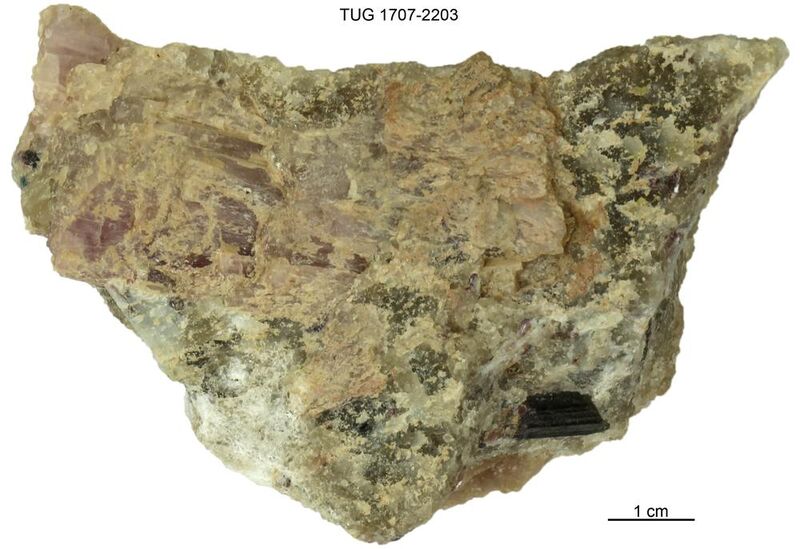
Compact masses with an indistinct fibrous to columnar structure.
Chemical composition
- Impurities
- Na
- K
Synonyms
- Eucryptiet
- Eucryptit
- Eucryptita
- Eukryptitt
- Lithionnephelin
In other languages
- French
- Eucriptite · Eucryptite · LiAlSiO4
- German
- Eukryptit
- Spanish
- Eucriptita
- Italian
- Eucriptite · Eucryptite
- Japanese
- ユークリプタイト
Classification
9.AA.05
- 9SilicatesClass
- 9.ANesosilicatesDivision
- 9.AANesosilicates without additional anions; cations in tetrahedral [4] coordinationGroup
- 9.AA.05EucryptiteSpecies
51.01.01.03
- 51Nesosilicates Insular Sio4 Groups OnlyClass
- 51.01Insular SiO4 Groups Only with cations in [4] coordinationType
- 51.01.01Phenakite groupGroup
- 51.01.01.03EucryptiteSpecies
16.1.3
- 16Silicates Containing Aluminum and other MetalsClass
- 16.1Aluminosilicates of LiGroup
- 16.1.3EucryptiteSpecies
Group, growth & confusion
Literature, links & citation
- 1880Brush, G.J., Dana, E.S. (1880) On the mineral locality at Branchville, Connecticut: Fourth paper. American Journal of Science, 120, 258-285.
- 1892Dana, Edward Salisbury; Dana, James Dwight (1892) A System of Mineralogy (6th ed.). John Wiley & Sons, Inc.
- 1950ROY, RUSTUM, ROY, DELLA M., OSBORN, E. F. (1950) Compositional and Stability Relationships Among the Lithium Aluminosilicates: Eucryptite, Spodumene, and Petalite. Journal of the American Ceramic Society, 33 (5). 152-159 doi:10.1111/j.1151-2916.1950.tb12780.xDOI: 10.1111/j.1151-2916.1950.tb12780.x
- 1953Mrose, M.E. (1953). α-Eucryptite Problem [abstract]. American Mineralogist, 38, 353-353.
- 1954Winkler, Helmut G. F. (1954) Struktur und Polymorphie des Eukryptits (Tief-LiAlSiO4). (Betrachtungen zur Polymorphie II.). Heidelberger Beiträge zur Mineralogie und Petrographie, 4 (1-2). 233-242 doi:10.1007/bf01111159DOI: 10.1007/bf01111159
Entry last updated
@misc{mineral2026,
  author    = {Mineral Index editorial board},
  title     = {Eucryptite — Mineral Index},
  year      = {2026},
  url       = {https://mineralindex.org/minerals/eucryptite-1419}
}