Where it forms, where it's found
- Geological setting
Alteration product of galena under arid, saline conditions.
- Type locality
- Mount Vesuvius
- Metropolitan City of Naples
- Campania
- Italy
83recorded occurrences
Safety & handling
Physical
Optical
- Optical type
- Biaxial (+) · 2V measured = 67° · 2V calc = 68°
- Refractive index
- 2.199 – 2.26
- Surface relief
- Very high
- Principal indices
- nα 2.199 · nβ 2.217 · nγ 2.26
- Dispersion
- relatively strong
Δ = 0Δmax
PPLpleochroism per grain
XPLindependent extinctions · rotate the stage
PPLpleochroism only · colour blends on rotation
XPLinterference colour · extinct every 90°
Retardation610 nm
Order2nd order
XPL colour
Crystallography
- Cell parameters
- a = 7.6222(5) Å · b = 9.0448(7) Å · c = 4.5348(4) Å
- Ratio a:b:c
- 1 : 1.187 : 0.595
- Z
- 4
- Morphology
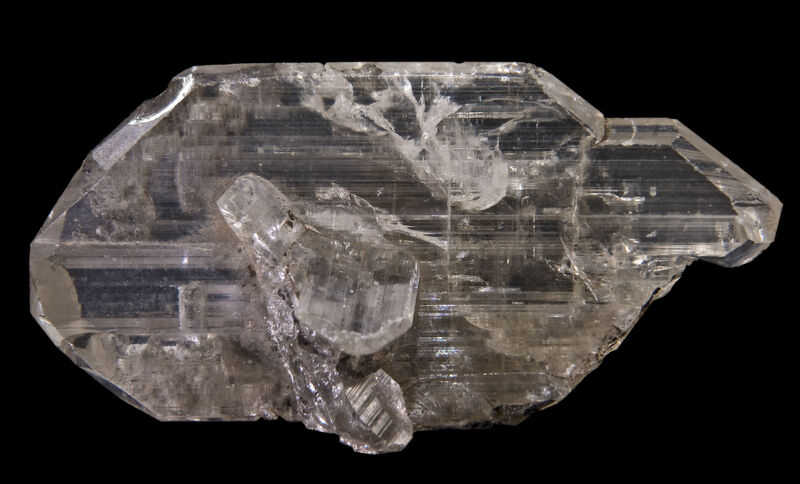
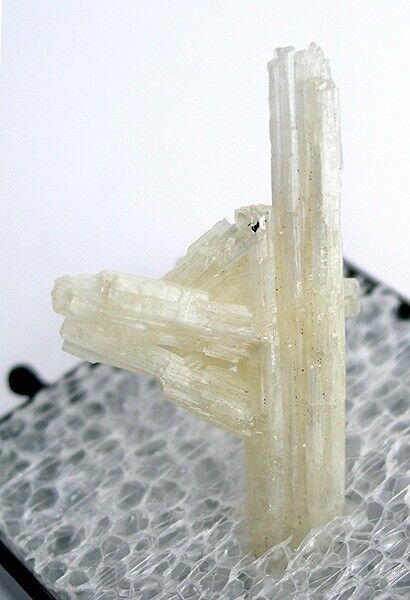
Usually flattened (010) and elongated [001]. Doubly terminated with equivalent faces unequally developed. Reentrant angles may be present in the prism zone due to oscillatory combination of (210) and (110). Massive, granular.
- Twinning
On (120) (artificial crystals).
- Comment
Space group Pnam (non-standard setting)
Crystal structure
Chemical composition
Synonyms
- Chlorblei
- Cottunite
- Cotunnia
- Lead chloride
In other languages
- German
- Cotunnit
- Spanish
- Cotunnita
- Italian
- Cotunnite
- Japanese
- コチュン石
- Chinese
- 氯铅矿
- Arabic
- Lead chloride · Lead(II) chloride · PbCl2 · ثنائي كلوريد الرصاص · ثنائي كلوريد رصاص · كلوريد الرصاص · كلوريد الرصاص الثنائي · كلوريد رصاص ثنائي
Classification
Strunz
10th ed.3.AB.85
- 3HalidesClass
- 3.ASimple halides, without H2ODivision
- 3.ABM:X = 1:2Group
- 3.AB.85CotunniteSpecies
Dana
8th ed.09.02.07.01
- 09Normal HalidesClass
- 09.02AX2Type
- 09.02.07Cotunnite GroupGroup
- 09.02.07.01CotunniteSpecies
CIM
—8.8.4
- 8Halides - Fluorides, Chlorides, Bromides and Iodides; also Fluoborates and FluosilicatesClass
- 8.8Halides of PbGroup
- 8.8.4CotunniteSpecies
Group, growth & confusion
Literature, links & citation
Citations
- 1825Monticelli, T., Covelli, N. (1825) Cotunnia (Piombo muriato). Prodromo della Mineralogia Vesuviana, Napoli: 1: 47-52.
- 1830Von Kobell, F. (1830) Charakteristik der Mineralien. Part 1 (1830); part 2 (1831), Nürnberg: 2: 179.
- 1895Stöber (1895) Académie royale des sciences de Belgique, Brussels, Bull.: 30(3): 345.
- 1910Lacroix, A. (1910) Minéralogie de la France et de ses colonies Vol. 4. Library Polytechnique, Paris.
- 1912Hintze, Carl (1912) Handbuch der Mineralogie. Berlin and Leipzig. 6 volumes: 1 [2B]: 2350.
Cite this entry
Entry last updated
@misc{mineral2026,
  author    = {Mineral Index editorial board},
  title     = {Cotunnite — Mineral Index},
  year      = {2026},
  url       = {https://mineralindex.org/minerals/cotunnite-1141}
}