Where it forms, where it's found
- Geological setting
Gossan zone of a manganiferous marble-hosted
- Type locality
- Franklin Mine
- Franklin
- Sussex County
- New Jersey
- USA
41.1158°, -74.5875°
15recorded occurrences
Physical
- Transparency
- Opaque
- Colour
- Lead-gray · brownish black
- Streak
- brown
- Tenacity
- brittle
- Density
- 3.249 g/cm³
Optical
- Optical type
- Uniaxial (-)
- Refractive index
- 1.95 – 2.055
- Surface relief
- Very high
- Principal indices
- nω 2.055 · nε 1.950
- Birefringence
- 0.105
- UV response
- Not fluorescent in ultraviolet
Δ = 0Δmax
PPLpleochroism per grain
XPLindependent extinctions · rotate the stage
PPLpleochroism only · colour blends on rotation
XPLinterference colour · extinct every 90°
Retardation1050 nm
Order2nd order
XPL colour
Crystallography
- Space group
- P-3m1
- Cell parameters
- a = 3.32 Å · c = 4.71 Å
- Z
- 1
- Morphology
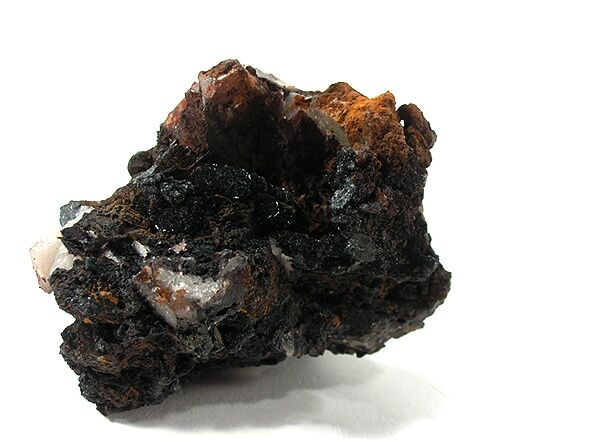
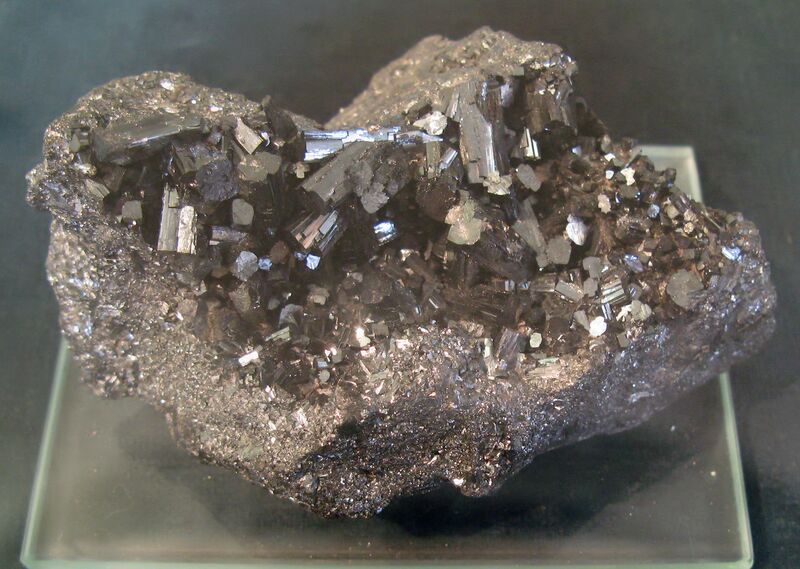
Hexagonal platelets; granular, earthy.
- Type-locality form
Black replacement of pyrochroite. May show trigonal platy appearance.
- Comment
Space group for synthetic material. Note: the structure of another synthetic material (Post et al. 2023) is monoclinic, space group C2/m, a=5.6541(4), b=2.89075(2), c=4.8347(3) Å, β=108.0709(1) deg.
Crystal structure
Chemical composition
Synonyms
- Feitknechtiet
In other languages
- German
- Feitknechtit
- Italian
- Feitknechtite
- Chinese
- 六方水锰矿
Classification
Strunz
10th ed.4.FE.25
- 4OxidesClass
- 4.FHydroxides (without V or U)Division
- 4.FEHydroxides with OH, without H2O; sheets of edge-sharing octahedraGroup
- 4.FE.25FeitknechtiteSpecies
Dana
8th ed.06.01.04.03
- 06Hydroxides and Oxides Containing HydroxylClass
- 06.01XO(OH)Type
- 06.01.04Heterogenite GroupGroup
- 06.01.04.03FeitknechtiteSpecies
CIM
—7.18.6
- 7Oxides and HydroxidesClass
- 7.18Oxides of MnGroup
- 7.18.6FeitknechtiteSpecies
Group, growth & confusion
Literature, links & citation
Citations
- 1945Feitknecht, W., Marti, W. (1945) Über die Oxydation von Mangan(II)-hydroxyd mit molekularem Sauerstoff. Helvetica Chimica Acta, 28 (1). 129-148 doi:10.1002/hlca.19450280113DOI: 10.1002/hlca.19450280113
- 1953Frondel, Clifford (1953) New manganese oxides: hydrohausmannite and woodruffite. American Mineralogist, 38 (9-10) 761-769
- 1962Feitknecht, W., Brunner, P., Oswaldw, H. R. (1962) Über den Einfluß der Feuchtigkeit auf die Oxydation von Manganhydroxid durch molekularen Sauerstoff. Zeitschrift für anorganische und allgemeine Chemie, 316 (3). 154-160 doi:10.1002/zaac.19623160307DOI: 10.1002/zaac.19623160307
- 1965Bricker, Owen P. (1965) Some stability relations in the system Mn-O2-H2O at 25° and one atmosphere total pressure. American Mineralogist, 50 (9) 1296-1354
- 1969Nambu, M., Tanida, K., Kitamura, T., Komura, T. (1969) Feitknechtite and its origin from Noda-Tamagawa mine, Iwate Prefecture, Japan. Ganseki Kobutsu Kosho Gakkaishi: 59(3): 91–107 (in Japanese).
Cite this entry
Entry last updated
@misc{mineral2025,
  author    = {Mineral Index editorial board},
  title     = {Feitknechtite — Mineral Index},
  year      = {2025},
  url       = {https://mineralindex.org/minerals/feitknechtite-1473}
}