History
Long before anyone gave it a name, manganite was already useful. Powder of the black mineral turns up at Neanderthal sites, where it served two purposes. It worked as a pigment, and it helped start fires: ground manganite lowers the temperature at which wood ignites, from about 350 °C down to 250 °C.
The mineral was described under several other names as early as 1772, before mineralogists settled on a single one. That came in 1827, when the Austrian mineralogist Wilhelm Karl von Haidinger published the name manganite, chosen for the mineral's manganese content.
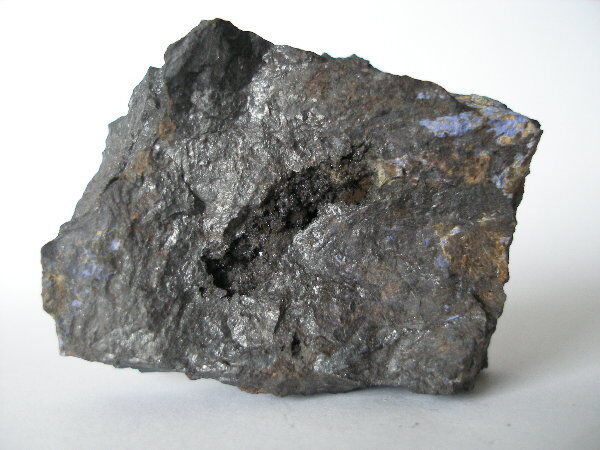
The finest crystals come from Ilfeld, in the Harz mountains of Germany. There manganite grows in veins alongside calcite and barite, in dark steel-grey prisms striated along their length. These specimens made the locality famous among collectors and supplied the material that mineralogists first studied closely.
Industrial & practical applications
Manganite carries manganese — the metal that hardens steel and fills dry-cell batteries — but the world rarely turns to manganite to get it. As an ore it is much less abundant than pyrolusite or psilomelane, the two oxides that supply most of the manganese industry uses. Where manganite gathers in quantity it can be worked as a local source, yet the metal that reaches steel mills and battery plants comes overwhelmingly from those richer ores, not from this one.
Its larger value today is to collectors. The bundled steel-grey crystals from Ilfeld, in the Harz mountains of Germany, are prized specimens and the reason the mineral is so well known.
Where it forms, where it's found
- Geological setting
Hydrothermal veins
Low temperature hydrothermal or hot spring manganese deposits. Sedimentary deposits.
- Type locality
- Manganese deposit
- Ilfeld
- Harztor
- Nordhausen District
- Thuringia
- Germany
51.5917°, 10.7511°
Physical
Optical
- Optical type
- Biaxial (+)
- Refractive index
- 2.25 – 2.53
- Surface relief
- Very high
- Principal indices
- nα 2.25 · nβ 2.25 · nγ 2.53
- Birefringence
- 0.028
- Pleochroism
- Weak
X = reddish brown; Z = red brown.
- Dispersion
- r > v extreme
- Extinction
- X = a; Y = b; Z ∧ c = 0°–4°.
- Optical colour
- Gray-white with brown tint
- Anisotropism
- Weak
- Bireflectance
- Distinct in grays
- Internal reflections
- Blood-red
- Tropism
- Anisotropic
- Reflectance R%
- (18.0,25.1) 400, (18.0,24.8) 420, (18.0,24.5) 440, (17.9,24.1) 460, (17.8,23.7) 480, (17.6,23.2) 500, (17.3,22.7) 520, (17.0,22.2) 540, (16.8,21.6) 560, (16.5,21.2) 580, (16.3,20.8) 600, (16.1,20.6) 620, (16.0,20.3) 640, (15.8,20.1) 660, (15.7,19.9) 680, (15.7,19.7) 700
- UV response
- Not fluorescent in ultraviolet.
- Notes
Weak pleochroism distinguishes manganite from groutite. Absorption: Z > X = Y.
Crystallography
- Space group
- P21/c
- Cell parameters
- a = 8.94 Å · b = 5.28 Å · c = 5.74 Å
- Cell angles
- β = 90 °
- Ratio a:b:c
- 1 : 0.591 : 0.642
- Z
- 8
- Morphology
Crystals striated and short to long prismatic [001]. Often terminated by (001) alone, by (001) with macrodomes, or by a series of macropyramids; highly modified at times. Prismatic faces deeply striated [001], and terminal {h0l} or {hkl} faces striated parallel to their mutual intersections. Crystals often grouped or markedly composite subparallel [001]. Stalactitic; granular (rare).
- Twinning
1. On (011), both as contact and penetration twins. Twinning often repeated with composition face either parallel or inclined. 2. Twin plane (100) lamellar, assuming a monoclinic symmetry for the species.
- Type-locality form
Coarse rectangular prism, often with multiple parallel growth.
- Comment
Space group B21/d (non-standard setting); pseudo-orthorhombic.
Chemical composition
- Impurities
- Fe
- Ba
- Pb
- Cu
- Al
- Ca
Synonyms
- Acerdèse
- Braunmanganerz
- Glanzmanganerz
- Grau-Braunsteinerz
- Graumanganerz
- Gray Oxide of Manganese
- Manganaise cristallisé
- Manganèse oxydé metalloïde
- Newkirkit
- Newkirkita
- Newkirkite
- Prismatoidisches Mangan-Erz
- Sphenomanganit
- Sphenomanganita
- Sphenomanganite
In other languages
- French
- Acerdèse · Magnésie noire · Manganaise cristallisée · Manganèse satinée · manganite · Newkirkite · Pierre de Périgueux · Savon des verriers · Sphénomanganite
- German
- Braunstein · Manganit
- Spanish
- manganita
- Italian
- Manganite
- Portuguese
- manganite
- Japanese
- 水マンガン鉱
- Chinese
- 水錳礦 · 水锰矿
- Russian
- Манганит
- Arabic
- منغنيت
Classification
4.FD.15
- 4OxidesClass
- 4.FHydroxides (without V or U)Division
- 4.FDHydroxides with OH, without H2O; chains of edge-sharing octahedraGroup
- 4.FD.15ManganiteSpecies
06.01.03.01
- 06Hydroxides and Oxides Containing HydroxylClass
- 06.01XO(OH)Type
- 06.01.03— unnamed intermediate level —Group
- 06.01.03.01ManganiteSpecies
7.18.7
- 7Oxides and HydroxidesClass
- 7.18Oxides of MnGroup
- 7.18.7ManganiteSpecies
Group, growth & confusion
Literature, links & citation
- 1826von Haidinger, W.K. (1826) On the crystalline forms and properties of the manganese ores. The Edinburgh Journal of Science: 4: 41-50.
- 1828Haidinger, W. (1828) Mineralogical Account of the Ores of Manganese. Transactions of the Royal Society of Edinburgh, 11 (1). p.119-142. doi:10.1017/s0080456800021876DOI: 10.1017/s0080456800021876
- 1828Turner, E. (1828) Chemical examination of the oxides of manganese. Part II. On the composition of the ores of manganese described by Mr. Haidinger. The Philosophical Magazine: 4: 96-104.
- 1866How, H. (1866) Contributions to the Mineralogy of Nova Scotia, Pt. I, Manganite, Pyrolusite, Wad. Philosophical Magazine, Series 4: 31(208): 165-170.
- 1892Rutley, Frank (1892) Note on Crystals of Manganite from Harzgerode. Mineralogical Magazine and Journal of the Mineralogical Society, 10 (45) 20-21 doi:10.1180/minmag.1892.010.45.05 DOI: 10.1180/minmag.1892.010.45.05
Entry last updated
@misc{mineral2026,
  author    = {Mineral Index editorial board},
  title     = {Manganite — Mineral Index},
  year      = {2026},
  url       = {https://mineralindex.org/minerals/manganite-2519}
}