Where it forms, where it's found
- Geological setting
Oxidation zones of molybdenum-bearing deposits
- Type locality
- Alekseevskii Mine
- Lake Iktul'
- Karysh River Basin
- Khakassia (Republic of Khakassia)
- Russia
320recorded occurrences
Physical
- Hardness
- 1Talc
- 2Gypsum
- 3Calcite
- 4Fluorite
- 5Apatite
- 6Orthoclase
- 7Quartz
- 8Topaz
- 9Corundum
- 10Diamond
- Lustre
- Silky
- Transparency
- Transparent · Translucent
- Colour
- Yellow · canary yellow · or sulfur yellow · greenish yellow · colourless to canary-yellow in transmitted light
- Streak
- Light yellow
- Cleavage
Distinct
- Density
- 2.99 g/cm³
Optical
- Optical type
- Biaxial (+) · 2V measured = 28° · 2V calc = 26 – 32°
- Refractive index
- 1.72 – 2.04
- Surface relief
- Very high
- Principal indices
- nα 1.72 – 1.81 · nβ 1.73 – 1.83 · nγ 1.85 – 2.04
- Pleochroism
- Visible
X = Y = Clear to nearly colourless Z = dirty gray to canary-yellow
- Dispersion
- r < v marked
Δ = 0Δmax
PPLpleochroism per grain
XPLindependent extinctions · rotate the stage
PPLpleochroism only · colour blends on rotation
XPLinterference colour · extinct every 90°
Retardation1800 nm
Order4th order
XPL colour
Crystallography
- Space group
- #69
- Cell parameters
- a = 6.665 Å · b = 15.423 Å · c = 29.901 Å
- Ratio a:b:c
- 1 : 2.314 : 4.486
- Z
- 8
- Morphology
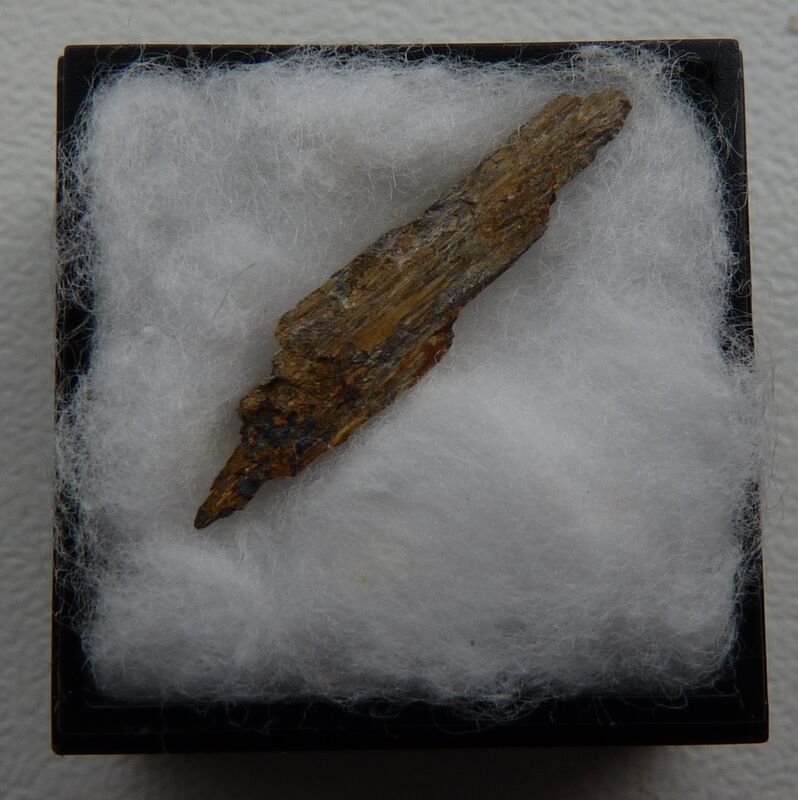
Crystals needlelike to fibrous forming crusts; tufted to radial aggregates; powdery, earthy, films, massive.
- Comment
Class may be mm2; Space Group may be Pm21n.
Chemical composition
Synonyms
- Ferrimolybdita
- Molybdänoxyd
- Molybdänsäure
- Molybdena Ocher
- Molybdic Acid
- Molybdic Ocher
- Molybdine
- Molybdite (of Breithaupt)
- Wasserbleiocker
In other languages
- German
- Ferrimolybdit
- Spanish
- Ferrimolibdita
- Italian
- Ferrimolibdite
- Portuguese
- ferrimolibdita
Classification
Strunz
10th ed.7.GB.30
- 7SulfatesClass
- 7.GMolybdates, Wolframates and NiobatesDivision
- 7.GBWith additional anions and/or H2OGroup
- 7.GB.30FerrimolybditeSpecies
Dana
8th ed.49.02.01.01
- 49Hydrated Molybdates and TungstatesClass
- 49.02Hydrated Normal Molybdates and TungstatesType
- 49.02.01— unnamed intermediate level —Group
- 49.02.01.01FerrimolybditeSpecies
CIM
—27.3.14
- 27Sulphites, Chromates, Molybdates and TungstatesClass
- 27.3MolybdatesGroup
- 27.3.14FerrimolybditeSpecies
Group, growth & confusion
Literature, links & citation
Citations
- 1800Karsten, D.L.G. (1800) Mineralogische Tabellen, Berlin. First edition: 54, 79 (as Wasserbleiocker).
- 1808Karsten, D.L.G. (1808) Mineralogische Tabellen, Berlin. second edition: 70 (as Molybdänocker).
- 1813Hausmann, Johann Friedrich Ludwig (1813) Handbuch der Mineralogie (1st ed.). Vandenhoeck und Ruprecht.
- 1854Dana, James D. (1854) A System of Mineralogy (4th ed.). p.1-849.
- 1858Greg, Robert Philips, Lettsom, William G. (1858) Manual of the Mineralogy of Great Britain and Ireland. John Van Voorst, London.
Cite this entry
Entry last updated
@misc{mineral2025,
  author    = {Mineral Index editorial board},
  title     = {Ferrimolybdite — Mineral Index},
  year      = {2025},
  url       = {https://mineralindex.org/minerals/ferrimolybdite-1496}
}