History
Pyrite was named for what it does. Struck with steel or another mineral, it throws sparks. The Greeks called it pyritēs lithos — the stone that strikes fire — from pyr, fire.
Nodules of pyrite have been found in prehistoric burial mounds, which suggests their use for fire-making long before any written tradition.
In about 50 CE, the Greek physician Dioscorides included the mineral in book 5 of his Peri hulēs iatrikēs — On Medical Material. The umbrella name purites lithos then covered both pyrite and what we now call chalcopyrite. Dioscorides prescribed the powder, mixed with honey, as a remedy for skin problems. Pliny the Elder, writing later in the same century, described a brassy stone almost certainly pointing to the same mineral.
By about 1550, pyrites had spread in mineralogical writing as a generic term for sulfide minerals. It no longer meant only the iron variety we now call by the name.
In the 16th and 17th centuries, the spark-striking property gave pyrite a second-life industrial role. In wheellock firearms — the precursor to the flintlock — a piece of pyrite was held against a circular file. The file rotated under spring tension, throwing sparks into the powder charge.
Pyrite's brassy lustre passes easily for gold in any untrained eye — the source of its fool's-gold nickname.
Industrial & practical applications
Pyrite was historically mined as a source of sulfur, particularly for sulfuric acid production. As petroleum processing offered more convenient sulfur, the practice declined.
A few modern uses remain. Pyrite still serves as a sulfuric acid feedstock in some industrial settings. Research has also explored it as a semiconductor material and as a battery cathode.
Pyrite also feeds the jewellery and decorative-stone markets.
Italy and China lead world production today, followed by Russia and Peru. Spain — long the historic centre of pyrite mining — no longer holds the top position.
Where it forms, where it's found
- Geological setting
Common in many rock types, igneous, metamorphic and sedimentary.
Varieties
Physical
Optical
- Optical type
- Isotropic
- Pleochroism
- Non-pleochroic
- Optical colour
- Creamy white
- Anisotropism
- Rarely anisotropic, due to polishing effects.
- Tropism
- Isotropic
- Reflectance R%
- (38.2) 400, (42.8) 440, (48.5) 480, (52.6) 520, (54.6) 560, (55.2) 600, (56.0) 640, (56.8) 680, (57.0) 700
- UV response
- Not fluorescent in UV
Crystallography
- Space group
- Pa3
- Cell parameters
- a = 5.417 Å
- Z
- 4
- Morphology
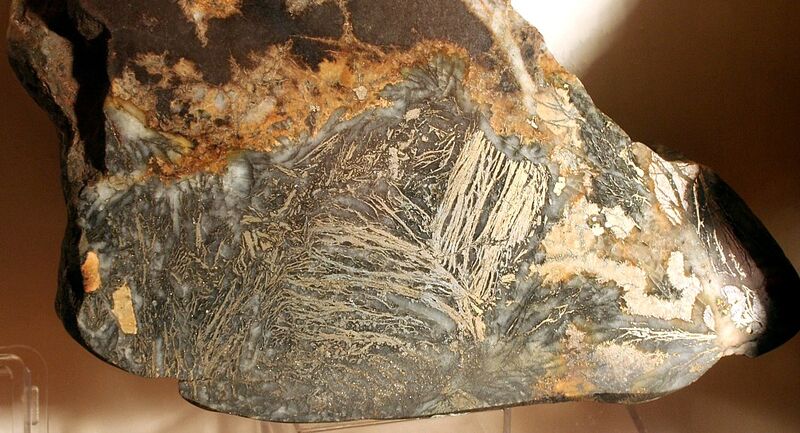
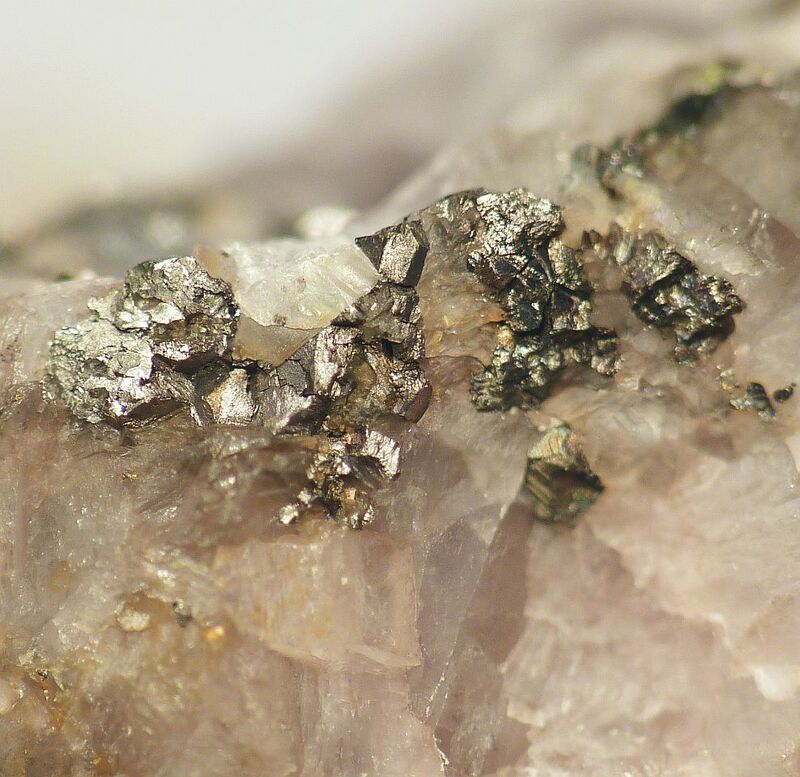
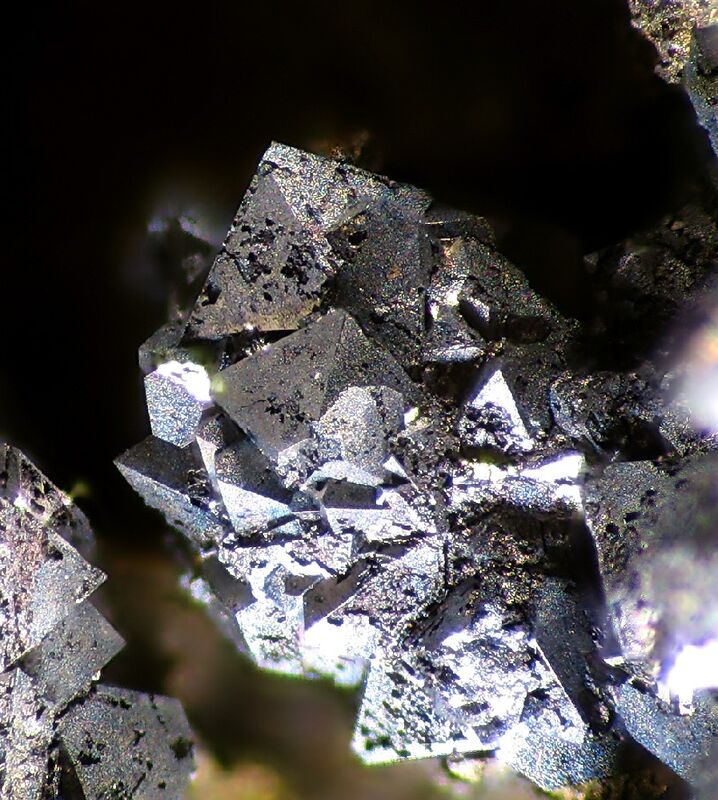
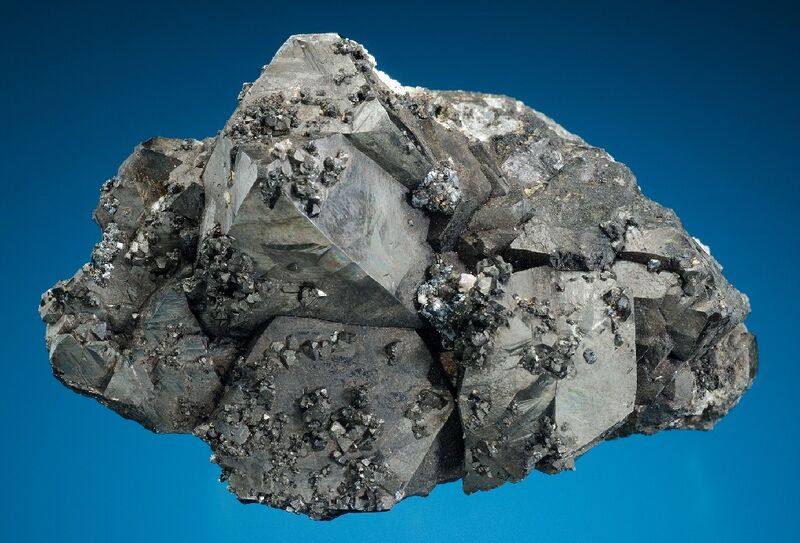
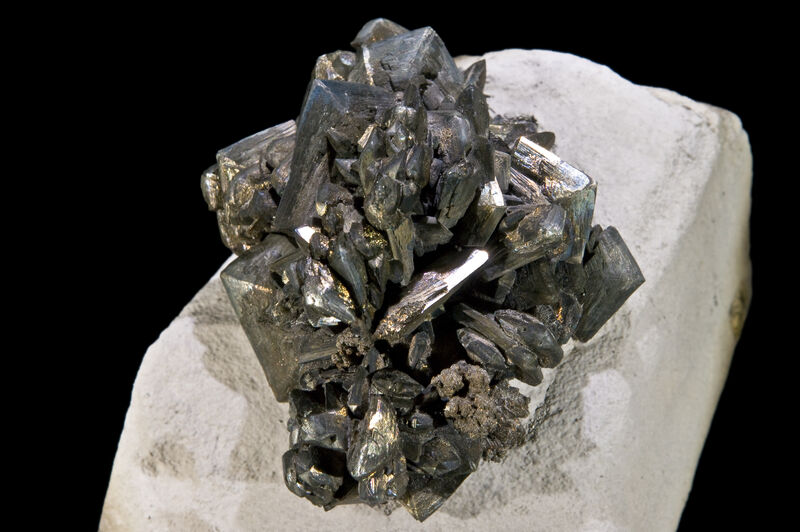
Typically cubic or pyritohedral (pentagonal dodecahedral), sometimes octahedral and combinations are common, resulting in striated faces. Less frequently octahedral, most commonly massive, granular, and sometimes radiating, reniform, discoidal or globular.
- Twinning
On [110], interpenetrating ('Iron Cross Law'). Twin axis [001] and twin plane (011), penetration and contact twins. Twinning on (111) was described by Nicol (1904), Goldschmidt and Nicol (1904) and Gaubert (1928), all of whom considered it rare.
- Epitaxy
Twinned prismatic marcasite crystals attached along pyrite octahedron edges from Rensselaer, Indiana (Brock and Slater, 1978). See also Rakovan et al. (1995). Pyrite on chalcopyrite from Ege-Khay, Yakutia, Russia (Novgorodova 1977).
Chemical composition
- Impurities
- Ni
- Co
- As
- Cu
- Zn
- Ag
- Au
- Tl
- Se
- V
Synonyms
- Alpine Diamond
- Brass Balls
- Copperas Stone
- Eisenkies
- Fool's Gold
- Fools gold
- Hexaedrischer Eisenkies
- Iron pyrite
- Iron Pyrites
- Kaltschedan
- Leber pyrites
- Lebereisener
- Lebereisenerz
- Marcasites
- Mundic
- Pyrita
- Pyrites
- Schwefelkies
- Sideropyrit
- Sideropyrita
- Sideropyrite
- Svovl Kis
- Vasskis
- Vitriolkies
- Xanthopyrites
- Σπίνος
In other languages
- French
- pyrite
- German
- Katzengold · Narrengold · Pyrit · Schwefelkies
- Spanish
- pirita
- Italian
- ghiaia di ferro · ghiaia di zolfo · oro degli sciocchi · pirite
- Portuguese
- ouro de tolo · Pirita · pirita de ferro · pirite · pirite de ferro
- Japanese
- 黄鉄鉱
- Chinese
- 傻愛成金 · 愚人金 · 黃鐵礦 · 黄铁矿
- Simplified Chinese
- 黄铁矿
- Traditional Chinese
- 愚人金 · 黃鐵礦
- Russian
- железный колчедан · золото дураков · пирит · серный колчедан
- Arabic
- البيريت · الذهب الكاذب · بيريت
- Hindi
- माक्षिक
Classification
2.EB.05a
- 2Sulfides and SulfosaltsClass
- 2.EMetal Sulfides, M: S <= 1:2Division
- 2.EBM:S = 1:2, with Fe, Co, Ni, PGE, etc.Group
- 2.EB.05aPyriteSpecies
02.12.01.01
- 02SulfidesClass
- 02.12AmBnXp, with (m+n):p = 1:2Type
- 02.12.01Pyrite Group (Isometric: Pa3)Group
- 02.12.01.01PyriteSpecies
3.9.3
- 3Sulphides, Selenides, Tellurides, Arsenides and Bismuthides (except the arsenides, antimonides and bismuthides of Cu, Ag and Au, which are included in Section 1)Class
- 3.9Sulphides etc. of FeGroup
- 3.9.3PyriteSpecies
Group, growth & confusion
Literature, links & citation
- —Kiskyras, D. A. (1943): Magnetic properties of the minerals of the system FeS-FeS2. Beiträge zur Angewandten Geophysik 10, 308-311.
- —Bannister, F.A. (1933) The preservation of pyrites and marcasite. Museums Journal: 33: 72-75.
- —Bannister, F.A., Sweet, J.M. (1943) The decomposition of pyrite. Museum Journal: 43: 8.
- —Birker, I., Kaylor, J. (1986) Pyrite disease: case studies from the Redpath Museum; pp.21-27 in J. Waddington and D. M. Rudkin (eds.), Proceedings of the 1985 Workshop on Care and Maintenance of Natural History Collections. Life Sciences Miscellaneous Publications.
- —Buttler, C.J. (1994) Environmental effects on geological material: pyrite decay; pp. 4-8 in R. E. Child (ed.), Conservation of Geological Collections. Archetype Publications, London.
Entry last updated
@misc{mineral2026,
  author    = {Mineral Index editorial board},
  title     = {Pyrite — Mineral Index},
  year      = {2026},
  url       = {https://mineralindex.org/minerals/pyrite-3314}
}