Where it forms, where it's found
- Geological setting
Common mineral in medium- to high-grade metamorphosed iron formations. Also occurs as a product of contact metamorphism, and in some blueschist facies metaquartzites.
- Type locality
- Serevengude ravine
- Collobrières
- Toulon
- Var
- Provence-Alpes-Côte d'Azur
- France
43.2697°, 6.3574°
246recorded occurrences
Varieties
Physical
- Hardness
- 1Talc
- 2Gypsum
- 3Calcite
- 4Fluorite
- 5Apatite
- 6Orthoclase
- 7Quartz
- 8Topaz
- 9Corundum
- 10Diamond
- Lustre
- Vitreous
- Transparency
- Translucent
- Colour
- Dark green to brown · gray to greenish gray
Colorless to pale green or brown in thin section.
- Streak
- nd
- Tenacity
- brittle
- Cleavage
Perfect on (110), with intersections of ~56° and ~124°.
- Density
- 3.40 g/cm³
Optical
- Optical type
- Biaxial (-) · 2V measured = 90 – 70° · 2V calc = 84 – 86°
- Refractive index
- 1.663 – 1.729
- Surface relief
- High
- Principal indices
- nα 1.663 – 1.686 · nβ 1.68 – 1.709 · nγ 1.696 – 1.729
- Pleochroism
- Visible
X = pale yellow; Y = pale yellow-brown; Z = pale brown.
- Dispersion
- r > v r, weak.
- Extinction
- Y = b; Z ∧ c = -16° to -12°; X ^ a = -3° to 2°.
- Luminescence
- Nonfluorescent
Δ = 0Δmax
PPLpleochroism per grain
XPLindependent extinctions · rotate the stage
PPLpleochroism only · colour blends on rotation
XPLinterference colour · extinct every 90°
Retardation380 nm
Order1st order
XPL colour
Crystallography
- Space group
- C2/m
- Cell parameters
- a = 9.5642(7) Å · b = 18.393(2) Å · c = 5.3388(3) Å
- Cell angles
- β = 101.892(3) °
- Ratio a:b:c
- 1 : 1.923 : 0.558
- Z
- 2
- Morphology
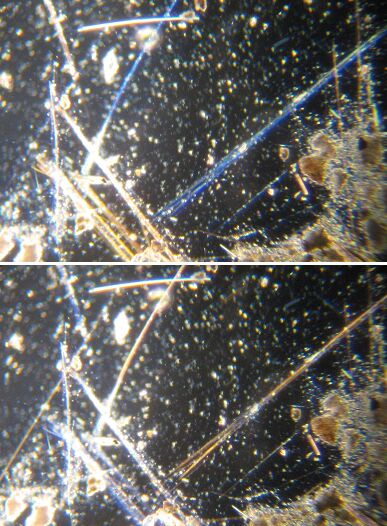
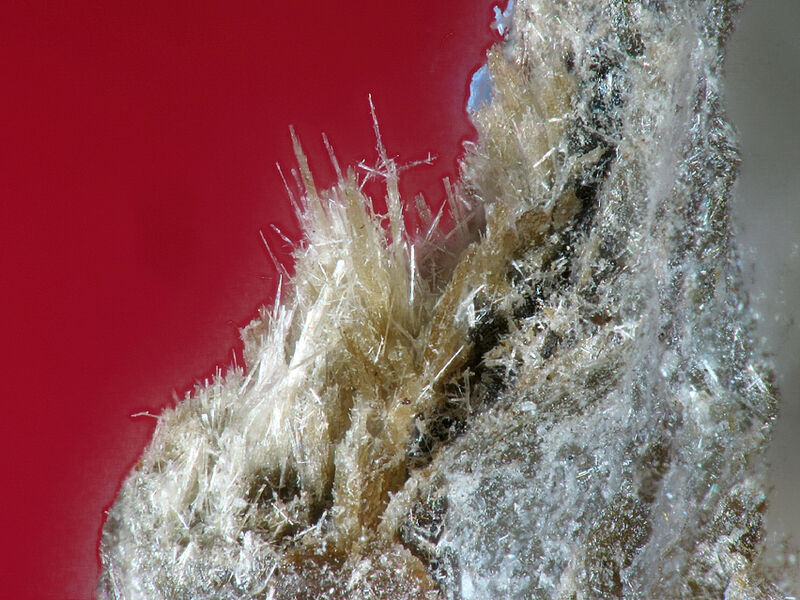
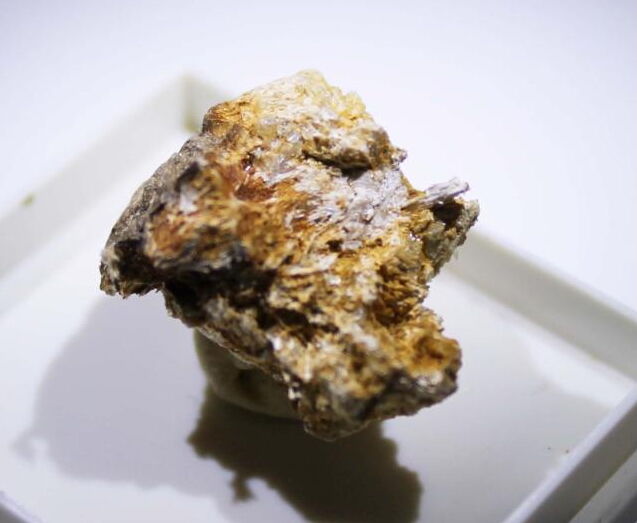
Acicular or fibrous radiating crystals; asbestiform.
- Twinning
Simple or multiple twinning common ∥ (100), producing narrow twin lamellae.
Crystal structure
In other languages
- French
- Grunérite
- German
- Amosit · Braunasbest · Grunerit
- Spanish
- Amosita · Grunerita
- Italian
- grunerite
- Japanese
- アモサイト · グニュネル閃石 · グリュネル閃石
- Chinese
- 鐵閃石 · 铁闪石
- Simplified Chinese
- 铁闪石
- Traditional Chinese
- 鐵閃石
- Russian
- грюнерит
- Arabic
- غرونيريت
Classification
Strunz
10th ed.9.DE.05
- 9SilicatesClass
- 9.DInosilicatesDivision
- 9.DEInosilicates with 2-periodic double chains, Si4O11; ClinoamphibolesGroup
- 9.DE.05GruneriteSpecies
CIM
—14.21.8
- 14Silicates not Containing AluminumClass
- 14.21Silicates of Fe and MgGroup
- 14.21.8GruneriteSpecies
Group, growth & confusion
Literature, links & citation
Citations
- 1847Gruner, Emmanuel L. (1847) Untitled communication (presented by Dufrénoy) [Description d'un minéral nouveau dont la composition correspond à un pyroxène à base de fer] [[Description of a new mineral whose composition corresponds to an iron-based pyroxene]], in Séance du lundi 4 janvier 1847. Compte Rendus Hebdomadaires des Seances de l'Academie des Sciences, 24 (1) 794-795
- 1853Kenngott, A. (1853) Das Mohs'sche Mineralsystem dem gegenwärtigen Standpunkt der Wissenschaft germäss bearbeitet. Wien, Gerol & Sohn, p.69.
- 1886Lacroix, Alfred (1886) Propriétés optiques de la grünérite de Collobrières (Var) Bulletin de Minéralogie, 9 (2) 40-41 doi:10.3406/bulmi.1886.1977DOI: 10.3406/bulmi.1886.1977
- 1969Finger, L.W. (1969) The crystal structure and cation distribution of a grunerite. Mineralogical Society of America Special Paper 2: 95-100.
- 1978Leake, Bernard E. (1978) Nomenclature of amphiboles. American Mineralogist, 63 (11-12) 1023-1052
Cite this entry
Entry last updated
@misc{mineral2026,
  author    = {Mineral Index editorial board},
  title     = {Grunerite — Mineral Index},
  year      = {2026},
  url       = {https://mineralindex.org/minerals/grunerite-1758}
}