Where it forms, where it's found
- Geological setting
In a Proterozoic peraluminous granitic gneiss.
- Type locality
- Bordvedåga
- Høgtuva
- Rana
- Nordland
- Norway
66.4042°, 13.8764°
1recorded occurrences
Safety & handling
Physical
Optical
- Optical type
- Biaxial (-)
- Refractive index
- 1.78 – 1.82
- Surface relief
- Very high
- Principal indices
- nα 1.78 · nγ 1.82
- Pleochroism
- Strong
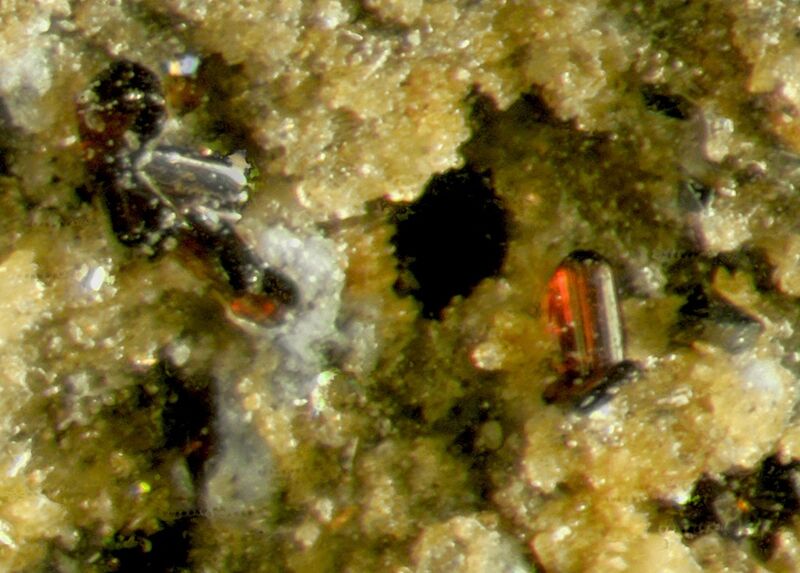
Very strong; X = bronze; Z = green.
- Dispersion
- r > v distinct
- Luminescence
- Nonfluorescent
Δ = 0Δmax
PPLpleochroism per grain
XPLindependent extinctions · rotate the stage
PPLpleochroism only · colour blends on rotation
XPLinterference colour · extinct every 90°
Retardation400 nm
Order1st order
XPL colour
Crystallography
- Cell parameters
- a = 10.317(1) Å · b = 10.724(1) Å · c = 8.855(1) Å
- Cell angles
- α = 105.77(1) ° · β = 96.21(1) ° · γ = 124.77(1) °
- Ratio a:b:c
- 1 : 1.039 : 0.858
- Z
- 2
- Twinning
Ubiquitous polysynthetic twinning; twin axis perpendicular pseudomonoclinic (010).
- Parting
- Parting ⊥ elongation.
- Type-locality form
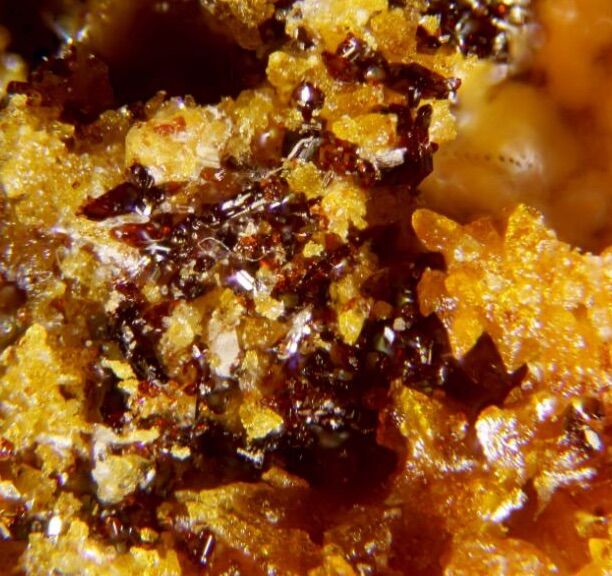
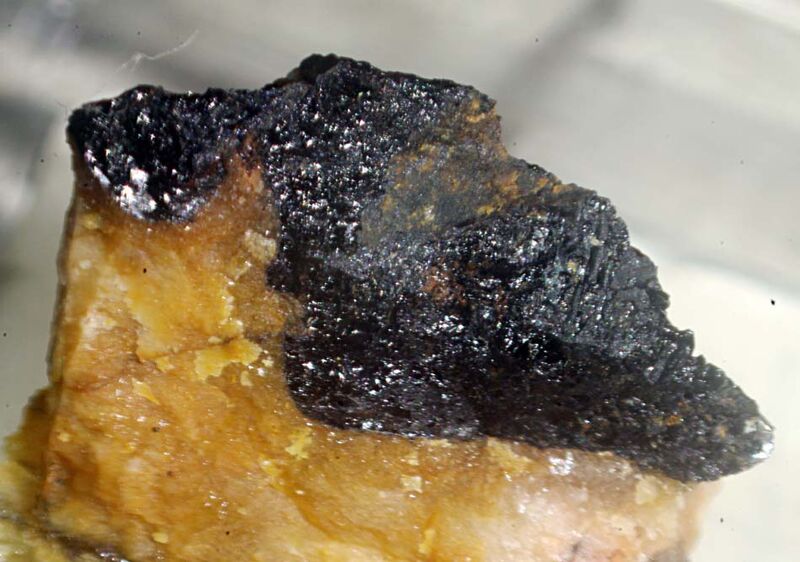
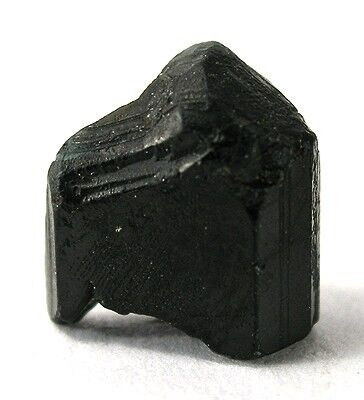
Black, elongate, poikiloblastic crystals up to 4 cm long.
Crystal structure
Chemical composition
Synonyms
- Høgtuvaiet
- IMA1990-051
In other languages
- German
- Høgtuvait · IMA 1990-051
- Italian
- Hogtuvaite · Høgtuvaite
Classification
Strunz
10th ed.9.DH.40
- 9SilicatesClass
- 9.DInosilicatesDivision
- 9.DHInosilicates with 4-periodic single chains, Si4O12Group
- 9.DH.40HøgtuvaiteSpecies
Dana
8th ed.69.02.1a.03
- 69Inosilicates Chains with Side Branches or LoopsClass
- 69.02Chains with Side Branches or Loops with P>2Type
- 69.02.1a— unnamed intermediate level —Group
- 69.02.1a.03HøgtuvaiteSpecies
Group, growth & confusion
Literature, links & citation
Citations
- 1990Yakubovich, O.V. et al. (1990) Kristallografiya 35: 1388-1394 (in Russian). [structure of "makarochkinite" = høgtuvaite]
- 1994Burt, D.M. (1994) Vector representation of some mineral compositions in the aenigmatite group, with special reference to hogtuvaite. The Canadian Mineralogist: 32: 449-457.
- 1994Grauch, R. I.; Lindahl, I.; Evans, H. T.; Burt, D. M.; Fitzpatrick, J. J.; Foord, E. E.; Graff, P. R.; Hysingjord, J. (1994) Høgtuvaite, a new beryllium member of the aenigmatite group from Norway, with new X-ray data on aenigmatite. The Canadian Mineralogist, 32 (2). 439-448
- 1996Raade, Gunnar (1996) Minerals originally described from Norway. Including notes on type material. Norsk Bergverksmuseum Skrift Vol. 11
- 1997Mandarino, Joseph A. (1997) New Minerals 1990-1994. The Mineralogical Record Inc., Tuscon, Arizona. 220pp.
Cite this entry
Entry last updated
@misc{mineral2025,
  author    = {Mineral Index editorial board},
  title     = {Høgtuvaite — Mineral Index},
  year      = {2025},
  url       = {https://mineralindex.org/minerals/h-gtuvaite-1917}
}