History
The name on this page honours a dealer, not a discoverer. Heulandite remembers John Henry Heuland (1778–1856), a mineral collector and dealer who lived and traded in England. The "-Ca" tagged onto it is something else entirely. It is a modern label, added more than a century later, that records which element sits inside the crystal. The two halves of the name come from two very different worlds.
The mineral itself was first noticed in 1818. The German mineralogist August Breithaupt pulled it apart from stilbite, a look-alike it had been confused with, and called it euzeolite — "beautiful zeolite". A zeolite is a mineral built around an open, cage-like framework of silicon, aluminium and oxygen. Water and loose metal atoms sit tucked into the gaps. Breithaupt's name did not stick.
Four years later, the English mineralogist Henry James Brooke reached the same conclusion on his own. In 1822 he named the mineral heulandite, after Heuland. Heuland had an international reputation in his trade, yet no portrait of him is known to survive.
For most of the next two centuries, heulandite was treated as a single mineral species. That changed in 1997. The International Mineralogical Association, the body that decides what counts as a distinct mineral, reclassified heulandite as a series rather than one species. The framework is the same throughout, but the loose atoms inside it vary. Whichever element dominates gives the specimen its full name — heulandite-Ca when calcium leads, then heulandite-Na, -K and -Sr for sodium, potassium and strontium. A barium-led member, heulandite-Ba, was added to the list in 2002. The mineral catalogued here, heulandite-Ca, is the calcium-dominant member of that series.
Industrial & practical applications
Heulandite-Ca earns its keep mostly on a collector's shelf. Like other zeolites, it has a useful trick. The loose calcium, sodium and potassium atoms inside its open framework swap freely for other dissolved metals passing through. That swapping is called cation exchange. It is what makes the mineral useful in water softeners.
The same property drives the bulk industrial work, but that work rarely falls to heulandite itself. Natural zeolites are cheap, selective and easy to maintain, which suits them to stripping pollutants out of water. They pull ammonium and heavy metals such as lead, cadmium and copper from wastewater. Heulandite is one of the acid-resistant, high-silica zeolites used this way. In farming and animal husbandry, though, the cheaper and more abundant zeolite clinoptilolite does most of the soil-conditioning and cattle-feed work.
The high-value jobs almost all use manufactured zeolites, not mined ones. These are the molecular sieves that sort gases by size, the catalysts that crack petroleum, and the ion-exchange beds in detergents. More than two hundred synthetic zeolites have been reported, made in a uniform, phase-pure state that a natural crystal cannot match. Natural heulandite-Ca is left, for the most part, to collectors and to mineralogists studying the zeolite framework.
Where it forms, where it's found
- Geological setting
Cavities in basalt and as a devitrification product from volcanic glasses.
- Type locality
- Strathclyde
- Scotland
- UK
Varieties
Physical
- Hardness
- 1Talc
- 2Gypsum
- 3Calcite
- 4Fluorite
- 5Apatite
- 6Orthoclase
- 7Quartz
- 8Topaz
- 9Corundum
- 10Diamond
- Lustre
- Vitreous · Pearly
- Transparency
- Transparent
- Colour
- White · colorless · red · yellow · brown · green
- Streak
- White
- Tenacity
- brittle
- Cleavage
- Perfect
Perfect on the (010)
- Fracture
- Irregular/Uneven · Sub-Conchoidal
- Density
- 2.1 g/cm³
Optical
- Optical type
- Biaxial (+) · 2V measured = 10 – 48° · 2V calc = 76°
- Refractive index
- 1.491 – 1.512
- Surface relief
- Moderate
- Principal indices
- nα 1.491 – 1.505 · nβ 1.493 – 1.503 · nγ 1.5 – 1.512
- Dispersion
- r > v distinct
- Extinction
- Z = b; X ∧ a = 0°-34°; Y ∧ c = 0°-32°.
Crystallography
- Space group
- C2/m
- Cell parameters
- a = 17.73 Å · b = 17.82 Å · c = 7.43 Å
- Cell angles
- β = 116.33 °
- Ratio a:b:c
- 1 : 1.005 : 0.419
- Z
- 2
- Morphology
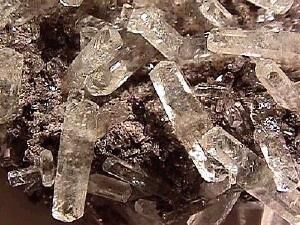
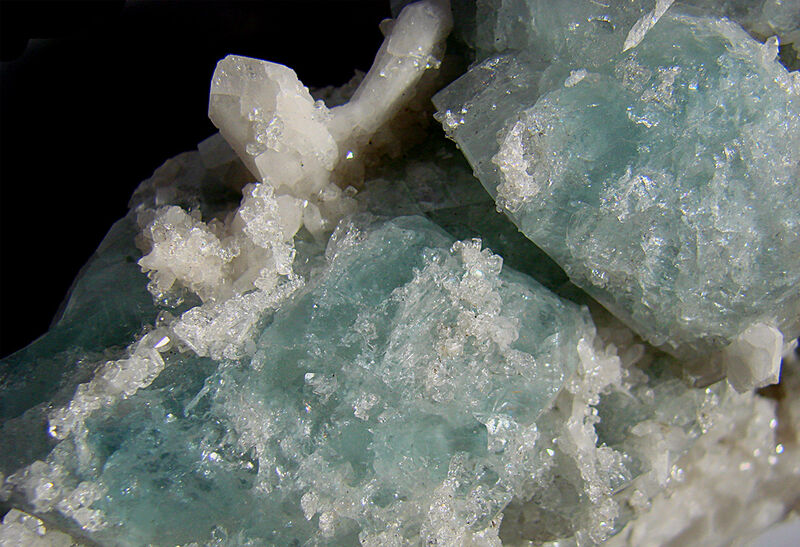
Rhombic prisms, or coffin-shaped tabular crystals, granular, massive. Often in curved aggregates.
- Twinning
(100) is twin and contact plane.
- Comment
Merkle & Slaughter (1967). The reduced cell has beta ~113°. May be triclinic due to Al-Si ordering.
Chemical composition
Synonyms
- Heulandiet-Ca
In other languages
- German
- Heulandit-Ca
- Italian
- Heulandite-Ca
- Chinese
- 钙片沸石
Classification
9.GE.05
- 9SilicatesClass
- 9.GTektosilicates with zeolitic H2O; zeolite familyDivision
- 9.GEChains of T10O20 TetrahedraGroup
- 9.GE.05Heulandite-CaSpecies
77.01.04.01
- 77Tectosilicates ZeolitesClass
- 77.01Zeolite group - True zeolitesType
- 77.01.04Heulandite and related speciesGroup
- 77.01.04.01Heulandite-CaSpecies
Group, growth & confusion
Literature, links & citation
- 1968Merkle, A. B., Slaughter, M. (1968) Determination and refinement of the structure of heulandite. American Mineralogist, 53 (7-8) 1120-1138
- 1972Alberti, A. (1972) On the crystal structure of the zeolite heulandite. TMPM Tschermaks Mineralogische und Petrographische Mitteilungen, 18 (2). 129-146 doi:10.1007/bf01081798DOI: 10.1007/bf01081798
- 1997Coombs, Douglas S., Alberti, Alberto, Armbruster, Thomas, Artioli, Gilberto, Colella, Carmine, Galli, Ermanno, Grice, Joel D., Liebau, Friedrich, Mandarino, Joseph A., Minato, Hideo, et al. (1997) Recommended nomenclature for zeolite minerals; report of the Subcommittee on Zeolites of the International Mineralogical Association, Commission on New Minerals and Mineral Names. The Canadian Mineralogist, 35 (6). 1571-1606
- 1998Esenli, Fahri, Kumbasar, Isik (1998) X-Ray Diffraction Intensity Ratios I(111)/I(3¯11) of Natural Heulandites and Clinoptilolites. Clays and Clay Minerals, 46 (6) 679-686 doi:10.1346/ccmn.1998.0460608DOI: 10.1346/ccmn.1998.0460608
- 2001Comodi, Paola, Gatta, Giacomo Diego, Zanazzi, Pier Francesco (2001) High-pressure structural behaviour of heulandite. European Journal of Mineralogy, 13 (3) 497-505 doi:10.1127/0935-1221/2001/0013-0497DOI: 10.1127/0935-1221/2001/0013-0497
Entry last updated
@misc{mineral2026,
  author    = {Mineral Index editorial board},
  title     = {Heulandite-Ca — Mineral Index},
  year      = {2026},
  url       = {https://mineralindex.org/minerals/heulandite-ca-6988}
}