History
Ancient Egyptians carved calcite into vessels, statues, and ritual objects, and associated the stone with the goddess Bast. Her name lives on in alabaster, the term still used for the finely banded calcite that Egyptian artisans worked.
In 79 CE, Pliny the Elder gave the mineral its first written name in Latin: calx, meaning lime. The word survives in modern technical vocabulary as a doublet of chalk.
In Viking-era Scandinavia, a rhombohedral cleavage piece of calcite may have been the sunstone the Icelandic Sagas describe as a navigation aid.
In 1669, the Danish scientist Rasmus Bartholin first described an optical curiosity of calcite. Held against a written page, a clear cleavage rhomb produces a double image — the effect now called birefringence. The clearest specimens, then known as Iceland spar, became the textbook material for studying the effect.
By the 19th century, German mineralogical writing had settled on Calcit. English borrowed it as calcite — the -ite suffix is the standard for mineral names.
Industrial & practical applications
Calcite is the rock that most of modern civilisation is built from. Burned, it becomes lime — the binding agent in the cement that fixes concrete and mortar. Quarried in bulk, it becomes limestone and marble, used as building stone and as crushed aggregate.
In farming, ground limestone — agricultural lime — is spread across fields to raise soil pH and supply calcium to crops.
Clear cleavage rhombs of optical-grade calcite — historically known as Iceland spar — go into optical equipment for microscopes and laboratory instruments.
Industrially synthesised precipitated calcium carbonate, made by reprecipitating ground calcite, is mainly used as a filler and coating in the paper industry. The same chemistry now extends to microbially induced calcite precipitation — used in soil remediation, soil stabilization, and concrete repair.
Where it forms, where it's found
- Geological setting
Found in most geologic settings and as a later forming replacement mineral in most other environments in one form or another, it is most common as massive material in limestones and marbles. It forms as chemical sedimentary deposits as limestone, can be regionally or contact metamorphosed into marbles and rarely forms igneous rocks (carbonatites). Also is a common gangue mineral in hydrothermal deposits.
Varieties
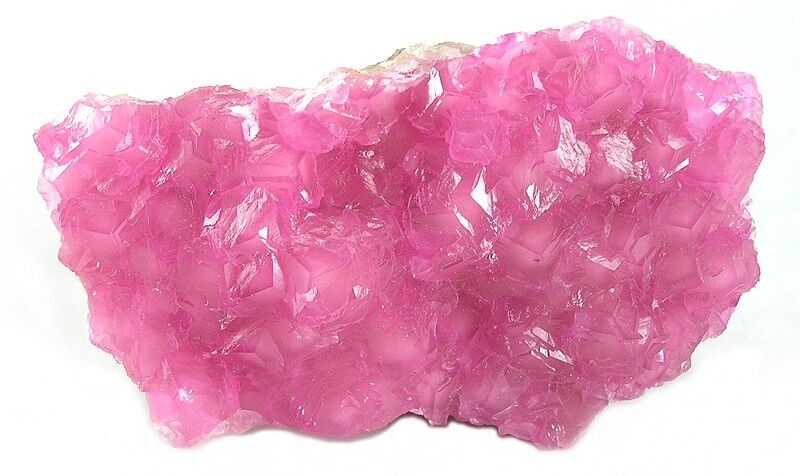
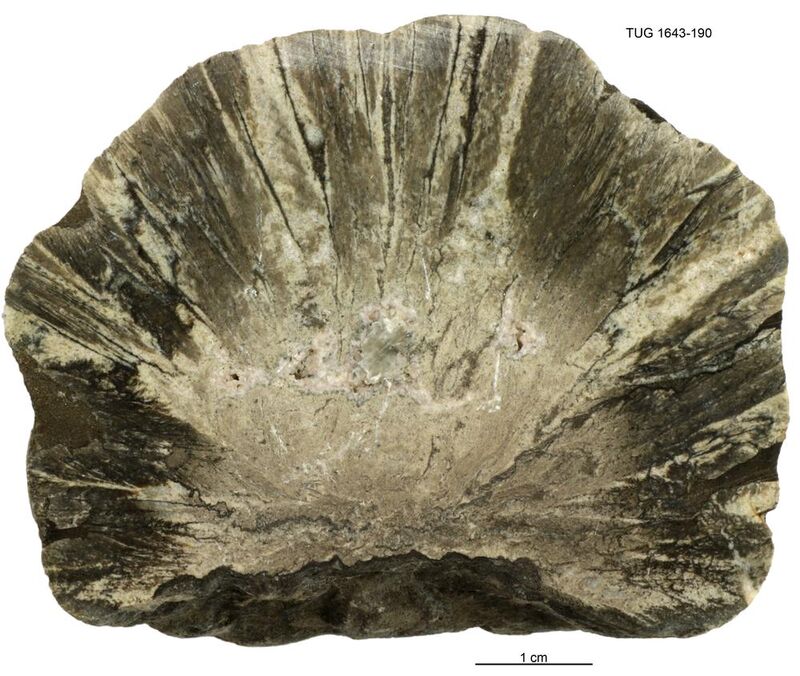
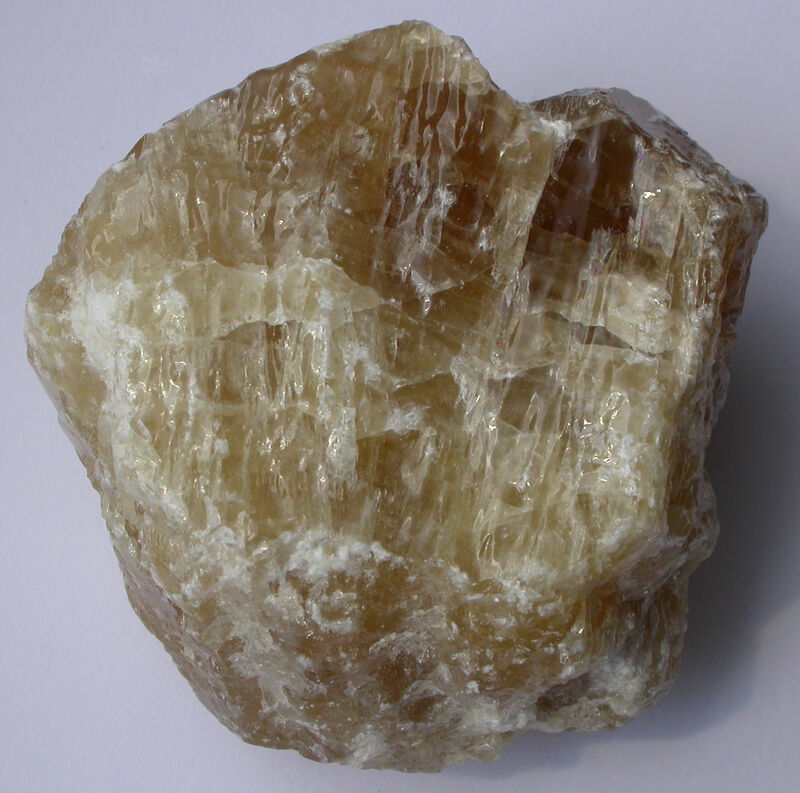
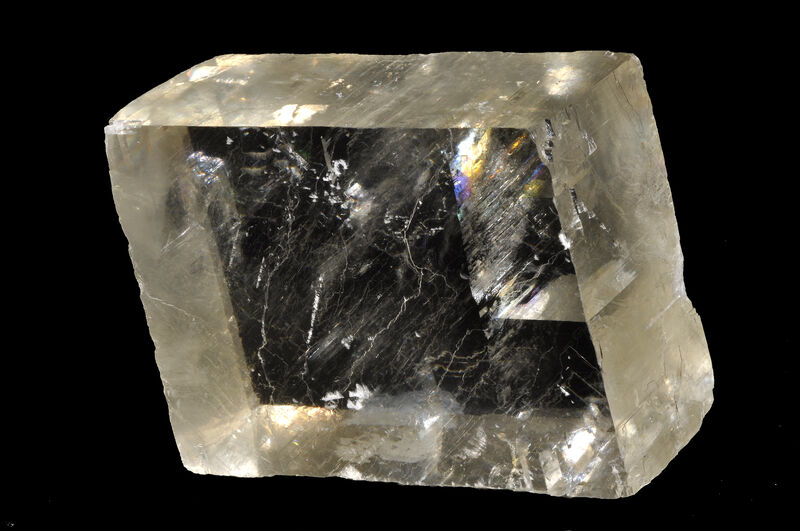
Physical
- Hardness
- 1Talc
- 2Gypsum
- 3Calcite
- 4Fluorite
- 5Apatite
- 6Orthoclase
- 7Quartz
- 8Topaz
- 9Corundum
- 10Diamond
- Lustre
- Vitreous
- Transparency
- Transparent · Translucent
- Colour
- White · Yellow · Red · Orange · Blue · Green · Brown · Gray etc.
- Streak
- White
- Tenacity
- brittle
- Cleavage
- Perfect
Perfect on (101).
- Fracture
- Conchoidal
- Density
- 2.7102 g/cm³
Optical
- Optical type
- Uniaxial (-)
- Refractive index
- 1.486 – 1.658
- Surface relief
- Moderate
- Principal indices
- nω 1.658 · nε 1.486
- Extinction
- Symmetrical to cleavage traces.
- Luminescence
- Fluorescent
- UV response
- May be fluorescent under LW UV, mid-range UV or SW UV as well as under X-rays, cathode rays and even sunlight, in a number of colors and shades, commonly an intense red under SW with Mn as an activator (such as at Franklin, New Jersey, USA, and Långban in Sweden. The yellow series exhibits blue–white fluorescence, together with a short-lived green phosphorescent afterglow after removal of the excitation source, whereas the pink series shows stable orange–red fluorescence with much weaker afterglow behavior. [[1]]
Crystallography
- Space group
- R-3c
- Cell parameters
- a = 4.9896(2) Å · c = 17.061(11) Å
- Z
- 6
- Morphology
Over 800 different forms have been described. Most commonly as acute rhombohedrons or prismatic with scalenohedral terminations, or combinations of the two.
- Twinning
At least four twin laws have been described, the most common being when the twin plane and the composition plane are (012). Also common with twinning on (0001) with (0001) as the compositional surface, producing re-entrant angles. Uncommon with (101) or (021) as twin planes, producing somewhat heart-shaped crystals ("butterfly" twins).
- Parting
- Readily along twin lamellae (012) and (0001).
- Epitaxy
Often noted overgrowing crystals of other members of the calcite group and of dolomite with the crystal axes oriented in parallel position. Calcite is similarly noted overgrown by these species. Noted in oriented position on quartz, with calcite (011) parallel to quartz (101)
Chemical composition
- Impurities
- Mn
- Fe
- Zn
- Co
- Ba
- Sr
- Pb
- Mg
- Cu
- Al
- Ni
- V
- Cr
- Mo
Synonyms
- Agyupat
- Androdamas
- Bladspat
- Blättercalcit
- Blätterspat
- Calc Spar
- Calcareous Spar
- Caliza
- Calx aerata
- Calzit
- Chaux carbonatée
- Dragon Scales
- Espato caliza
- Focobonite
- Kalchstein
- Kalkspath
- Kalkstein
- Kalsitla
- Kalzit
- Lapis calcarius
- Marmelstein
- Rhomboedrisches Kalkhaloid
- Saxum calcis
- Spath Calcaire
- Spatig Kalksten
- Tafelspat
- Vaterite-A
- Χάλζ
In other languages
- French
- calcite · Protocalcite · Spath calcaire · Vaterite-A
- German
- Atlasspat · Blätterspat · Calcit · Calcitgruppe · Doppelspat · Kalkkristall · Kalkspat · Kalzit · Kanonenspat · Manganocalcit · Marmelstein · Seidenspat
- Spanish
- calcita · Calcitas
- Italian
- calcite
- Portuguese
- calcita · Calcite
- Japanese
- アイスランドスパー · カルサイト · 方解石 · 氷州石
- Chinese
- 方解石
- Simplified Chinese
- 方解石
- Traditional Chinese
- 方解石
- Russian
- Атласный шпат · Известковый шпат · кальцит · Оранжевый кальцит · Удвояющий шпат
- Arabic
- كالسيت
- Hindi
- कैल्साइट
Classification
5.AB.05
- 5CarbonatesClass
- 5.ACarbonates without additional anions, without H2ODivision
- 5.ABAlkali-earth (and other M2+) carbonatesGroup
- 5.AB.05CalciteSpecies
14.01.01.01
- 14Anhydrous Normal CarbonatesClass
- 14.01A(XO3)Type
- 14.01.01Calcite Group (Trigonal: R-3c)Group
- 14.01.01.01CalciteSpecies
11.4.1
- 11CarbonatesClass
- 11.4Carbonates of CaGroup
- 11.4.1CalciteSpecies
Group, growth & confusion
 AcanthiteAg2SMineral—
 AdamiteZn2(AsO4)(OH)Mineral—
 Agardite-(La)LaCu2+6(AsO4)3(OH)6 · 3H2OMineral—
 AgateSiO2Variety—
 AguilariteAg4SeSMineral—
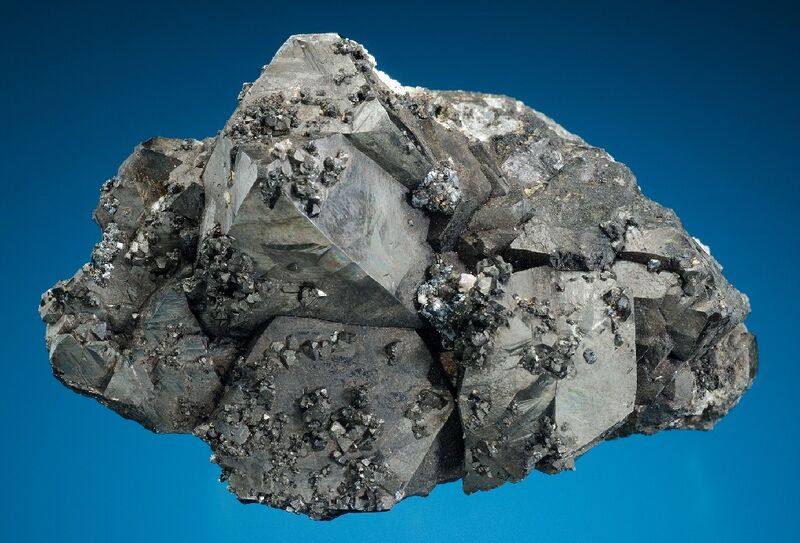 AlabanditeMnSMineral—
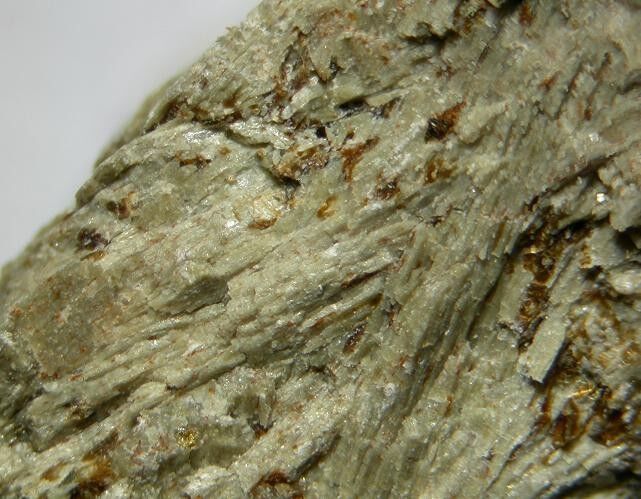 AliettiteCa0.2Mg6(Si,Al)8O20(OH)4 · 4H2OMineral—
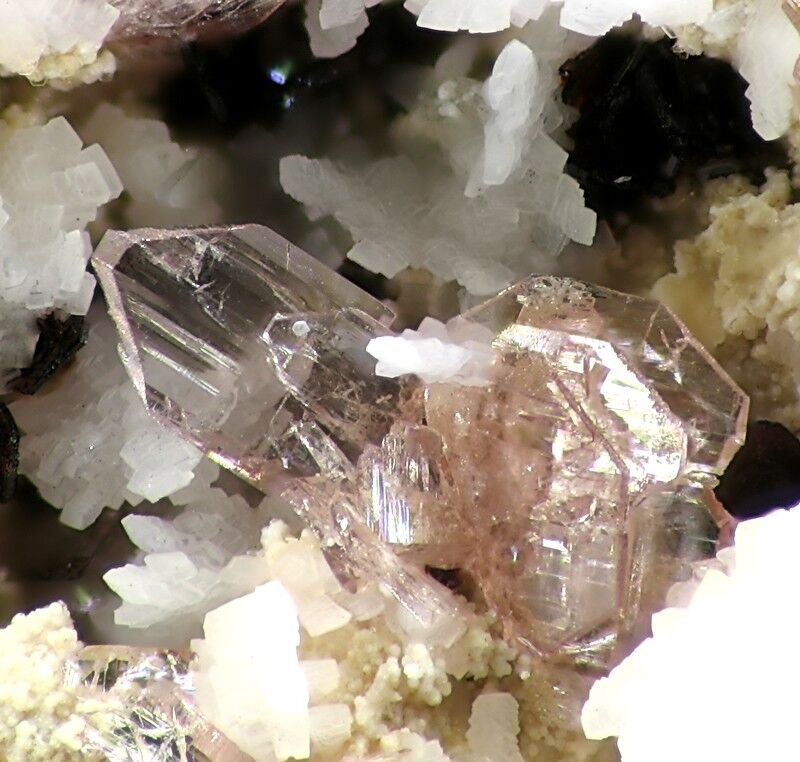 AllactiteMn2+7(AsO4)2(OH)8Mineral—
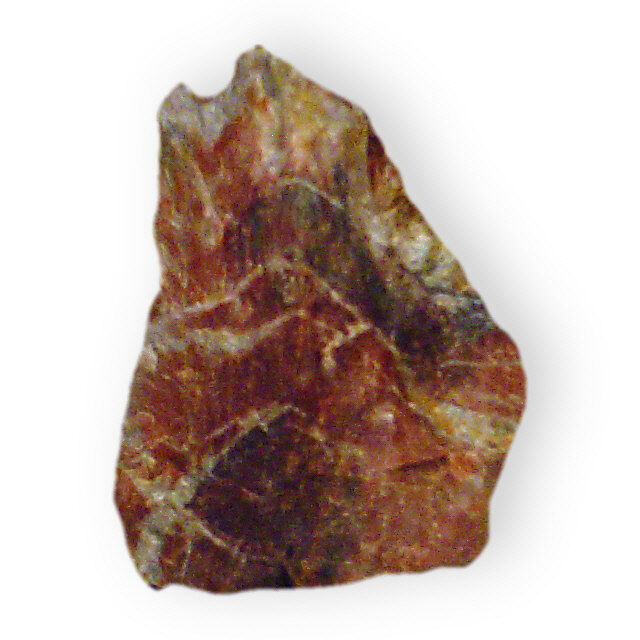 AlleghanyiteMn2+5(SiO4)2(OH)2Mineral—
 AlloclasiteCoAsSMineral—
Literature, links & citation
- —Li, H., Sun, C.-Yu, Fang, Y., Carlson, C.M., Xu, H., Ješovnik, A., Sosa-Calvo, J., Zarnowski, R., Bechtel, H.A., Fournelle, J.H., Andes, D.R., Schultz, T.R., Gilbert, P.U.P.A., Currie, C.R. (2020): Biomineral armor in leaf-cutter ants. Nature Communications, 11, 5792.
- 1878Irby, J. R. Mc. D (1878) On the Crystallography of Calcite. Charles Georgi. 73 pp.
- 1879Irby (1879) Zeitschrift für Kristallographie, Mineralogie und Petrographie, Leipzig: 3: 610.
- 1891Cesàro, G. (1891) Sur la notation compliquée des cristaux de calcite. Annales de la Société géologique de Belgique, 18, 63.
- 1892Cesàro, G. (1892) Action de la calcite sur une solution de sulfate ferreux, en présence de l'oxygène de l'air. Production de cristaux de gypse. Annales de la Société géologique de Belgique, 19, 18.
Entry last updated
@misc{mineral2026,
  author    = {Mineral Index editorial board},
  title     = {Calcite — Mineral Index},
  year      = {2026},
  url       = {https://mineralindex.org/minerals/calcite-859}
}