History
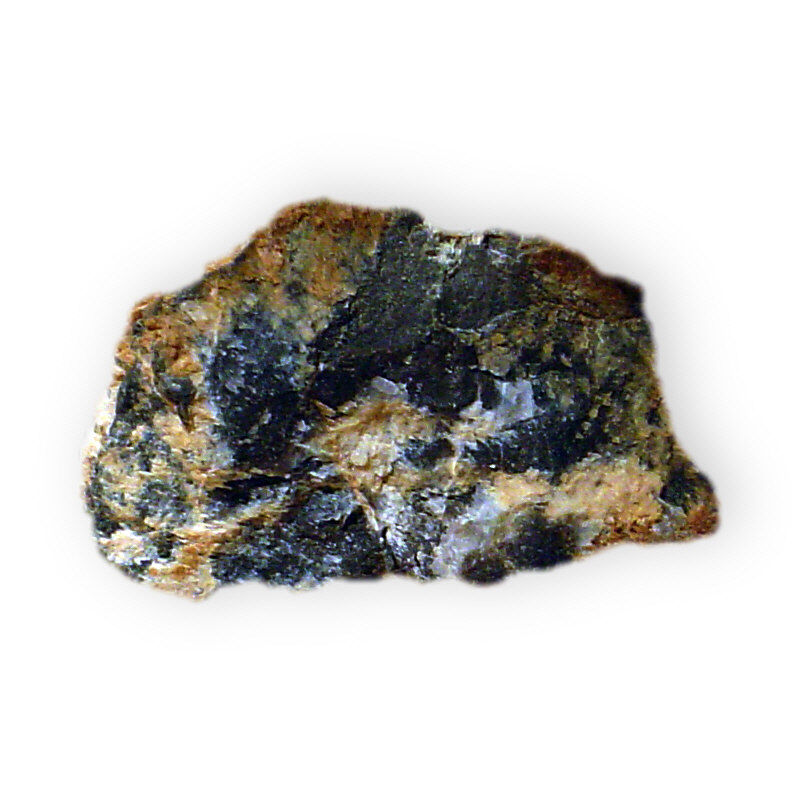
The name datolite comes from a Greek verb meaning to divide. The Danish-Norwegian geologist Jens Esmark coined it in 1806, in allusion to the granular texture of massive varieties of the mineral. Up close, those compact pieces split into tiny grains rather than the glassy crystals you see in well-formed specimens — the name describes what the rock does in the hand.
Esmark had first identified the mineral the year before. On 17 January 1806 he laid it out in a letter to Morten Thrane Brünnich, a professor in Copenhagen, with an uncomplete chemical analysis attached. The letter was read at a meeting of the Naturhistorie-Selskabet — the Natural History Society — and the new mineral was introduced to the scientific world there.
The first printed description appeared the same year, written by the chemist Klaproth in the Journal de Chemie. Four years later, in 1810, Hausmann published a fuller account that added the physical and crystallographic data Esmark's first announcement had lacked. Among the type localities recorded since are the diabases — coarse dark volcanic rocks — of the Connecticut River valley and Arendal, in Aust-Agder, Norway.
A second chapter belongs to the copper country of northern Michigan. In the basalts around Lake Superior, datolite forms porcelaneous nodules — rounded lumps with a smooth, china-like surface. Many of them carry inclusions of native copper. The copper and the datolite were laid down together by hot mineral-rich water, in successive stages. Cut faces show coloured banding in oranges, reds and yellows, with bright copper dendrites running through the paler stone. The Quincy Mine on the Keweenaw Peninsula is among the historic workings that have yielded such pieces. Michigan datolite remains one of the most recognisable American collector materials.
Industrial & practical applications
Datolite is a calcium boron silicate, and in one corner of the world it is mined as a boron ore. The Dalnegorsk deposit sits in Russia's Primorsky Krai on the Pacific coast. It is the largest of its kind in Russia and Southeast Asia. The on-site processing plant turns the ore into boric acid in two commercial grades. It also produces calcium borate, datolite concentrate, and other boron compounds for downstream industry. It is the only producer of high-quality boron compounds in Russia working from its own raw material base.
That operation is a regional player rather than a world supplier. Datolite is not the principal world ore for boron; that role belongs to other borate minerals. Its place in the global picture comes from the fact that the Dalnegorsk deposit is large enough to anchor Russian domestic demand.
The mineral has a second working life as a lapidary stone — material cut and polished for ornament rather than faceted as a gem. The nodules from the Lake Superior copper country of Michigan yield cabochons (domed, polished stones without facets) up to several ounces in weight. Sliced nodules can run to about 15 cm (six inches) across. Cutting them is awkward: hardness varies inside a single nodule, and the copper inclusions tear under the saw. The reward is a polish that brings out peach, pink and red banding, often shot through with bright copper dendrites. Faceted and cabbed datolites are uncommon enough that you are more likely to find them in mineral collections than in jewellery.
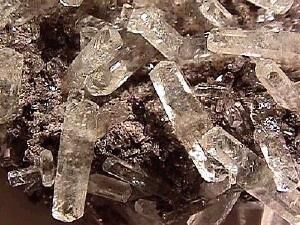
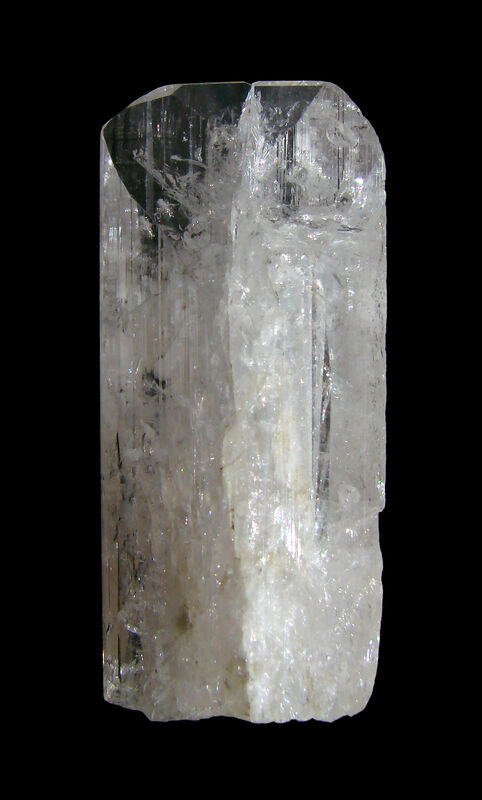
Beyond those two niches, the mineral is essentially a collector specimen. Sharp glassy crystals from Dalnegorsk are prized for their form and frequently surface on the specimen market. They reach buyers through dealers rather than industry, and museums hold them as representatives of the species.
Where it forms, where it's found
- Geological setting
Secondary mineral in mafic igneous rocks. Geodes in tuff, limestone skarns, serpentinites, schists, ore veins.
- Type locality
- Nødebro Mine (Nøddebro)
- Øyestad
- Arendal
- Agder
- Norway
58.4352°, 8.7047°
Varieties
Physical
- Hardness
- 1Talc
- 2Gypsum
- 3Calcite
- 4Fluorite
- 5Apatite
- 6Orthoclase
- 7Quartz
- 8Topaz
- 9Corundum
- 10Diamond
- Lustre
- Vitreous
- Transparency
- Transparent · Translucent · Opaque
- Colour
- White · greyish · pale green · red · yellow · pink · etc.
Commonly with a greenish tinge
- Streak
- White
- Tenacity
- brittle
- Fracture
- Irregular/Uneven · Conchoidal
- Density
- 2.96 g/cm³
Optical
- Optical type
- Biaxial (-) · 2V measured = 74° · 2V calc = 72 – 74°
- Refractive index
- 1.626 – 1.67
- Surface relief
- Moderate
- Principal indices
- nα 1.626 · nβ 1.653 – 1.654 · nγ 1.67
- Dispersion
- weak r > v
- Extinction
- Y = b; Z ∧ c = -1° to -4°.
- UV response
- Commonly fluoresces blue under SW UV.
Crystallography
- Space group
- #14
- Cell parameters
- a = 9.62 Å · b = 7.6 Å · c = 4.84 Å
- Cell angles
- β = 90.15 °
- Ratio a:b:c
- 1 : 0.790 : 0.503
- Z
- 4
- Morphology
Short prismatic, lenticular, botryoidal, granular to compact, cryptocrystalline.
Chemical composition
- Impurities
- Mn
- Mg
- Al
- Fe
Synonyms
- Datholite
- Dystome Spar
- Esmarkite (of Hausmann)
- Humboldtite (of Levy)
In other languages
- French
- datolite
- German
- Datolith
- Spanish
- datolita
- Italian
- datolite
- Portuguese
- datolita · datolite
- Japanese
- ダトー石
- Chinese
- 硅硼钙石
- Simplified Chinese
- 硅硼钙石
- Traditional Chinese
- 矽硼鈣石 · 矽硼钙石
- Russian
- датолит
Classification
9.AJ.20
- 9SilicatesClass
- 9.ANesosilicatesDivision
- 9.AJNesosilicates with BO3 triangles and/or B[4], Be[4] tetrahedra, cornersharing with SiO4Group
- 9.AJ.20DatoliteSpecies
54.02.1a.01
- 54Nesosilicates Borosilicates and Some BeryllosilicatesClass
- 54.02Borosilicates and Some Beryllosilicates with B in [4] coordinationType
- 54.02.1a— unnamed intermediate level —Group
- 54.02.1a.01DatoliteSpecies
17.5.10
- 17Silicates Containing other AnionsClass
- 17.5BorosilicatesGroup
- 17.5.10DatoliteSpecies
Group, growth & confusion
Literature, links & citation
- —Marinoni, L., Caucia, F., Gilio, M., Scacchetti, M. (2023): Evaluation of the Gemological Properties of Datolites from the Campotrera Deposit in the Northern Apennines (Italy). Minerals, 13, 1057.
- 1806Klaproth, M.H. (1806): Chemische Untersuchung des Datoliths. Neues allgemeines Journal der Chemie. 6, 107-110
- 1807Klaproth, M. H. (1807) CLXIV. Untersuchung des Datoliths. In Beiträge zur chemischen Kenntniss der Mineralkörper Vol. 4. Rottmann. p.354-359.
- 1810Hausmann, J.F.L (1810) Bermerkungen über den Datolith, von der Nödebroe-Grube bei Arendal in Norwegen. Beiträge zur Naturkunde, 2, 59-67.
- 1906Kraus, E.H., Cook, C.W. (1906). Datolite from Westfield, Massachusetts. American Journal of Science, 22(127), 21.
Entry last updated
@misc{mineral2026,
  author    = {Mineral Index editorial board},
  title     = {Datolite — Mineral Index},
  year      = {2026},
  url       = {https://mineralindex.org/minerals/datolite-1340}
}