Where it forms, where it's found
- Geological setting
Nepheline syenite pegmatite.
- Type locality
- Bratthagen 1
- Lågendalen
- Hedrum
- Larvik Commune
- Vestfold
- Norway
59.1567°, 10.0172°
2recorded occurrences
Physical
Optical
- Optical type
- Biaxial (+) · 2V measured = 80° · 2V calc = 84.5°
- Refractive index
- 1.694 – 1.73
- Surface relief
- High
- Principal indices
- nα 1.694 · nβ 1.710 · nγ 1.730
- Pleochroism
- Visible
X = yellowish brown; Y = brownish yellow; Z = pale yellow.
- Dispersion
- Strong, r > v.
- Extinction
- X ∧ a = 89.9°, X ∧ b = 23.9°, X ∧ c = 95.1°; Y ∧ a = 86.5°, Y ∧ b = 110.1°, Y ∧ c = 9.8°; Z ∧ a = 3.5°, Z ∧ b = 102.0°, Z ∧ c = 98.3°.
- UV response
- Not fluorescent.
- Notes
Absorption: X > Y > Z.
Δ = 0Δmax
PPLpleochroism per grain
XPLindependent extinctions · rotate the stage
PPLpleochroism only · colour blends on rotation
XPLinterference colour · extinct every 90°
Retardation360 nm
Order1st order
XPL colour
Crystallography
- Cell parameters
- a = 5.392(2) Å · b = 11.968(4) Å · c = 11.868(4) Å
- Cell angles
- α = 112.743(8) ° · β = 94.816(7) ° · γ = 103.037(8) °
- Ratio a:b:c
- 1 : 2.220 : 2.201
- Unit cell volume
- 675.6 ų
- Z
- 1
- Morphology
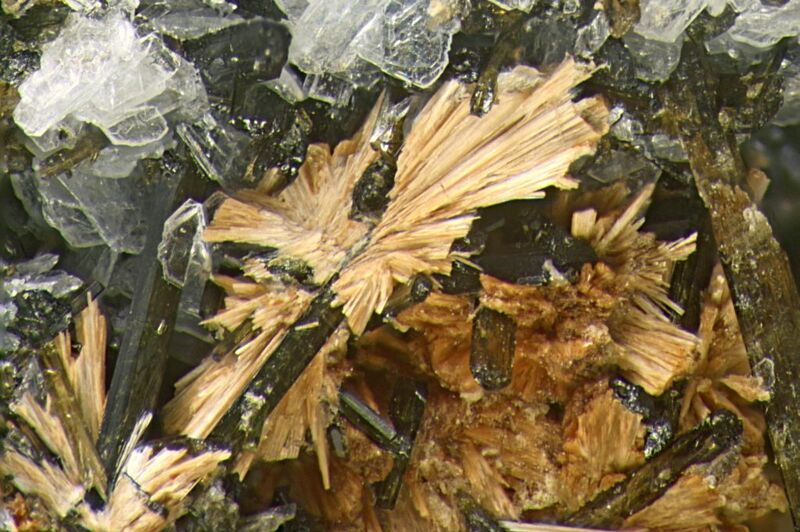
Radiating fans of lath-like crystals.
- Type-locality form
Radiating fans up to 2 mm in diameter, consisting of transparent colourless to pale-brown elongated lath-like crystals. The crystals are ∼1 mm long and only 50 μm wide.
Chemical composition
Synonyms
- Heyerdahliet
- IMA2016-108
In other languages
- German
- Heyerdahlit · IMA 2016-108
Classification
Strunz
10th ed.9.DC.05
- 9SilicatesClass
- 9.DInosilicatesDivision
- 9.DCInosilicates with branched 2-periodic single chains; Si2O6 + 2SiO3 Si4O12Group
- 9.DC.05HeyerdahliteSpecies
Group, growth & confusion
Literature, links & citation
Citations
- 2017Hålenius, U., Hatert, F., Pasero, M., Mills, S. J. (2017) New minerals and nomenclature modifications approved in 2017. CNMNC Newsletter No 36. Mineralogical Magazine, 81 (2) 403-409 doi:10.1180/minmag.2017.081.022DOI: 10.1180/minmag.2017.081.022
- 2018Sokolova, Elena, Day, Maxwell C., Hawthorne, Frank C., Kristiansen, Roy (2018) Heyerdahlite, Na3Mn7Ti2(Si4O12)2O2(OH)4F(H2O)2, a new mineral of the astrophyllite supergroup from the Larvik Plutonic complex, Norway: Description and crystal structure. Mineralogical Magazine, 82 (2). 243-255 doi:10.1180/minmag.2017.081.051 DOI: 10.1180/minmag.2017.081.051
- 2020(2020) Heyerdahlite. Handbook of Mineralogy. Mineralogical Society of America
Cite this entry
Entry last updated
@misc{mineral2025,
  author    = {Mineral Index editorial board},
  title     = {Heyerdahlite — Mineral Index},
  year      = {2025},
  url       = {https://mineralindex.org/minerals/heyerdahlite-51557}
}