Where it forms, where it's found
- Geological setting
Formed from the oxidation of native arsenic and other As-bearing primary phases, followed by later alteration by saline fluids derived from evaporating meteoric water under hyperarid conditions
- Type locality
- Torrecillas mine
- Iquique
- Iquique Province
- Tarapacá
- Chile
-20.9767°, -70.1419°
2recorded occurrences
Safety & handling
Physical
Optical
- Optical type
- Biaxial (+) · 2V measured = 50° · 2V calc = 50°
- Refractive index
- 1.579 – 1.62
- Surface relief
- Moderate
- Principal indices
- nα 1.579 · nβ 1.586 · nγ 1.620
- Pleochroism
- Non-pleochroic
- Dispersion
- r < v, medium
Δ = 0Δmax
PPLpleochroism per grain
XPLindependent extinctions · rotate the stage
PPLpleochroism only · colour blends on rotation
XPLinterference colour · extinct every 90°
Retardation410 nm
Order1st order
XPL colour
Crystallography
- Cell parameters
- a = 7.8702(7) Å · b = 15.8081(6) Å · c = 6.6389(14) Å
- Cell angles
- α = 90.814(6) ° · β = 96.193(6) ° · γ = 90.094(7) °
- Ratio a:b:c
- 1 : 2.009 : 0.844
- Unit cell volume
- 821.06 ų
- Z
- 8
- Morphology
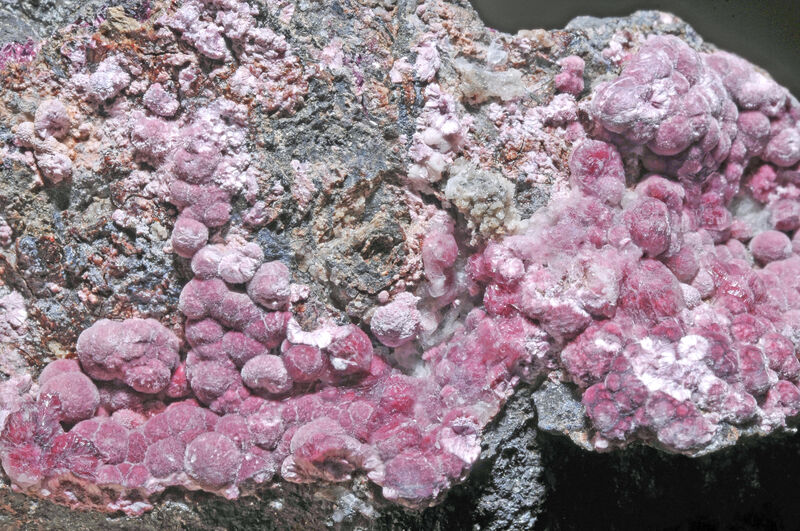
Thin to thick laths up to 2 mm long. Laths are elongated on [001], flattened on (010) and exhibit the forms (010), (110), {11İ0}, (101), (031) and {03İ1}.
- Type-locality form
thin to thick laths up to 2 mm long
Chemical composition
Synonyms
- IMA2013-049
- Magnesiokoritnigiet
In other languages
- German
- IMA 2013-049 · Magnesiokoritnigit
- Italian
- magnesiokoritnigite
Classification
Strunz
10th ed.8.CB.20
- 8Phosphates, Arsenates, VanadatesClass
- 8.CPhosphates without additional anions, with H2ODivision
- 8.CBWith only medium-sized cations, RO4:H2O = 1:1Group
- 8.CB.20MagnesiokoritnigiteSpecies
Group, growth & confusion
Literature, links & citation
Citations
- 2013Williams, P. A., Hatert, F., Pasero, M., Mills, S. J. (2013) New minerals and nomenclature modifications approved in 2013. CNMNC Newsletter No.17. Mineralogical Magazine, 77 (7) 2997-3005 doi:10.1180/minmag.2013.077.7.09DOI: 10.1180/minmag.2013.077.7.09
- 2013Kampf, A. R., Nash, B. P., Dini, M., Molina Donoso, A. A. (2013) Magnesiokoritnigite, Mg(AsO3OH)·H2O, from the Torrecillas mine, Iquique Province, Chile: the Mg-analogue of koritnigite. Mineralogical Magazine, 77 (8) 3081-3092 doi:10.1180/minmag.2013.077.8.03 DOI: 10.1180/minmag.2013.077.8.03
- 2016(2016) Magnesiokoritnigite. Handbook of Mineralogy. Mineralogical Society of America
Cite this entry
Entry last updated
@misc{mineral2025,
  author    = {Mineral Index editorial board},
  title     = {Magnesiokoritnigite — Mineral Index},
  year      = {2025},
  url       = {https://mineralindex.org/minerals/magnesiokoritnigite-43924}
}