History
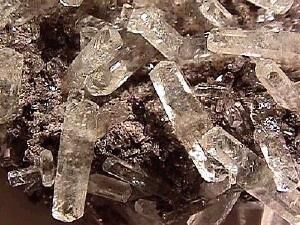
The name says exactly what the mineral is. Manganese-bearing calcite is plain calcite — calcium carbonate — in which some of the calcium atoms have been quietly swapped out for manganese. The swap leaves the crystal structure intact but tints the stone anywhere from pale peach to a saturated blush pink. Older mineralogical literature calls the same material manganoan calcite or manganocalcite; all three names point at the same compositional variety.
The variety was first reported from the Banská Štiavnica mining district in present-day Slovakia, a silver and base-metal area whose ore veins carry pink carbonate alongside the more familiar white calcite. No formal type description by a named mineralogist circulates in the modern reference literature, and the early-19th-century paper trail is thin. What the sources are confident about is the locality, not the discoverer.
Manganese-bearing calcite sits on a continuous chemical bridge between two species. At one end is ordinary calcite, CaCO₃. At the other is rhodochrosite, MnCO₃ — a rose-red manganese carbonate. As Mn²⁺ ions take the place of Ca²⁺ in the lattice, the colour shifts redder.
The species name shifts with it. The intermediate composition is named kutnohorite; beyond that, the material is rhodochrosite outright. The variety name manganese-bearing calcite covers the lower-manganese stretch of that bridge, where the host is still calcite.
The mineral's behaviour under ultraviolet (UV) light drew sustained attention in the mid-20th century. A 1947 paper by Schulman, Evans, Ginther and Murata, in the Journal of Applied Physics, pinned down the mechanism. The manganese ion is what makes calcite glow: the Mn²⁺ centre absorbs incoming energy and re-emits it as a characteristic orange light.
Pure manganese-bearing calcite responds poorly to UV on its own, but couples readily to a cathode-ray beam. A trace of lead, thallium or cerium added as an auxiliary impurity makes the material respond strongly under standard UV lamps too. The mechanism the authors named — sensitized luminescence — became a working concept in carbonate spectroscopy.
Industrial & practical applications
Manganese-bearing calcite has no industrial role of its own. The variety is too small a slice of the wider calcite supply to drive a separate market.
Bulk industries that consume calcite — cement, lime, fillers, soil amendments — do not sort it from ordinary calcite at the quarry. Where the mineral earns its place today is in two narrow registers: mineral collecting and laboratory science.
The collector market is the larger of the two. Specimens prized as pink mangano calcite travel out of three regions in particular: the N'Chwaning mines in the Kalahari Manganese Field of South Africa, the Erma Reka district of Bulgaria's Madan ore belt, and the Huanggang mines of Inner Mongolia.
They are sold as cabinet pieces — soft pastel-pink rhombs, sometimes coupled with manganite or hausmannite. A portion of the Chinese material is marketed specifically for its red-orange glow under ultraviolet (UV) light.
The scientific role rests on the same luminescence property. Manganese-bearing calcite is a working reference material in cathodoluminescence microscopy, a method in which a focused electron beam excites a mineral and the colour of the emission reports its trace chemistry.
Mn²⁺ in calcite produces a characteristic orange emission near 620 nanometres. The signal is sensitive enough to map manganese variations down to the parts-per-billion range. Sedimentary petrologists read it to reconstruct the growth history of carbonate cements; geochemists use it to fingerprint Mn-bearing carbonate phases that ordinary microscopy cannot resolve.
Where it forms, where it's found
Chemical composition
Synonyms
- Calcimangite
- Calciodadochit
- Calcite-rhodochrosite
- Calcium-Rhodochrosite
- Calciumrhodochrosit
- Calciumrhodochrosita
- Kalkmanganspat
- Manganiferous Calcite
- Mangankalkspat
- Manganoan Calcite
- Manganocalcit
- Manganocalcita
- Manganocalcite
- Manganokalzit
- Spartait
- Spartaita
- Spartaite
Group, growth & confusion
Literature, links & citation
- 1947Schulman, James H., Evans, Lyle W., Ginther, Robert J., Murata, K. J. (1947) The Sensitized Luminescence of Manganese‐Activated Calcite. Journal of Applied Physics, 18 (8). 732-739 doi:10.1063/1.1697831DOI: 10.1063/1.1697831
- 1993El Ali, Ahmad; Barbin, Vincent; Calas, Georges; Cervelle, Bernard; Ramseyer, Karl; Bouroulec, Jacqueline (1993) Mn2+-activated luminescence in dolomite, calcite and magnesite: quantitative determination of manganese and site distribution by EPR and CL spectroscopy. Chemical Geology, 104 (1-4). 189-202 doi:10.1016/0009-2541(93)90150-hDOI: 10.1016/0009-2541(93)90150-h
- 2007Polgári, M., Bajnóczi, B., Götze, J., and Vígh, T. (2007) Cathodoluminescence behaviour of Mn-rich carbonates. Goldschmidt 2007 Conference, 20-24 August, Cologne, Germany, Geochimica et Cosmochimica Acta, vol. 71, no. 15., Special Supplement, A801.
Entry last updated
@misc{mineral2026,
  author    = {Mineral Index editorial board},
  title     = {Manganese-bearing Calcite — Mineral Index},
  year      = {2026},
  url       = {https://mineralindex.org/minerals/manganese-bearing-calcite-2526}
}