Where it forms, where it's found
- Geological setting
is located in the upper-Jurassic accretionary complex chert and underwent contact metamorphism by the intrusion of granodiorite
- Type locality
- Matsumaezawa pit
- Tanohata mine
- Tanohata
- Shimohei District
- Iwate Prefecture
- Japan
39.9167°, 141.9000°
2recorded occurrences
Physical
- Hardness
- 1Talc
- 2Gypsum
- 3Calcite
- 4Fluorite
- 5Apatite
- 6Orthoclase
- 7Quartz
- 8Topaz
- 9Corundum
- 10Diamond
- Transparency
- Translucent
- Colour
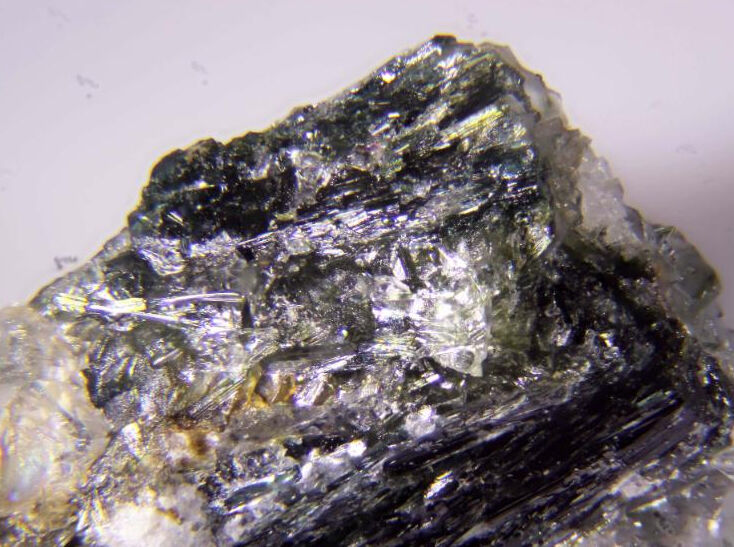
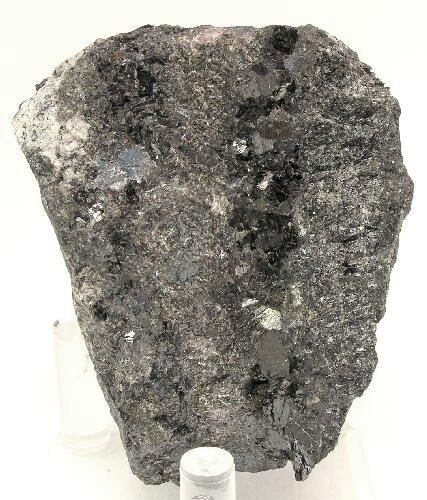
- Cherry-red to very dark red
In thicker grains it is reddish-brown.
- Streak
- pinkish white
- Tenacity
- brittle
- Cleavage
- Perfect
(110)
fracture is stepped along crystal elongation and uneven across a crystal
- Fracture
- Irregular/Uneven · Step-Like
- Density
- 3.16 g/cm³
Optical
- Optical type
- Biaxial (-) · 2V measured = 60° · 2V calc = 57°
- Refractive index
- 1.645 – 1.675
- Surface relief
- High
- Principal indices
- nα 1.645 · nβ 1.668 · nγ 1.675
- Pleochroism
- Weak
weakly pleochroic in brown colours, with Z ~Y >X
- Extinction
- parallel
- UV response
- Nofluorescence is observed under long- or short-wave ultraviolet light.
Δ = 0Δmax
PPLpleochroism per grain
XPLindependent extinctions · rotate the stage
PPLpleochroism only · colour blends on rotation
XPLinterference colour · extinct every 90°
Retardation300 nm
Order1st order
XPL colour
Crystallography
- Space group
- C2/m
- Cell parameters
- a = 9.9533(4) Å · b = 18.1440(7) Å · c = 5.2970(2) Å
- Cell angles
- β = 103.948(4) °
- Ratio a:b:c
- 1 : 1.823 : 0.532
- Z
- 2
- Twinning
twinning plane parallel to crystal elongation
- Type-locality form
prismatic crystals up to 0.3 x 0.2 mm and their aggregates up to 1 mm
Crystal structure
Chemical composition
Synonyms
- IMA2023-004
- Mangani-eckermanniet
In other languages
- German
- IMA 2023-004 · Mangani-Eckermannit
- Italian
- Mangani-eckermannite
Classification
Strunz
10th ed.9.DE
- 9SilicatesClass
- 9.DInosilicatesDivision
- 9.DEInosilicates with 2-periodic double chains, Si4O11; ClinoamphibolesGroup
- 9.DEMangani-eckermanniteSpecies
Group, growth & confusion
Literature, links & citation
Citations
- 2023Bosi, Ferdinando; Hatert, Frédéric; Pasero, Marco; Mills, Stuart J. (2023) IMA Commission on New Minerals, Nomenclature and Classification (CNMNC) – Newsletter 73. European Journal of Mineralogy, 35 (3). 397-402 doi:10.5194/ejm-35-397-2023 DOI: 10.5194/ejm-35-397-2023
- 2023Kasatkin, Anatoly V., Zubkova, Natalia V., Agakhanov, Atali A., Chukanov, Nikita V., Škoda, Radek, Nestola, Fabrizio, Belakovskiy, Dmitry I., Pekov, Igor V. (2023) Mangani-eckermannite, NaNa2(Mg4Mn3+)Si8O22(OH)2, a new amphibole from Tanohata Mine, Iwate Prefecture, Japan. Mineralogical Magazine, 87 (6) 935-942 doi:10.1180/mgm.2023.63DOI: 10.1180/mgm.2023.63
Cite this entry
Entry last updated
@misc{mineral2026,
  author    = {Mineral Index editorial board},
  title     = {Mangani-eckermannite — Mineral Index},
  year      = {2026},
  url       = {https://mineralindex.org/minerals/mangani-eckermannite-470778}
}