Where it forms, where it's found
- Type locality
- Broken Hill
- Broken Hill district
- Yancowinna Co.
- New South Wales
- Australia
15recorded occurrences
Physical
Optical
- Optical type
- Isotropic
- Surface relief
- Very high
- Principal indices
- n 2.20
- UV response
- None
- Notes
Exhibits weak anomalous birefringence at times.
PPL intrinsic colour; no change on stage rotation
XPL extinct at every orientation
- Single index
- n = 2.200
Crystallography
- Space group
- #208
- Cell parameters
- a = 6.5 Å
- Morphology
Tetrahedral, often with small faces of (01); cubo-octahedral rare by equal development of (001), (111), and (11). (001) striated parallel to the edges with the tetrahedral faces. o differences exhibited by the positive and negative tetrahedra. Crusts; aggregates of indistinct crystals.
- Twinning
On (011), repeated at times.
- Epitaxy
Oriented intergrowths with iodargyrite.
- Type-locality form
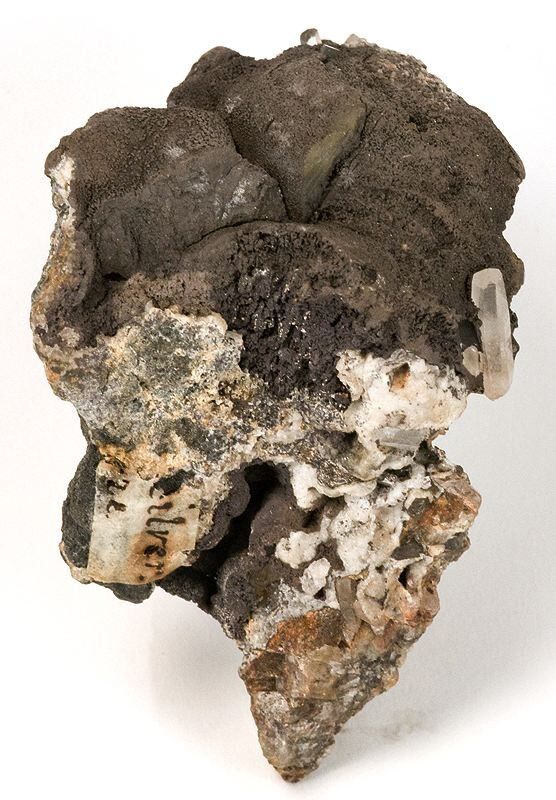
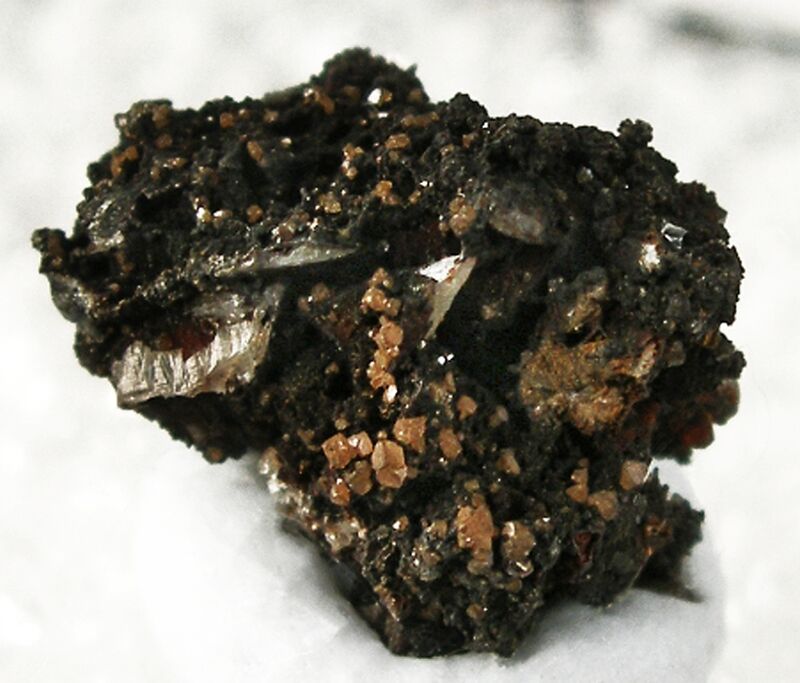
Usually as crystalline crusts or as aggregates of rather indistinct crystals on rock surfaces. Also as scattered crystals to 2 mm in size.
Crystal structure
Chemical composition
Synonyms
- Miersiet
In other languages
- German
- Miersit
- Italian
- miersite
- Russian
- майерсит · миерсит
Classification
Strunz
10th ed.3.AA.05
- 3HalidesClass
- 3.ASimple halides, without H2ODivision
- 3.AAM:X = 1:1, 2:3, 3:5, etc.Group
- 3.AA.05MiersiteSpecies
Dana
8th ed.09.01.07.02
- 09Normal HalidesClass
- 09.01AXType
- 09.01.07Nantokite SeriesGroup
- 09.01.07.02MiersiteSpecies
CIM
—8.3.5
- 8Halides - Fluorides, Chlorides, Bromides and Iodides; also Fluoborates and FluosilicatesClass
- 8.3Halides of AgGroup
- 8.3.5MiersiteSpecies
Group, growth & confusion
Literature, links & citation
Citations
- 1898Spencer, L.J. (1898) Miersite, a cubic modification of native silver iodide. Nature: 57: 574-574.
- 1901Spencer, L. J. (1901) Marshite, Miersite, and Iodyrite from Broken Hill, New South Wales. Mineralogical Magazine and Journal of the Mineralogical Society, 13 (59) 38-53 doi:10.1180/minmag.1901.013.59.04 DOI: 10.1180/minmag.1901.013.59.04
- 1902Prior, G. T. (1902) The Identity of Kilbriekenite with Geocronite : and Analyses of Miersite, Marshite, and Copper-pyrites. Mineralogical Magazine and Journal of the Mineralogical Society, 13 (60) 186-190 doi:10.1180/minmag.1902.13.60.07 DOI: 10.1180/minmag.1902.13.60.07
- 1914Quercigh, E. (1914) On the true nature of miersite and cuproiodargyrite. Atti Reale Accademia dei Lincei, Classe di Scienze Fisiche, Matematiche e Naturali. Rendiconti: 23: 441, 711, 825-833.
- 1921Wilsey, R.B. (1921) The crystal structure of the silver halides. Philosophical Magazine: 42: 262-263.
Cite this entry
Entry last updated
@misc{mineral2025,
  author    = {Mineral Index editorial board},
  title     = {Miersite — Mineral Index},
  year      = {2025},
  url       = {https://mineralindex.org/minerals/miersite-2707}
}