Where it forms, where it's found
- Geological setting
Banded Iron Formation
Low grade metamorphosed banded iron formations; also hydrothermal alteration around sulphide veins.
- Type locality
- Mesabi Range
- Minnesota
- USA
62recorded occurrences
Physical
Optical
- Optical type
- Biaxial (-) · 2V measured = 4° · 2V calc = 16°
- Refractive index
- 1.578 – 1.623
- Surface relief
- Moderate
- Principal indices
- nα 1.578 – 1.583 · nβ 1.578 – 1.622 · nγ 1.615 – 1.623
- Birefringence
- 0.037-0.040
- Pleochroism
- Visible
X= pale green Z= colorless to pale greenish yellow
- Dispersion
- r < v moderate
- UV response
- Not fluorescent
Δ = 0Δmax
PPLpleochroism per grain
XPLindependent extinctions · rotate the stage
PPLpleochroism only · colour blends on rotation
XPLinterference colour · extinct every 90°
Retardation370 nm
Order1st order
XPL colour
Crystallography
- Cell parameters
- a = 5.623(2) Å · b = 9.419(2) Å · c = 9.624(3) Å
- Cell angles
- α = 85.21(3) ° · β = 95.64(3) ° · γ = 90.00 °
- Ratio a:b:c
- 1 : 1.675 : 1.712
- Z
- 2
- Morphology
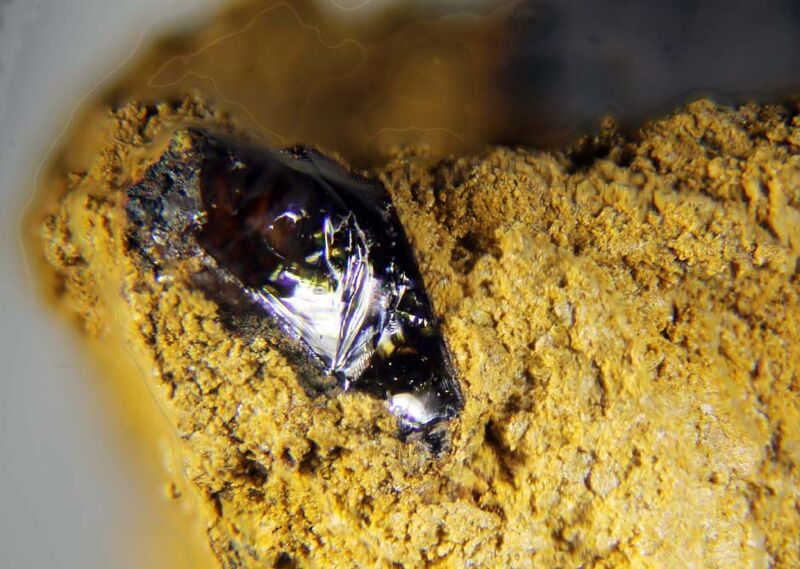
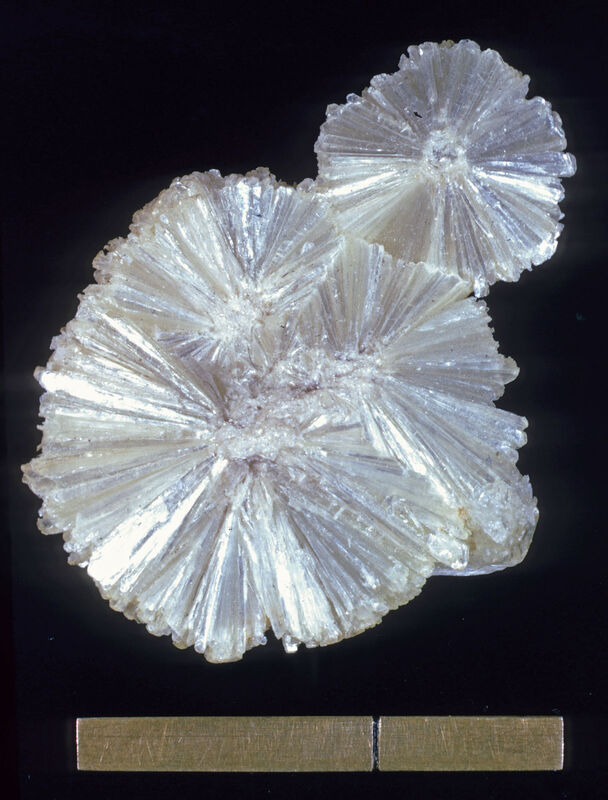
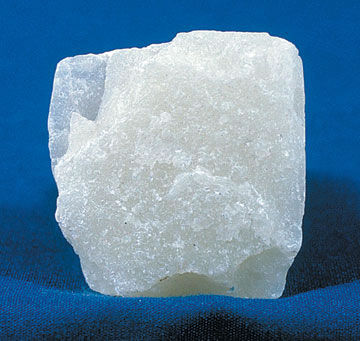
Usually fine-grained dense masses of microscopic plates or needles
- Twinning
Inferred from single crystal X-ray analysis
Crystal structure
Chemical composition
- Impurities
- Ti
- Al
- Mn
- Ca
- Na
- K
- H2O
Synonyms
- Iron-Talc
- Minnesotaiet
In other languages
- French
- Minnésotaïte
- German
- Minnesotait
- Italian
- Minnesotaite
Classification
Strunz
10th ed.9.EC.05
- 9SilicatesClass
- 9.EPhyllosilicatesDivision
- 9.ECPhyllosilicates with mica sheets, composed of tetrahedral and octahedral netsGroup
- 9.EC.05MinnesotaiteSpecies
Dana
8th ed.71.02.01.05
- 71Phyllosilicates Sheets of Six-membered RingsClass
- 71.02Sheets of 6-membered rings with 2:1 layersType
- 71.02.01Pyrophyllite-talc groupGroup
- 71.02.01.05MinnesotaiteSpecies
CIM
—14.21.9
- 14Silicates not Containing AluminumClass
- 14.21Silicates of Fe and MgGroup
- 14.21.9MinnesotaiteSpecies
Group, growth & confusion
Literature, links & citation
Citations
- —Rasmussen, M. G., Evans, B. W., Kuehner, S. M. (1998). Low-temperature fayalite, greenalite, and minnesotaite from the Overlook gold deposit, Washington: phase relations in the system FeO-SiO2-H2O. The Canadian Mineralogist, 36 (1), 147-162.
- —Lempart-Drozd, M., Błachowski, A. (2023): 57Fe Mössbauer studies of Fe2+-phyllosilicates dehydrogenation. 9th Meeting of the Mineralogical Society of Poland / 28th Meeting of the Petrology group of the Mineralogical Society of Poland, "Oceanic lithosphere: rocks, minerals, and critical resources", October 19-22, Bielawa, Poland. Mineralogia - Special Papers, 51, 79.
- 1944Gruner, John W. (1944) The composition and structure of minnesotaite, a common iron silicate in iron formations. American Mineralogist, 29 (9-10) 363-372
- 1945Fleischer, M. (1945) New mineral names. American Mineralogist, 30 (7-8). 548-550
- 1974Klein, Cornelis (1974) Greenalite, stilpnomelane, minnesotaite, crocidolite and carbonates in a very low-grade metamorphic Precambrian iron formation. The Canadian Mineralogist, 12 (7). 475-498
Cite this entry
Entry last updated
@misc{mineral2026,
  author    = {Mineral Index editorial board},
  title     = {Minnesotaite — Mineral Index},
  year      = {2026},
  url       = {https://mineralindex.org/minerals/minnesotaite-2722}
}