History
Talc is the softest mineral there is — a fingernail scratches it, and rubbed between two fingers it feels soapy, almost greasy. That feel is why people reached for the rock built from it long before anyone gave it a formal name.
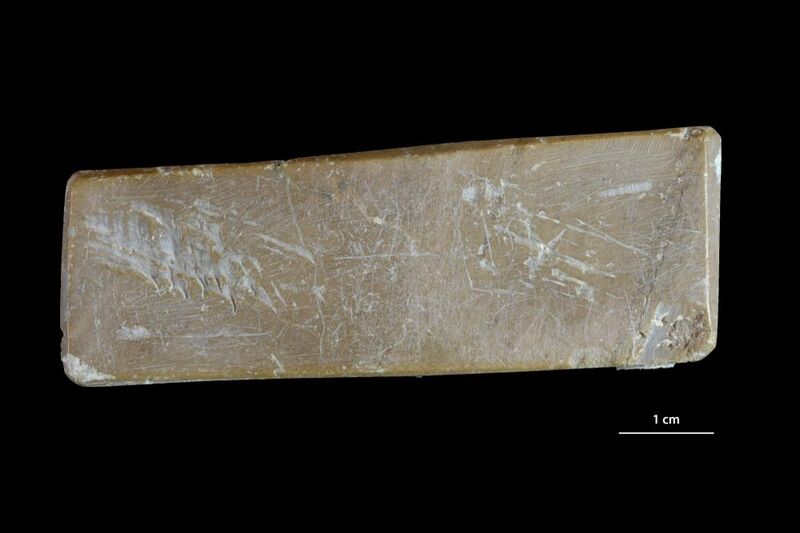
A coarse, soft, grey-green stone rich in talc is soapstone, also called steatite. Because it can be carved with even the most basic tools, often yielding very finely detailed results, early craftspeople used it again and again.
In Ancient Egypt steatite served for small statues, shabtis, beads, amulets, and seals, across both the Predynastic and Dynastic periods. Egyptian workers also learned to glaze it. Fired in a copper-bearing medium, the soft stone hardened as it converted to a tougher mineral called enstatite. The result was a glassy blue-green surface much like faience. The same softness made steatite a favourite elsewhere — Assyrian cylinder seals and Chinese statuary are carved from it too.
The name talc was settled in the early modern period. The German scholar Georgius Agricola, born Georg Bauer, is credited with applying it in 1546. He drew on the Arabic talq, meaning pure — probably a nod to the pale colour of its powder. An older tradition traces the word instead to the Persian tālk. In antiquity the term was loose, covering talc, mica, and selenite alike.
Industrial & practical applications
Talc is a workhorse filler — a cheap, soft, inert powder mixed into other materials to bulk them out and change how they behave. Its four largest markets are ceramics, paint, paper, and plastics. In paint it controls how the finish flows and dries; in paper it adds smoothness and brightness; in plastics it stiffens and cheapens the blend. The same role extends to rubber and to roofing materials.
Beyond fillers, talc serves a scatter of practical trades. It is used as a carrier in insecticides — the powder spreads the active chemical evenly. It works as a mild abrasive in polishing cereal grains such as rice and corn. It also turns up in lubricants, leather dressings, and marking pencils.
In personal care, powdered talc — often combined with corn starch — is sold as baby powder. It is valued commercially for its fragrance retention, luster, purity, softness, and whiteness. The food and drug industries use it too. It serves as a food additive, and as a glidant in pharmaceutical tablets — an agent that helps powders flow smoothly during manufacturing.
The talc rock itself, soapstone, has its own modern uses. Resistant to most reagents and to moderate heat, it is well suited to sinks and countertops, and is still cut for stoves and electrical switchboards.
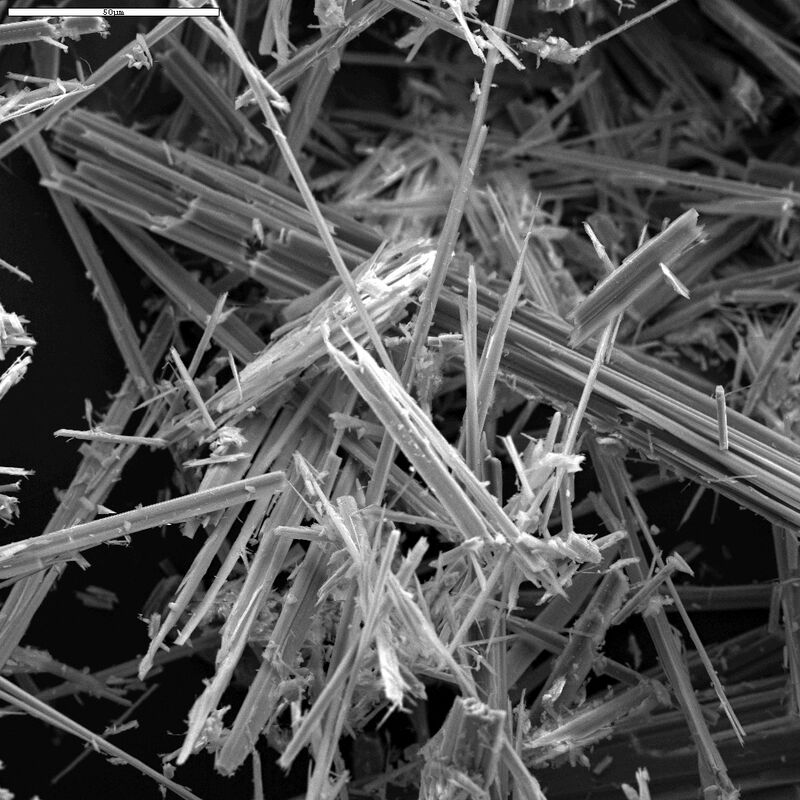
One problem shadows commercial talc: it often sits underground alongside asbestos ore, a known carcinogen, and the two can be hard to fully separate. In July 2024 the International Agency for Research on Cancer listed talc as probably carcinogenic to humans. Litigation has followed in the United States. In February 2016 a jury awarded $72 million to the family of a woman who died of ovarian cancer, in a suit against the manufacturer Johnson & Johnson. In 2020 the company stopped selling the talc-based baby powder it had marketed for 130 years.
China dominates supply, producing about 2.2 million tonnes in 2016 — roughly 30 percent of the world total. The next-largest producers are Brazil at 12 percent, India at 11 percent, the United States at 9 percent, and France at 6 percent. The single largest mine, at Trimouns near Luzenac in southern France, yields 400,000 tonnes a year.
Where it forms, where it's found
- Geological setting
Schists and steatite through hydrothermal alteration of mafic rocks. Low-temperature metamorphism of siliceous dolomites.
Varieties
Physical
- Hardness
- 1Talc
- 2Gypsum
- 3Calcite
- 4Fluorite
- 5Apatite
- 6Orthoclase
- 7Quartz
- 8Topaz
- 9Corundum
- 10Diamond
- Lustre
- Waxy · Greasy · Resinous
- Transparency
- Transparent · Translucent
- Colour
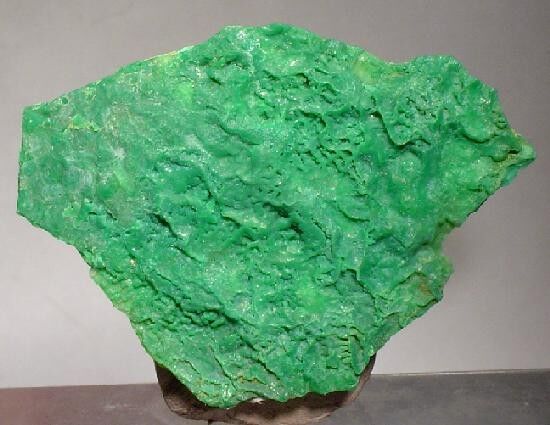
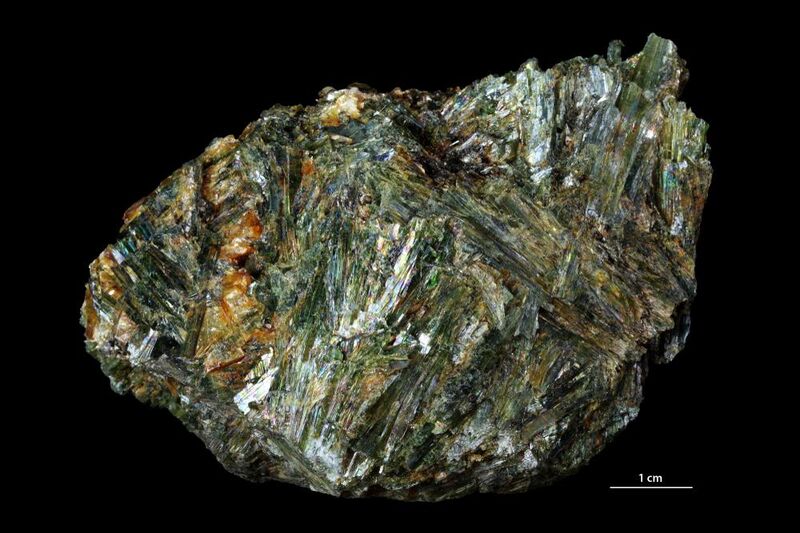
- Colorless · white · pale green · bright emerald-green to dark green · brown · gray
- Streak
- White
- Tenacity
- sectile
- Cleavage
- Perfect
on (001)
Flexible but not elastic. Feels slippery or greasy to the touch.
- Fracture
- Fibrous · Micaceous
- Density
- 2.58 g/cm³
Optical
- Optical type
- Biaxial (-) · 2V measured = 30° · 2V calc = 38°
- Refractive index
- 1.538 – 1.6
- Surface relief
- Moderate
- Principal indices
- nα 1.538 – 1.55 · nβ 1.589 – 1.594 · nγ 1.589 – 1.6
- Birefringence
- 0.05
- Pleochroism
- Weak
Only visible in dark varieties.
- Dispersion
- r > v perceptible
- UV response
- Not usually fluorescent.
Crystallography
- Cell parameters
- a = 5.29 Å · b = 9.173 Å · c = 9.46 Å
- Cell angles
- α = 90.46 ° · β = 98.68 ° · γ = 90.09 °
- Ratio a:b:c
- 1 : 1.734 : 1.788
- Z
- 2
- Morphology
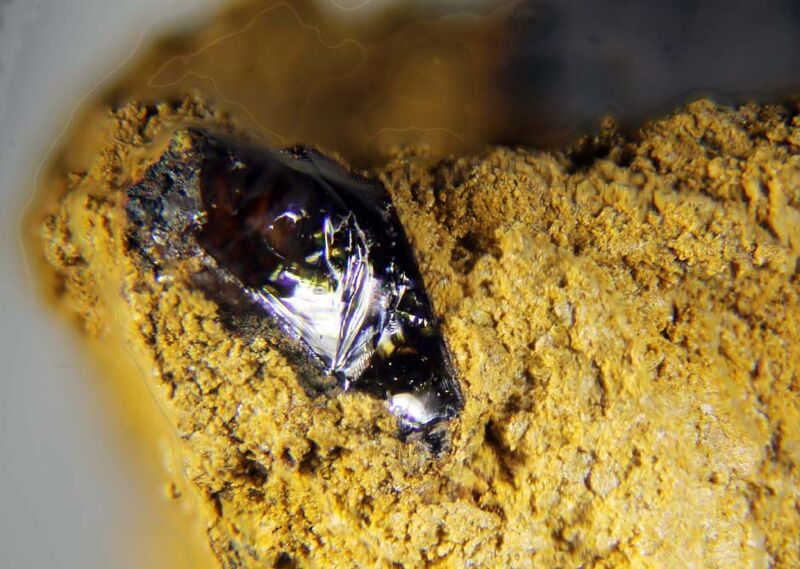
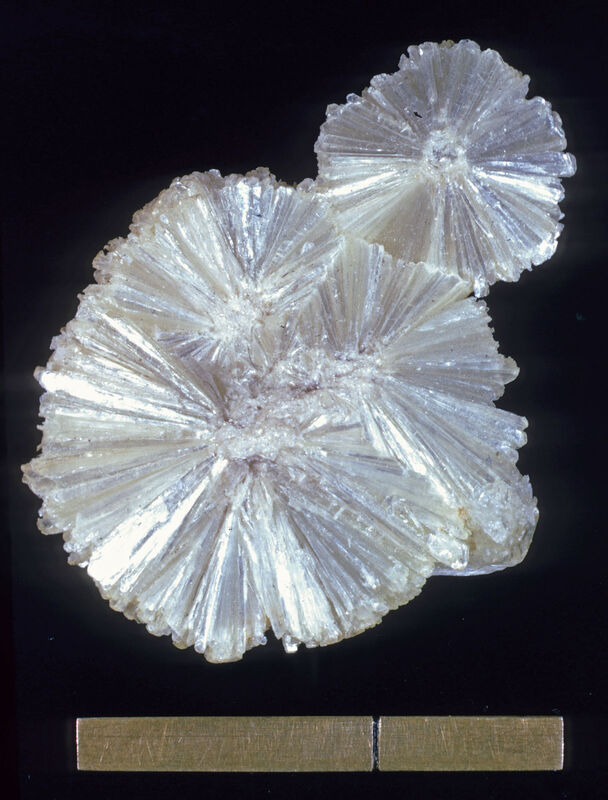
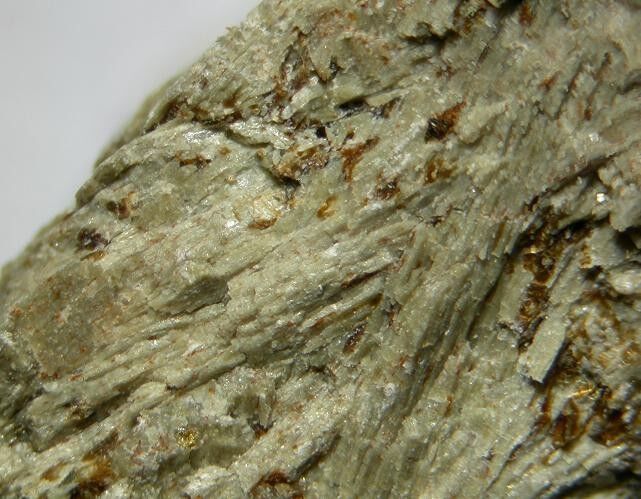
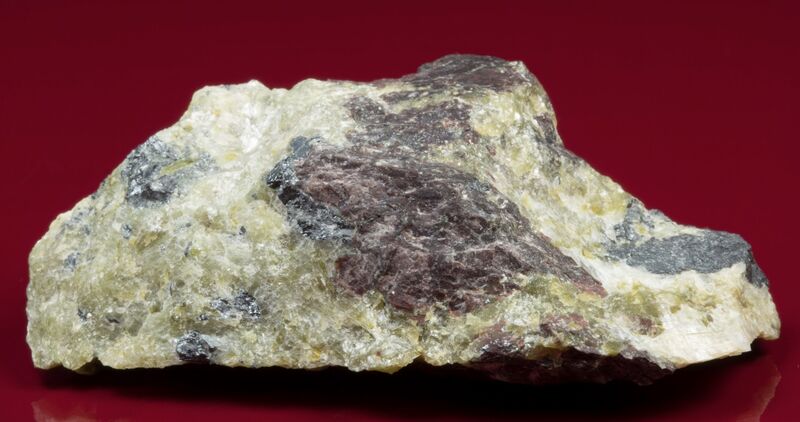
Euhedral crystals are extremely rare, usually found in platy, foliated to fine-grained compact masses, sometimes has a radial appearance.
- Comment
The 1A polytype has C-1 setting. Pseudo-monoclinic.
Chemical composition
- Impurities
- Ni
- Fe
- Al
- Ca
- Na
- H2O
Synonyms
- Agalit
- Agalita
- Agalite
- Asbestin
- Colubrine
- Craie de Briancon
- Federweiß
- Fedtsten
- French Chalk
- Gilstein
- Keffekelit
- Keffekil
- Keffekilit
- Lardite (of Wallerius)
- Leberstein (of Haditsch & Maus)
- Mussolinit
- Mussolinita
- Mussolinite
- Ollit
- Ollita
- Ollite
- Talck
- Yalck
In other languages
- French
- Agalite · Agalmatolite · Colubrine · Kérolite · Lardite · Ollite · talc
- German
- Magnesiumsilikathydrat · Talcum · Talk · Talkum
- Spanish
- talco · Talcoso
- Italian
- talco
- Portuguese
- Pedra sabão · talco
- Japanese
- カッセキ · ケイ酸マグネシウム · タルク · 滑石
- Chinese
- 滑石 · 滑石粉 · 矽酸鎂 · 硅酸镁
- Simplified Chinese
- 滑石
- Traditional Chinese
- 滑石
- Russian
- Тальк
- Arabic
- التلك · طلق
- Hindi
- टाल्क
Classification
9.EC.05
- 9SilicatesClass
- 9.EPhyllosilicatesDivision
- 9.ECPhyllosilicates with mica sheets, composed of tetrahedral and octahedral netsGroup
- 9.EC.05TalcSpecies
71.02.01.03
- 71Phyllosilicates Sheets of Six-membered RingsClass
- 71.02Sheets of 6-membered rings with 2:1 layersType
- 71.02.01Pyrophyllite-talc groupGroup
- 71.02.01.03TalcSpecies
14.4.9
- 14Silicates not Containing AluminumClass
- 14.4Silicates of MgGroup
- 14.4.9TalcSpecies
Group, growth & confusion
Literature, links & citation
- —De natura fossilium - Lib. I-X
- 1778Bras-de-Fer, L. (1778) (84) Terre (Élément). in: Explication Morale du Jeu de Cartes; Anecdote Curieuse et Interessante, (Bruxelles), 99-100.
- 1934Gruner, John W. (1934) The Crystal Structures of Talc and Pyrophyllite. Zeitschrift für Kristallographie, 88 (1). 412-419 doi:10.1524/zkri.1934.88.1.412 DOI: 10.1524/zkri.1934.88.1.412
- 1938Hendricks, Sterling B. (1938) On the Crystal Structure of Talc and Pyrophyllite. Zeitschrift für Kristallographie, 99 (1). 264-274 doi:10.1524/zkri.1938.99.1.264DOI: 10.1524/zkri.1938.99.1.264
- 1948Avgustinik, A.I. and Vigderganz, V.S. (1948) Properties of talc during heating. Ogneupory: 13: 218-227.
Entry last updated
@misc{mineral2026,
  author    = {Mineral Index editorial board},
  title     = {Talc — Mineral Index},
  year      = {2026},
  url       = {https://mineralindex.org/minerals/talc-3875}
}