History
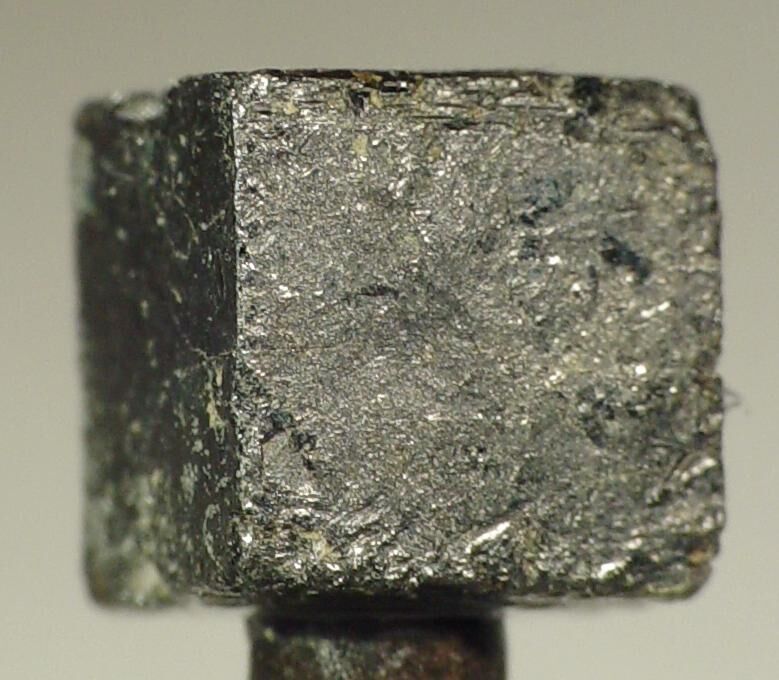
Few minerals have lent their name to a whole branch of materials science the way perovskite has. The crystal itself is calcium titanate, a dark cube of calcium, titanium and oxygen. The German mineralogist Gustav Rose found it in the Ural Mountains of Russia and described it in 1839.
Rose named it after Count Lev Perovski, a Russian mineralogist and statesman who lived from 1792 to 1856. Perovski sat in the Ministry of Regions and later led the Appanage Department, the office that managed crown estates. There he pushed the growth of Russian mining and opened several new deposits, and he kept an influential mineral collection of his own.
For nearly a century the mineral was a regional curiosity. That changed when chemists noticed that its atomic arrangement — calcium, a metal, and three oxygens, written ABX₃ — repeats across hundreds of synthetic compounds. The crystallographer Victor Goldschmidt set out the rules governing that arrangement in 1926. The structure was pinned down precisely in 1945, from X-ray work on barium titanate by Helen Megaw.
That arrangement is now called the perovskite structure, and the name is applied to the entire class of compounds built the same way. The label has travelled far from the original crystal. Engineered perovskite-structured materials — not the natural mineral — drive today's perovskite solar cells, the barium-titanate capacitors in electronics, and a range of ferroelectrics, materials that hold an electric charge after the field is switched off.
The deepest reach of the name lies beneath our feet. A magnesium-silicate with the same structure makes up most of Earth's lower mantle, which makes it the most abundant mineral on the planet. For decades it had no formal name, because no one had a natural sample to study; geologists simply called it silicate perovskite. In 2014 a grain of it was finally identified in the shock-melted veins of the Tenham meteorite, and the mineral was named bridgmanite after the high-pressure physicist Percy Bridgman.
Industrial & practical applications
The natural mineral earns its keep modestly, as a minor ore rather than a headline commodity. Alongside rutile and ilmenite — the two oxides that supply most of the world's titanium — perovskite is worked for the titanium locked in its structure, which is recovered during processing.
Its real draw is what often rides along with the titanium. Perovskite is frequently enriched in cerium, niobium, thorium, lanthanum, neodymium and other rare earth metals. Those rare earths — a group of metals prized for magnets, phosphors and batteries — make the mineral worth prospecting where it concentrates.
The clearest commercial case is a close relative. Loparite, a rare-earth member of the perovskite group, is the principal ore of the light rare earth elements in Russia. It is mined on the Kola Peninsula and beneficiated — concentrated by separating it from waste rock — into a 95% loparite concentrate holding about 30% rare-earth oxides. That concentrate is broken down by a chlorination or acid decomposition process. The treatment recovers the rare earths along with titanium, niobium and tantalum.
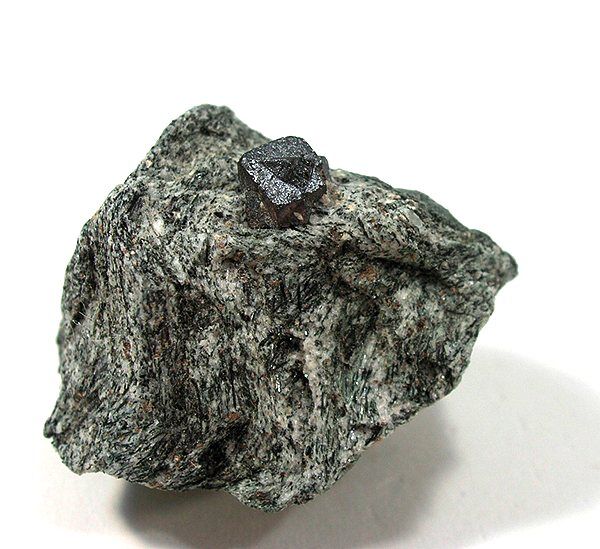
Beyond ore, well-formed perovskite crystals are valued in their own right as mineral specimens for collectors.
Where it forms, where it's found
- Geological setting
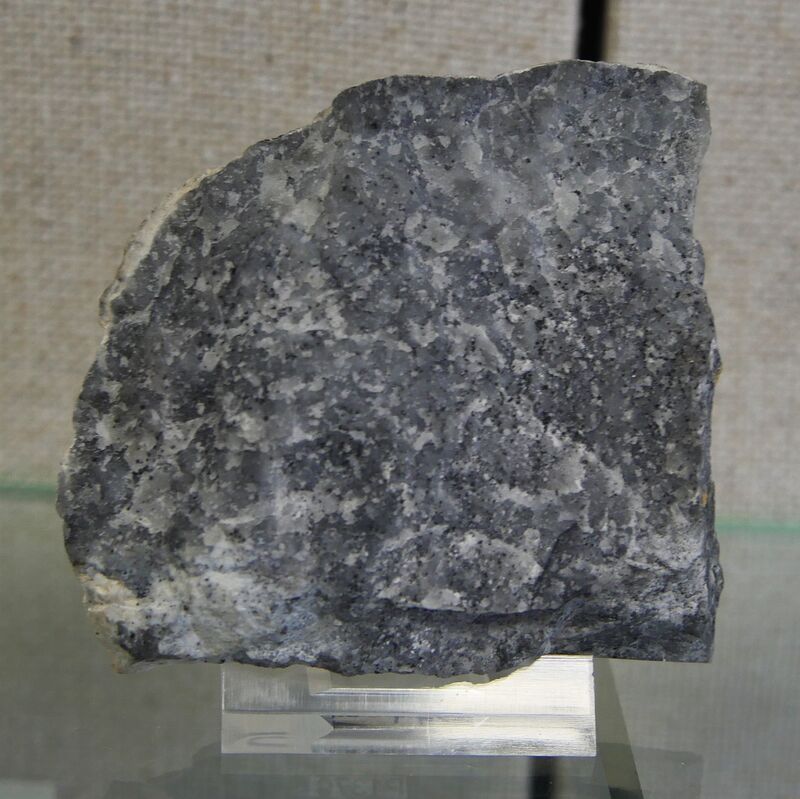
An accessory in alkaline mafic rocks.
- Type locality
- Akhmatov mine
- Magnitka
- Kusinsky District
- Chelyabinsk Oblast
- Russia
55.3042°, 59.6561°
Varieties
Physical
- Hardness
- 1Talc
- 2Gypsum
- 3Calcite
- 4Fluorite
- 5Apatite
- 6Orthoclase
- 7Quartz
- 8Topaz
- 9Corundum
- 10Diamond
- Transparency
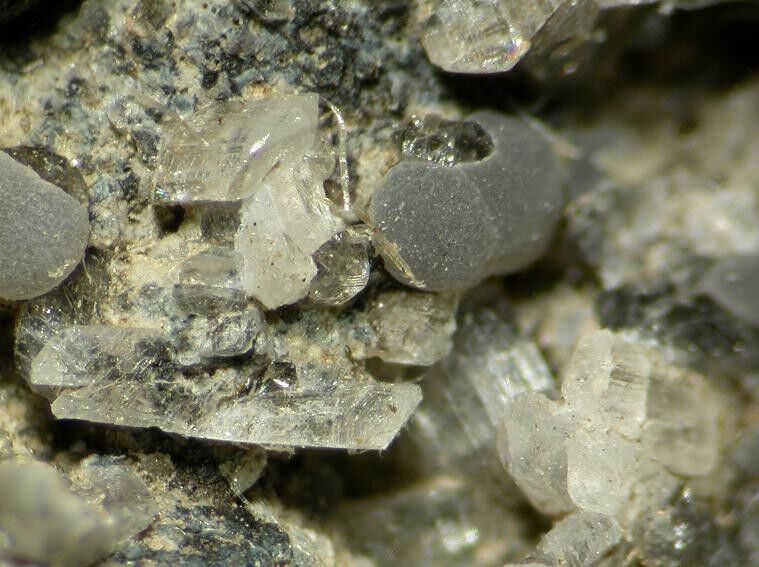
- Transparent · Translucent
- Colour
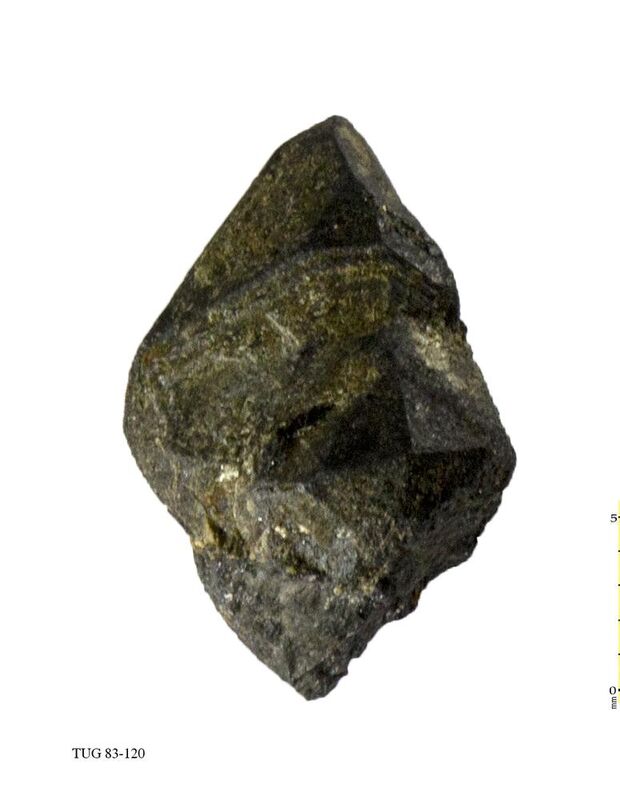
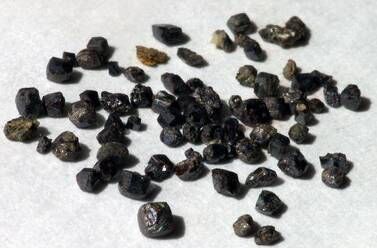
- Dark brown · black · red-brown · yellow shades
- Streak
- Colourless, greyish white
- Tenacity
- brittle
- Cleavage
- Imperfect/Fair
On (001).
- Fracture
- Irregular/Uneven · Sub-Conchoidal
- Density
- 3.98 g/cm³
Optical
- Optical type
- Biaxial (+) · 2V measured = 90° · 2V calc = 88°
- Refractive index
- 2.3 – 2.38
- Surface relief
- Very high
- Principal indices
- nα 2.3 · nβ 2.34 · nγ 2.38
- Pleochroism
- Weak
Z > X.
- Dispersion
- r > v
- Extinction
- Parallel. X = a; Y = c; Z = b.
- Optical colour
- Dark bluish grey
- Internal reflections
- Brown
- Tropism
- Isotropic
- Reflectance R%
- (19.2) 400, (18.8) 420, (18.4) 440, (18.0) 460, (17.6) 480, (17.3) 500, (17.0) 520, (16.8) 540, (16.6) 560, (16.4) 580, (16.2) 600, (16.1) 620, (16.0) 640, (16.0) 660, (15.9) 680, (15.9) 700
Crystallography
- Space group
- #71
- Cell parameters
- a = 5.447(1) Å · b = 7.654(1) Å · c = 5.388(1) Å
- Ratio a:b:c
- 1 : 1.405 : 0.989
- Z
- 4
- Morphology
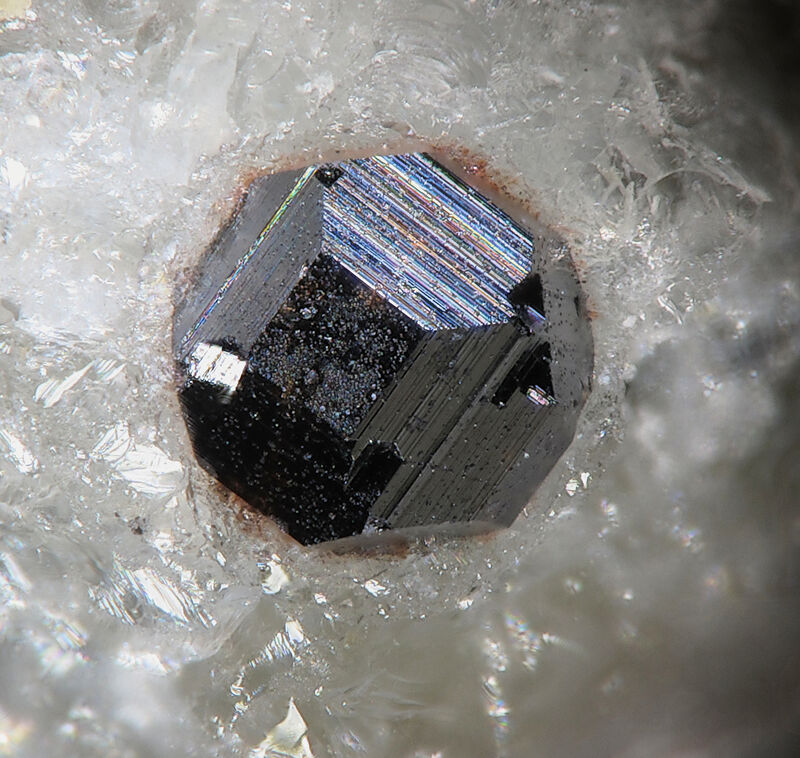
Crystals usually cubic, highly modified at times, but the planes are often irregularly distributed. Cubic faces striated parallel to [001] and apparently penetrations twins (as if of pyritohedral individuals; also striated parallel to [110]. (001) less developed with (113) and (449) prominent. Also cubooctahedra or octahedra (esp. Ce and Nb varieties). Rarely reniform masses exhibiting small cubes on the surface, or massive granular.
- Twinning
On (111): 1. penetration twins (esp. Ce or Nb varieties); 2. complex lamellar twinning. About [101] and rarely [121]
Chemical composition
- Impurities
- Fe
- Nb
- Ce
- La
- TR
Synonyms
- Metaperovskite
- Perofskite
- Perovskite (of Rose)
- Uhligite (of Hauser)
In other languages
- French
- 37226-56-5 · CaTiO3 · metaperovskite · pérovskite
- German
- Perovskit · Perowskit
- Spanish
- Perovskita · Perowskita
- Italian
- perovskite · perowskite
- Portuguese
- perovskita · Perovskite · Perowskite
- Japanese
- ペロブスカイト · ペロブスキー石 · 灰チタン石 · 灰チタン石グループ
- Chinese
- 鈣鈦礦
- Simplified Chinese
- 钙钛矿
- Traditional Chinese
- 鈣鈦礦
- Russian
- перовскит
- Arabic
- بيروفسكيت
Classification
4.CC.30
- 4OxidesClass
- 4.CMetal: Oxygen = 2: 3,3: 5, and similarDivision
- 4.CCWith large and medium-sized cationsGroup
- 4.CC.30PerovskiteSpecies
04.03.03.01
- 04Simple OxidesClass
- 04.03A2X3Type
- 04.03.03Perovskite GroupGroup
- 04.03.03.01PerovskiteSpecies
7.9.6
- 7Oxides and HydroxidesClass
- 7.9Oxides of TiGroup
- 7.9.6PerovskiteSpecies
Group, growth & confusion
Literature, links & citation
- 1839Rose, Gustav (1839) Beschreibung einiger neuen Mineralien des Urals. Annalen der Physik und Chemie, 124. 551-573 doi:10.1002/andp.18391241205DOI: 10.1002/andp.18391241205
- 1877Knop, A. (1877) Dysanalyt, ein pyrochlorartiges Mineral. Zeitschrift für Kristallographie: 1(1-6): 284-296. (as dysanalyte)
- 1880Baumhauer, H. (1880) Ueber den Perowskit. Zeitschrift für Kristallographie - Crystalline Materials: 4(1-6): 187-200.
- 1882Ben Saude (1882) Preiss. Göttingen.
- 1892Federov, E. (1892) Zusammenstellung der krystallographischen Resultate des Herrn Schoenflies und der meinigen. Zeitschrift für Kristallographie - Crystalline Materials: 20(1-6): 25-75 (74). (as Metaperovskite).
Entry last updated
@misc{mineral2026,
  author    = {Mineral Index editorial board},
  title     = {Perovskite — Mineral Index},
  year      = {2026},
  url       = {https://mineralindex.org/minerals/perovskite-3166}
}