Where it forms, where it's found
- Geological setting
It is of hydrothermal origin in a carbonatite vein
- Type locality
- Pit No. 97
- Miass
- Chelyabinsk Oblast
- Russia
55.0167°, 60.1833°
2recorded occurrences
Physical
Optical
- Pleochroism
- Non-pleochroic
- Optical colour
- Gray.
- Internal reflections
- brown internal reflections are rarely observed.
- Tropism
- Isotropic
- UV response
- none
- Notes
1.931 < n < 1.935
Crystallography
- Space group
- C2/m
- Cell parameters
- a = 13.398 Å · b = 5.6974 Å · c = 11.042 Å
- Cell angles
- β = 100.539 °
- Ratio a:b:c
- 1 : 0.425 : 0.824
- Unit cell volume
- 828.6 ų
- Z
- 2
- Morphology
Euhedral crystals, elongate [010] showing the forms (100), (001), (201), _201}, (110), (111), (11), (112), (12), and (02) (almost identical to chevkinite).
- Parting
- none
- Type-locality form
Equant anhedral grains, to 2.5 cm across, and as euhedral crystals, elongate [010] to 2 mm.
- Comment
annealed from metamict crystal
Crystal structure
Chemical composition
Synonyms
- IMA1998-029
- Polyakoviet-(Ce)
In other languages
- German
- IMA 1998-029 · Polyakovit-(Ce)
- Italian
- Polyakovite- · Polyakovite-(Ce)
Classification
Strunz
10th ed.9.BE.70
- 9SilicatesClass
- 9.BSorosilicatesDivision
- 9.BESi2O7 groups, with additional anions; cations in octahedral [6] and greater coordinationGroup
- 9.BE.70Polyakovite-(Ce)Species
Group, growth & confusion
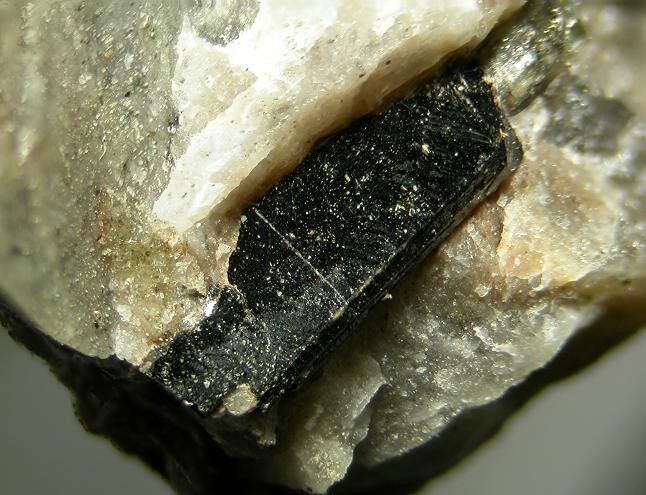 Chevkinite-(Ce)Ce4(Ti,Fe2+,Fe3+)5O8(Si2O7)2Mineral—
- Christofschäferite-(Ce)(Ce,La,Ca)4Mn(Ti,Fe)3(Fe,Ti)(Si2O7)2O8Mineral—
- Delhuyarite-(Ce)Ce4Mg(Fe3+2W)◻(Si2O7)2O6(OH)2Mineral—
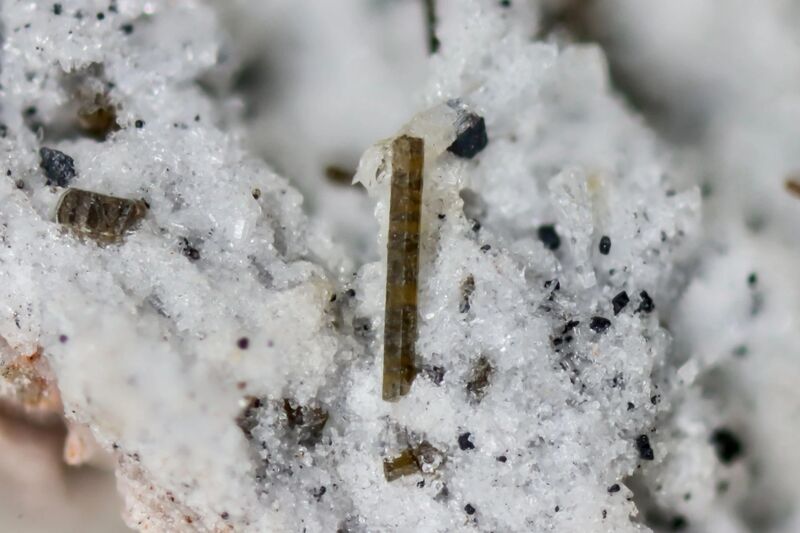 Dingdaohengite-(Ce)(Ce,La)4Fe2+(Ti,Fe2+,Mg,Fe3+)2Ti2Si4O22Mineral—
- Maoniupingite-(Ce)(Ce,Ca)4(Fe3+,Ti,Fe2+,◻)(Ti,Fe3+,Fe2+,Nb)4Si4O22Mineral—
Literature, links & citation
Citations
- 2001Popov, V. A., Pautov, L. A., Sokolova, E., Hawthorne, F. C., McCammon, C., Bazhenova, L. F. (2001) Polyakovite-(Ce), (REE,Ca)4(Mg,Fe2+)(Cr3+,Fe3+)2(Ti,Nb)2Si4O22, a new metamict mineral species from the Ilmen Mountains, southern Urals, Russia: mineral description and crystal chemistry. The Canadian Mineralogist, 39 (4). 1095-1104 doi:10.2113/gscanmin.39.4.1095 DOI: 10.2113/gscanmin.39.4.1095
- 2002Jambor, J.L., Roberts, A.C. (2002) New mineral names. American Mineralogist: 87: 765-768.
- 2021Popov, V.A. (2021): Parageneses of polyakovite-(Ce) in carbonatites and ultramafites of the Ilmen mountains (South Urals, Russia). Zapiski RMO: 150: 88-95.
- 2021(2021) Polyakovite-(Ce). Handbook of Mineralogy. Mineralogical Society of America
Cite this entry
Entry last updated
@misc{mineral2026,
  author    = {Mineral Index editorial board},
  title     = {Polyakovite-(Ce) — Mineral Index},
  year      = {2026},
  url       = {https://mineralindex.org/minerals/polyakovite-ce-10397}
}