History
Run a thumb across the surface of a phyllite — a fine-grained metamorphic rock — and it shines back with a soft, silky sheen. That sheen comes from sericite, and it gave the material its name. The word was coined in 1852 by Karl List, who drew on the Greek seiros — silken. The silk reference points back to where silk itself was first worked, the same root that gives the word "silk" its history.
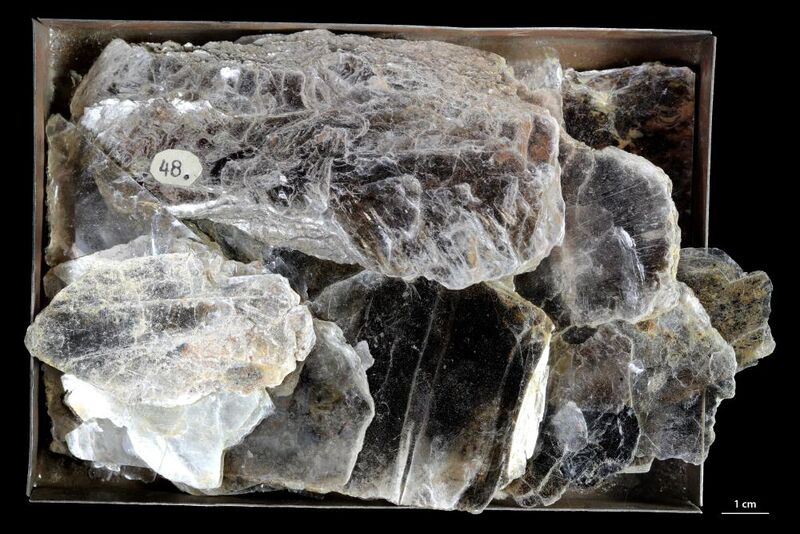
Sericite is a field and microscope term, not a species in its own right. It names very fine, ragged grains and aggregates of white mica — usually muscovite, sometimes the clay mineral illite or the sodium mica paragonite. Because the grains are too small to tell apart by eye, geologists settled on one word for the texture rather than naming the exact mineral each time. The page header shows the muscovite formula because muscovite is the most common ingredient, not because sericite is a distinct mineral.
The other half of the term's story is a process, not a thing. When hot, mineral-rich water moves through rock — what geologists call hydrothermal alteration — it can break down feldspar, the rock-forming mineral that makes up much of granite. The feldspar turns into a felt of tiny white mica flakes. That conversion is called sericitization, and it often surrounds copper and tin ore deposits. The same fine mica also forms when rock is squeezed and reheated deep in the crust, lending its sheen to phyllite and to schist, a coarser banded metamorphic rock.
Industrial & practical applications
The same fine white mica sold under the name sericite is, in commercial terms, a grade of muscovite. Ground into a fine powder of small, flat platelets, it works as a filler — an inexpensive bulk material added to a product — and a surface modifier across several industries.
Cosmetics are the most visible use. Sericite goes into face powders, foundations, eyeshadows, and skincare products. Its flat platelets give a soft, silky skin feel and good adhesion and spreadability. They also scatter light in a way that softens the look of skin, an effect formulators call a soft-focus optical effect that reduces the visibility of imperfections.
In paint and coatings, the platelets line up flat within the dried film. That alignment improves the barrier against moisture and lowers the film's permeability, which helps anti-corrosion primers and barrier coatings protect the metal underneath. The mineral acts here as a functional extender — a filler that adds useful properties rather than just bulk.
Engineering plastics use it for similar reasons. Added to a plastic, sericite improves dimensional stability and reduces warpage in injection-moulded parts. It also serves as a raw material in ceramics such as tiles and insulators, and as an additive in oil and gas drilling mud.
Where it forms, where it's found
Chemical composition
Synonyms
- Episericit
- Episericita
- Episericite
- Lepidomorphit
- Lepidomorphita
- Lepidomorphite
- Sericit
- Sericita
- Serizit
Group, growth & confusion
Literature, links & citation
- 1970Henley, K. J. (1970) Cupriferous sericite from the Sar Cheshmeh porphyry copper ore, Kerman Province, Iran. Mineralogical Magazine, 37 (292) 945-947 doi:10.1180/minmag.1970.037.292.15 DOI: 10.1180/minmag.1970.037.292.15
- 2005Zhang, Ming; Wang, Ling; Hirai, Shigeto; Redfern, Simon A.T.; Salje, Ekhard K.H. (2005) Dehydroxylation and CO2 incorporation in annealed mica (sericite): An infrared spectroscopic study. American Mineralogist, 90 (1). 173-180 doi:10.2138/am.2005.1615DOI: 10.2138/am.2005.1615
Entry last updated
@misc{mineral2026,
  author    = {Mineral Index editorial board},
  title     = {Sericite — Mineral Index},
  year      = {2026},
  url       = {https://mineralindex.org/minerals/sericite-9252}
}