History
Heat a small crystal of stilbite and a thin curl of steam lifts off the stone. That trick — water boiling out of a mineral — gave a whole family its name half a century before stilbite was named in its own right.
In 1756 the Swedish mineralogist Axel Fredrik Cronstedt was studying a pearly, sheaf-like crystal — most likely stilbite itself. Heated, it released a surprising amount of water. He coined the term zeolite from the Greek for to boil and stone, a stone that boils. Cronstedt's name was loose at first: it covered a handful of similar minerals that all behaved the same way under a flame. Through the second half of the 18th century, mineralogists kept renaming what we now call stilbite. Cronstedt himself called it crystalii ad centrum tendentes in 1758 — crystals tending toward a centre. Johan Gottschalk Wallerius called it zeolite selenitica lamellaris in 1772 — "lamellar selenite-like zeolite". Abraham Gottlob Werner gave it the German strehliger zeolith, "ray-like zeolite", in 1780.
The modern name arrived in 1797. The French naturalist Jean-Claude de la Métherie picked the Greek stilbein — to glitter or shine — and built stilbite around the mineral's pearly lustre on its cleavage faces. He also used the parallel French form zéolite nacrée, "pearly zeolite", in the same breath. A few years later, in 1801, René Just Haüy used the term stilbite anamorphique for a different mineral — what we now call heulandite. The two species stayed tangled in the literature for some time after that.
Two more names enter the picture in the 19th century. In 1818 the German mineralogist Johann Friedrich August Breithaupt proposed desmine — Greek for "a bundle" — for the mineral's sheaf-like aggregates. The name is still in everyday use in German-speaking countries. In 1832 François Sulpice Beudant introduced sphaerostilbite for a globular variety. Older literature also carries blättricher zeolit, hypostilbite, puflerite, radiated zeolite and syhedrite as synonyms or varietal names.
The mineral kept the name stilbite through the 19th and 20th centuries. The current form Stilbite-Ca dates only from 1997. That year the International Mineralogical Association adopted a new zeolite nomenclature. It split what had been called "stilbite" into a series of two species, distinguished by their dominant exchangeable cation. Stilbite-Ca, the calcium-dominant end-member, is by far the more common; Stilbite-Na, the sodium-dominant one, is rare. The two are visually indistinguishable, and the bare name stilbite is still used in the field whenever no chemical test has been run. The type locality for Stilbite-Ca is the Helgusta Iceland Spar mine in Reydarfjordur, on the east coast of Iceland.
Industrial & practical applications
Stilbite-Ca is famous more for what it looks like than for what it does. Its sheaf-shaped, pearly-pink crystals are among the most photographed of all the zeolite-group minerals — minerals built around an open framework of silicon, aluminium and oxygen, with water loosely trapped inside. Most modern demand comes from collectors and museums. The Tertiary Deccan Trap basalts of western India are the world's most prolific source of the species.
The mineral has only a thin direct industrial role. Its open channels can in principle act as a molecular sieve, separating hydrocarbon molecules by size — a property exploited in petroleum refining. In practice, almost all such sieving work is done with synthetic zeolites grown in factories to a controlled pore size, not with mined stilbite. Among natural zeolites, the commercially important species are mordenite, clinoptilolite and analcime. They turn up in detergents, agricultural soil amendments, ion-exchange beds for water softening, and as catalysts in fluid catalytic cracking. Stilbite-Ca does not sit on that short list. It is mined in no notable quantity for industrial use.
Field geologists do put it to work as a tracer. Stilbite-Ca is a classic low-temperature alteration product in the gas cavities — amygdales, almond-shaped holes left by trapped vapour — of weathered basaltic lava flows. Its presence, alongside other zeolites in the same cavities, helps petrologists read the burial-and-heating history of a basalt province. The mineral records temperature. Each zeolite has its own narrow stability window, and the assemblage that survives tells petrologists how hot the rock got.
The remaining demand is decorative and educational. Salmon-pink Indian crystals, on green apophyllite matrix, end up in museum cabinets and high-end specimen collections. Icelandic and Faroese specimens are sought for their type-locality status. Nova Scotia material circulates among Canadian collectors — stilbite is the provincial mineral of Nova Scotia. Demand here is steady rather than industrial-scale, limited mostly by what can be extracted from accessible basalt outcrops.
Where it forms, where it's found
- Geological setting
A low temperature hydrothermal mineral, in amygdules and cavities in basalt.
Physical
- Hardness
- 1Talc
- 2Gypsum
- 3Calcite
- 4Fluorite
- 5Apatite
- 6Orthoclase
- 7Quartz
- 8Topaz
- 9Corundum
- 10Diamond
- Lustre
- Vitreous · Pearly
- Transparency
- Transparent · Translucent
- Colour
- White · colourless · red · light yellow · light to dark brown · cream · orange · pink
- Streak
- White
- Cleavage
- Perfect
on (010)
- Fracture
- Irregular/Uneven
- Density
- 2.19 g/cm³
Optical
- Optical type
- Biaxial (-) · 2V measured = 30 – 49° · 2V calc = 76 – 78°
- Refractive index
- 1.484 – 1.513
- Principal indices
- nα 1.484 – 1.5 · nβ 1.492 – 1.507 · nγ 1.494 – 1.513
- Dispersion
- r < v
- UV response
- May fluoresce pale-yellow or blue-white in shortwave UV.
Crystallography
- Space group
- C2/m
- Cell parameters
- a = 13.63 Å · b = 18.17 Å · c = 11.31 Å
- Cell angles
- β = 129.166 °
- Ratio a:b:c
- 1 : 1.333 : 0.830
- Z
- 4
- Morphology
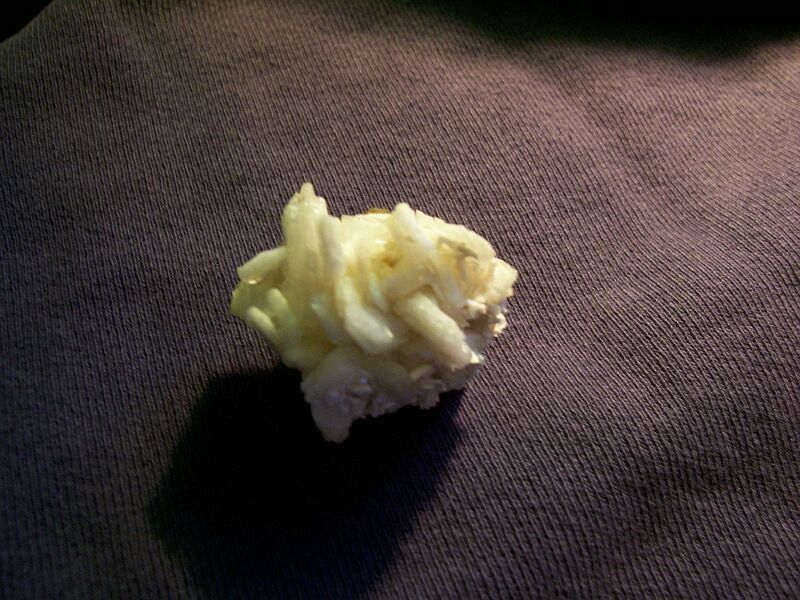
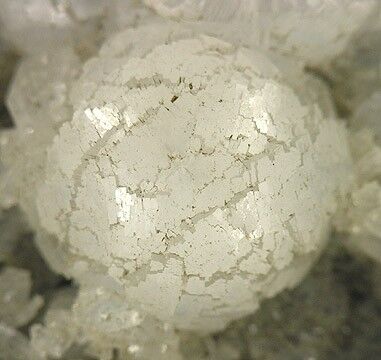
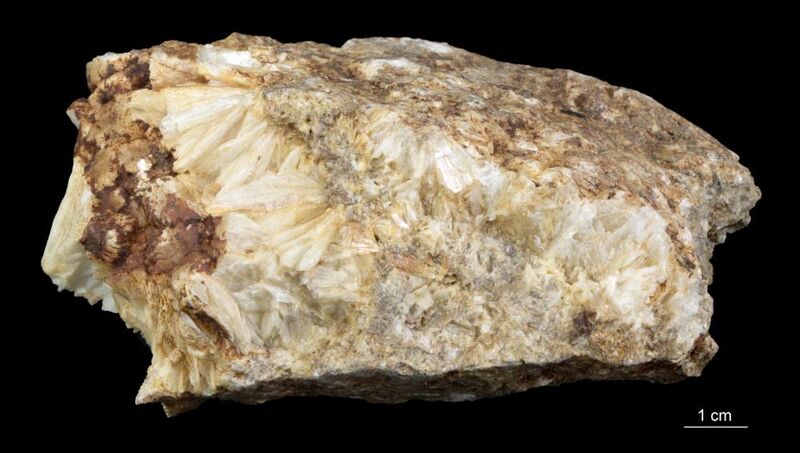
Typically thin tabular, sheaflike or globular clusters.
- Twinning
Ubiquitous on (001), cruciform and penetration.
- Comment
Pseudo-orthorhombic F-centred (compare orthorhombic stellerite).
Chemical composition
Synonyms
- Stilbiet-Ca
In other languages
- German
- Stilbit-Ca
- Italian
- stilbite-Ca
Classification
9.GE.10
- 9SilicatesClass
- 9.GTektosilicates with zeolitic H2O; zeolite familyDivision
- 9.GEChains of T10O20 TetrahedraGroup
- 9.GE.10Stilbite-CaSpecies
77.01.04.03
- 77Tectosilicates ZeolitesClass
- 77.01Zeolite group - True zeolitesType
- 77.01.04Heulandite and related speciesGroup
- 77.01.04.03Stilbite-CaSpecies
Group, growth & confusion
Literature, links & citation
- 1970Slaughter, Maynard (1970) Crystal structure of stilbite. American Mineralogist, 55 (3-4) 387-397
- 1971Galli, E. (1971) Refinement of the crystal structure of stilbite. Acta Crystallographica Section B Structural Crystallography and Crystal Chemistry, 27 (4) 833-841 doi:10.1107/s056774087100298xDOI: 10.1107/s056774087100298x
- 1978Passaglia, Elio, Galli, Ermanno, Leoni, Leonardo, Rossi, Giuseppe (1978) The crystal chemistry of stilbites and stellerites. Bulletin de Minéralogie, 101 (3) 368-375 doi:10.3406/bulmi.1978.7200DOI: 10.3406/bulmi.1978.7200
- 1985Akizuki, Mizuhiko, Konno, Hiroshi (1985) Order-disorder structure and the internal texture of stilbite. American Mineralogist, 70 (7-8) 814-821
- 1992Tschernich, Rudy W. (1992) Zeolites of the World. Geoscience Press, Inc. 567pp.
Entry last updated
@misc{mineral2026,
  author    = {Mineral Index editorial board},
  title     = {Stilbite-Ca — Mineral Index},
  year      = {2026},
  url       = {https://mineralindex.org/minerals/stilbite-ca-7313}
}