Where it forms, where it's found
- Geological setting
As replacements of chkalovite in hydrothermal veins cutting sodalite syenite and syenite.
- Type locality
- Tugtup Agtakôrfia
- Tunulliarfik Fjord
- Ilímaussaq complex
- Kujalleq
- Greenland
60.9303°, -45.9239°
13recorded occurrences
Safety & handling
Physical
- Hardness
- 1Talc
- 2Gypsum
- 3Calcite
- 4Fluorite
- 5Apatite
- 6Orthoclase
- 7Quartz
- 8Topaz
- 9Corundum
- 10Diamond
- Transparency
- Translucent
- Colour
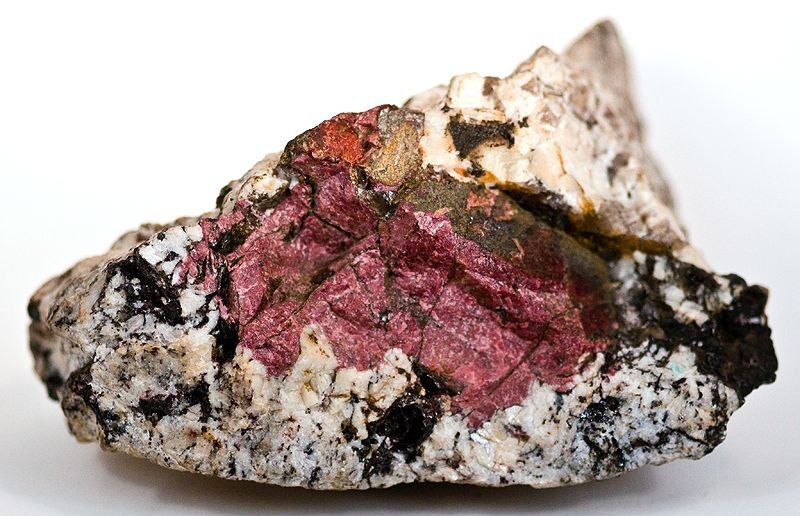
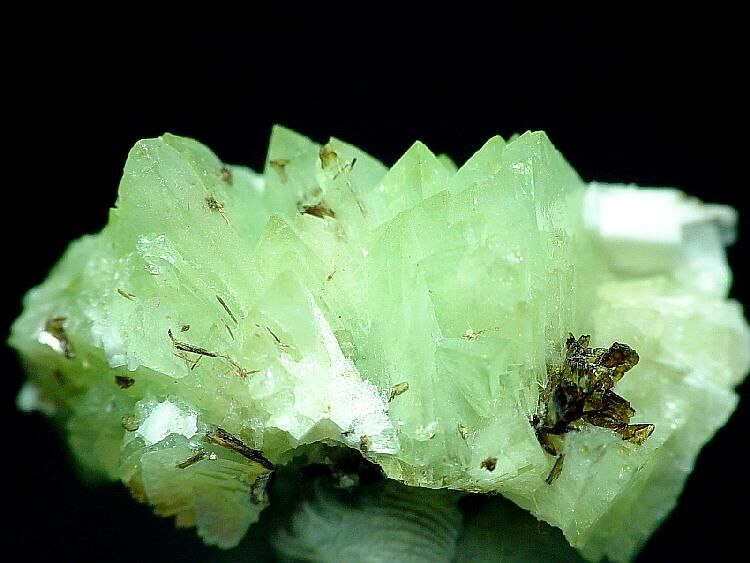
- Commonly red · also white to pink · bluish white · greenish white
colorless in transmitted light
- Streak
- white
- Tenacity
- brittle
- Cleavage
- Distinct/Good
On (101); on (110) fair.
Usually shows cleavage because of the great number of planes associated with the cleavage forms.
- Fracture
- Step-Like
- Density
- 2.33 g/cm³
Optical
- Optical type
- Uniaxial (+) · 2V measured = 10°
- Refractive index
- 1.496 – 1.502
- Principal indices
- nω 1.496 · nε 1.502
- Birefringence
- 0.006
- Pleochroism
- Weak
Weak lilac to weak red-orange.
- Dispersion
- Anomalously biaxial
- UV response
- Bright magenta-red to pink (SW UV). A stone was initially pink, and turned red immediately upon exposure to long-wave UV radiation. After the UV lamp was turned off, the stone returned to pink after several minutes. This chromatic change was repeatable. Specifically, it becomes dark red when exposed to UV radiation (or is irradiated by X-rays), and the colour fades to a paler red, pink or white when kept in the dark or exposed to bright light for a few minutes. This colour behaviour is probably due to an electron trapped in a Cl vacancy and associated sulphur polyanions.
Δ = 0Δmax
PPLpleochroism per grain
XPLindependent extinctions · rotate the stage
PPLpleochroism only · colour blends on rotation
XPLinterference colour · extinct every 90°
Retardation60 nm
Order1st order
XPL colour
Crystallography
- Space group
- #127
- Cell parameters
- a = 8.640(1) Å · c = 8.873(1) Å
- Unit cell volume
- 662.4 ų
- Z
- 2
- Morphology
Short tetragonal prisms with pyramids, sphenoids, and bisphenoids. Fine-grained aggregates; massive.
- Twinning
On (101), penetration twinning resulting in pseudocubic triplets; pseudotrigonal contact twins with composition planes (10_1) and (01_1).
- Comment
Pseudo-cubic. Cell parameters from Hassan and Grundy (1991).
Crystal structure
Chemical composition
- Impurities
- Fe
- Ga
- Mg
- Ca
- K
- H2O
- S
In other languages
- French
- Tugtupite
- German
- Tugtupit
- Spanish
- Tugtupita
- Italian
- Tugtupite
- Portuguese
- tugtupita · tugtupite
- Japanese
- ツグツパイト
- Chinese
- 鈹方鈉石
- Russian
- Олений камень · Тугтупит
- Arabic
- التوجتوبايت · توغتوبايت · توغتوبيت
Classification
Strunz
10th ed.9.FB.10
- 9SilicatesClass
- 9.FTektosilicates without zeolitic H2ODivision
- 9.FBTektosilicates with additional anionsGroup
- 9.FB.10TugtupiteSpecies
Dana
8th ed.76.02.03.07
- 76Tectosilicates Al-si FrameworkClass
- 76.02Al-Si Framework Feldspathoids and related speciesType
- 76.02.03Sodalite groupGroup
- 76.02.03.07TugtupiteSpecies
CIM
—17.3.5
- 17Silicates Containing other AnionsClass
- 17.3Silicates with chloride (including aluminosilicates)Group
- 17.3.5TugtupiteSpecies
Group, growth & confusion
Literature, links & citation
Citations
- 1960Semenov, E.I., Bykova, A.V. (1960) Beryllosodalite. Doklady Akademii Nauk SSSR., Earth Sciences Section, 133, 812-814.
- 1960Sørensen, Henning (1960) Beryllium minerals in a pegmatite in the nepheline syenites of Ilìmaussaq, south west Greenland. In International Geological Congress XXI Session Norden 1960. International Geological Congress. p.31-35.
- 1961Fleischer, M. (1961) New mineral names. American Mineralogist, 46 (1-2). 241-244
- 1962Sørenson, H. (1962) On the occurrence of steenstrupine in the Ilimaussaq massif, south-west Greenland. Medd. om Grønland, 167(1), 1-251 (218-219).
- 1963Fleischer, M. (1963) New mineral Names. American Mineralogist, 48 (9-10) 1178-1184
Cite this entry
Entry last updated
@misc{mineral2025,
  author    = {Mineral Index editorial board},
  title     = {Tugtupite — Mineral Index},
  year      = {2025},
  url       = {https://mineralindex.org/minerals/tugtupite-4044}
}