Where it forms, where it's found
- Geological setting
Hydrothermal vein within urtite
- Type locality
- Kirovskii apatite mine
- Kukisvumchorr Mt
- Murmansk Oblast
- Russia
67.6667°, 33.7167°
1recorded occurrences
Radioactivity
Physical
- Hardness
- 1Talc
- 2Gypsum
- 3Calcite
- 4Fluorite
- 5Apatite
- 6Orthoclase
- 7Quartz
- 8Topaz
- 9Corundum
- 10Diamond
- Transparency
- Transparent · Translucent
- Colour
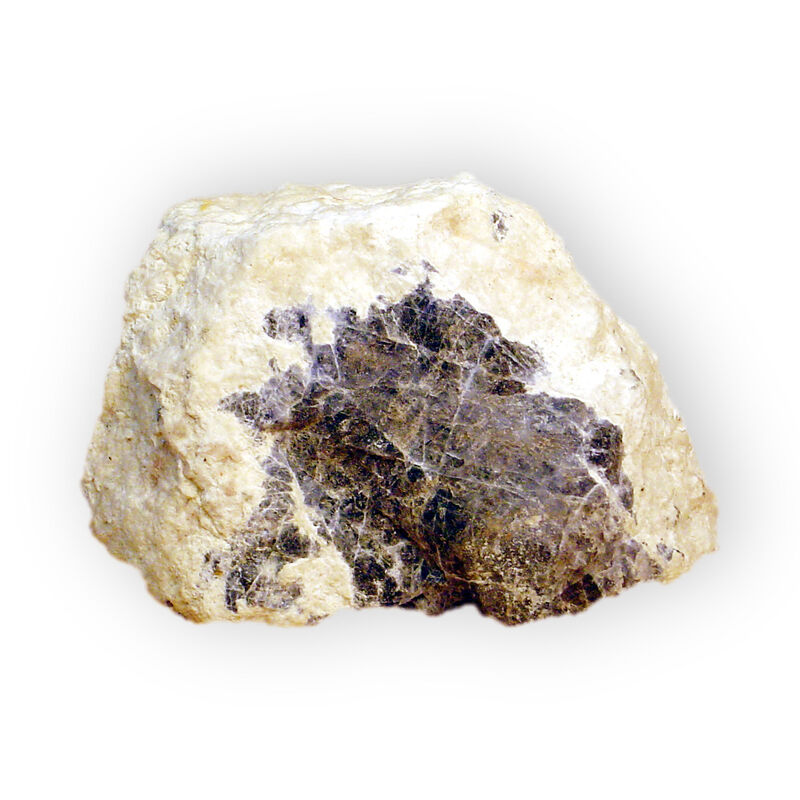
- Colourless · white
May contain finely dispered inclusions of iron-bearing sulphides or solid organics which makes the color dark-grey to black.
- Streak
- White
- Tenacity
- brittle
- Cleavage
- None Observed
- Fracture
- Conchoidal
- Density
- 3.15 g/cm³
Optical
- Optical type
- Uniaxial (+)
- Refractive index
- 1.574 – 1.587
- Surface relief
- Moderate
- Principal indices
- nω 1.574 · nε 1.587
Δ = 0Δmax
PPLpleochroism per grain
XPLindependent extinctions · rotate the stage
PPLpleochroism only · colour blends on rotation
XPLinterference colour · extinct every 90°
Retardation130 nm
Order1st order
XPL colour
Crystallography
- Space group
- #80
- Cell parameters
- a = 14.175(7) Å · c = 8.605(4) Å
- Z
- 3
- Morphology
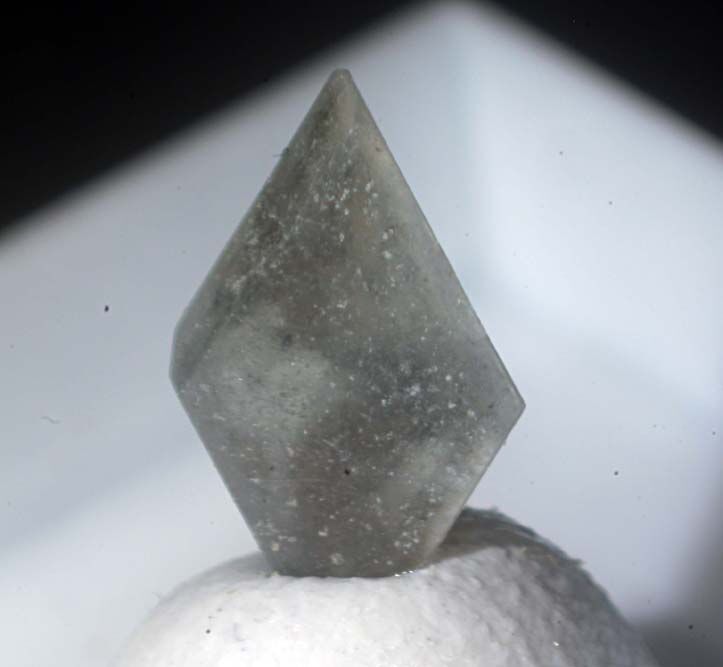
Small prismatic crystals dominated by hexagonal prism (110), rhombohedral (101) and pinacoidal (0001) faces.
- Type-locality form
prismatic to rhombohedral crystals, to 4 mm.
Crystal structure
Chemical composition
- Impurities
- ORG
Synonyms
- IMA1988-041
- Tuliokiet
In other languages
- German
- IMA 1988-041 · Tuliokit
- Italian
- Tuliokite
Classification
Strunz
10th ed.5.CB.50
- 5CarbonatesClass
- 5.CCarbonates without additional anions, with H2ODivision
- 5.CBWith large cations (alkali and alkali-earth carbonates)Group
- 5.CB.50TuliokiteSpecies
Dana
8th ed.15.04.06.01
- 15Hydrated Normal CarbonatesClass
- 15.04AmBn(XO3)p·xH2O, with (m+n):p < 1:1Type
- 15.04.06— unnamed intermediate level —Group
- 15.04.06.01TuliokiteSpecies
CIM
—11.9.6
- 11CarbonatesClass
- 11.9Carbonates of Pb, Zr and ThGroup
- 11.9.6TuliokiteSpecies
Group, growth & confusion
Literature, links & citation
Citations
- 1990Yakovenchuk, V.N., Pakhomovskiy, Y.A., Voloshin, A.V., Bogdanova, A.N., Yamnova, N.A., Pushcharovskiy, D.Y. (1990) Tuliokite Na6BaTh(CO3)6·H2O - a new hydrous carbonate of sodium, barium, and thorium, from alkalic pegmatites of the Khibiny massif (Kola Peninsula). Mineralogiceskij Zhurnal: 12: 74-78.
- 1990Yamnova, N.A., Pushcharovskii, D.Y., Voloshin, A.V. (1990) Crystal structure of the tuliokite a new natural Na, Ba, Th carbonate. Doklady Akademii Nauk SSSR: 310: 99-102.
- 1991Jambor, John L., Puziewicz, Jacek (1991) New Mineral Names. American Mineralogist, 76 (3-4) 665-671
- 1992Jambor, L., 207, Edward S. Grew (1992) New Mineral Names. American Mineralogist, 77 (1-2) 207-213
- 1997Mandarino, Joseph A. (1997) New Minerals 1990-1994. The Mineralogical Record Inc., Tuscon, Arizona. 220pp.
Cite this entry
Entry last updated
@misc{mineral2025,
  author    = {Mineral Index editorial board},
  title     = {Tuliokite — Mineral Index},
  year      = {2025},
  url       = {https://mineralindex.org/minerals/tuliokite-4047}
}