Where it forms, where it's found
- Geological setting
Albitized Upper Carboniferous sandy shales in the contact aureole of the Jelisu massif (a massif consisting largely of albitized nepheline syenites). Also found in a boulder of microcline, pectolite, quartz, aegirine, and calcite near the alkaline to subalkaline intrusions of the Dara-i-Pioz massif.
- Type locality
- Dara-i-Pioz Massif
- Districts of Republican Subordination
- Tajikistan
39.4504°, 70.7163°
11recorded occurrences
Radioactivity
Physical
Optical
- Optical type
- Uniaxial (-)
- Refractive index
- 1.606 – 1.611
- Surface relief
- Moderate
- Principal indices
- nω 1.611 · nε 1.606
Δ = 0Δmax
PPLpleochroism per grain
XPLindependent extinctions · rotate the stage
PPLpleochroism only · colour blends on rotation
XPLinterference colour · extinct every 90°
Retardation50 nm
Order1st order
XPL colour
Crystallography
- Space group
- #180
- Cell parameters
- a = 7.592 Å · c = 14.824 Å
- Z
- 2
- Morphology
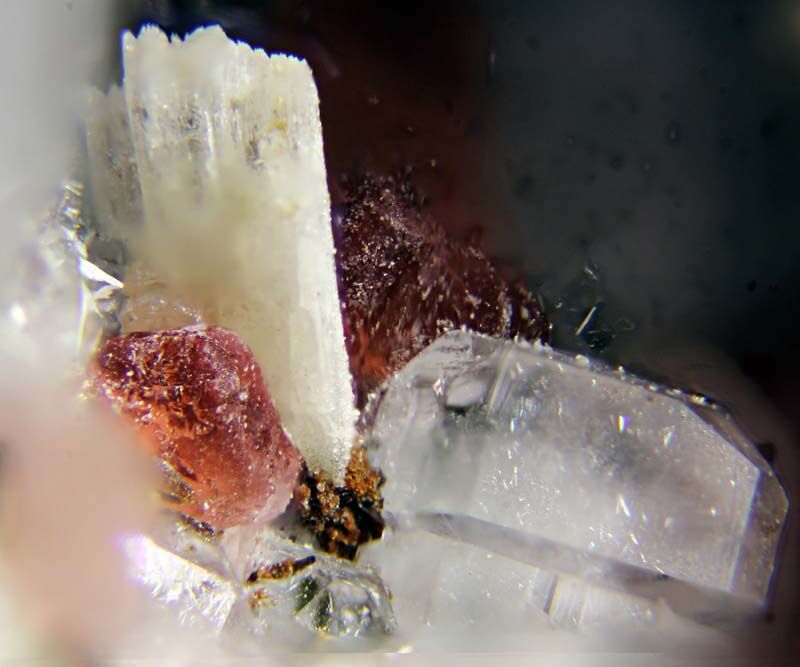
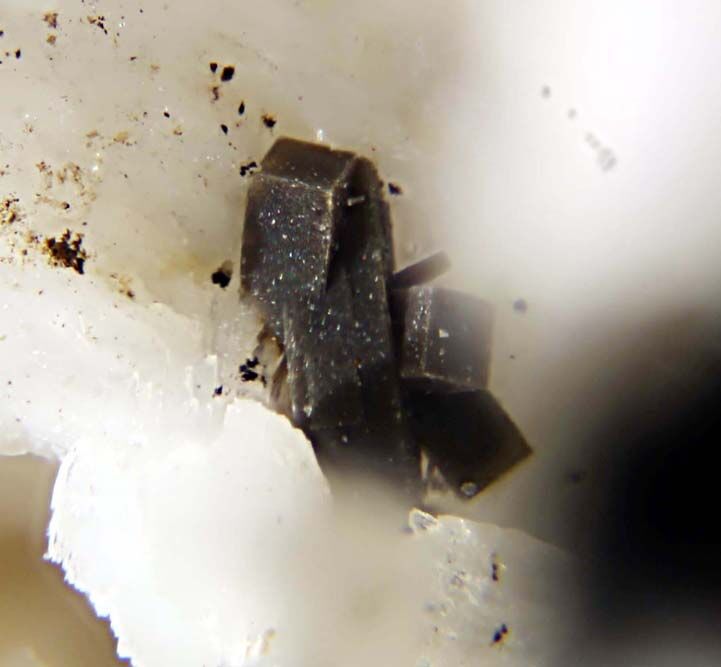
Prisms. Forms observed include (100), (001), and rarely (101).
- Type-locality form
At Dara-i-Pioz, occurs as prisms, 0.5 to 5 mm across, showing (100), (001), and rarely (101). At the Jelisu massif, the mineral forms deformed (100) prisms, 2 to 50 mm across, rarely with (101) pyramids.
Crystal structure
Synonyms
- IMA1996-036
- Turkestaniet
In other languages
- German
- IMA 1996-036 · Turkestanit
- Italian
- Turkestanite
Classification
Strunz
10th ed.9.CH.10
- 9SilicatesClass
- 9.CCyclosilicatesDivision
- 9.CH[Si4O12]8- 4-membered double ringsGroup
- 9.CH.10TurkestaniteSpecies
Group, growth & confusion
Literature, links & citation
Citations
- 1997Pautov, L. A., Agakhanov, A. A., Sokolova, E. V., Kabalov, Y. K. (1997) Turkestanite Th(Ca,Na)2(K1-x◻x)Si8O20·nH2O – a new mineral. Zapiski Vserossijskogo Mineralogicheskogo Obshchestva, 126 (6) 45-55
- 1998Jambor, John L., Grew, Edward S., Roberts, Andrew C. (1998) New mineral names. American Mineralogist, 83 (11) 1347-1352
- 1998Kabalov, Y.K., Sokolova, E.V., Pautov, L.A., Schneider, J. (1998) Crystal structure of a new mineral turkestanite: a calcium analogue of steacyite. Crystallography Reports: 43: 584-588.
- 1998Kabalov, Y.K., Sokolova, E.V., Pautov, L.A., Schneider, J. (1998) Crystal structure of a new mineral turkestanite: A calcium analogue of steacyite. Crystallography Reports: 43: 632-636.
- 1999Petersen, O. V., Johnsen, O., Micheelsen, H. I. (1999) Turkestanite from the Ilimaussaq alkaline complex, south Greenland. Neues Jahrbuch für Mineralogie - Monatshefte, 1999 (9) 424-432
Cite this entry
Entry last updated
@misc{mineral2025,
  author    = {Mineral Index editorial board},
  title     = {Turkestanite — Mineral Index},
  year      = {2025},
  url       = {https://mineralindex.org/minerals/turkestanite-7345}
}