Where it forms, where it's found
- Type locality
- Nishinomaki mine
- Shimonita
- Kanra District
- Gunma Prefecture
- Japan
36.2448°, 138.6863°
16recorded occurrences
Safety & handling
Physical
Optical
- Pleochroism
- Strong
- Anisotropism
- Weak
- Internal reflections
- Golden yellow
- Tropism
- Anisotropic
- Reflectance R%
- (28.4) 400, (27.2) 440, (24.5) 480, (22.5) 520, (21.8) 560, (21.6) 600, (21.4) 640, (21.2) 680, (21.2) 700
Reflected-light panel
R̄ 23.3 %isotropic · single curve
Specimen
White reference
Crystallography
- Space group
- #35
- Cell parameters
- a = 25.262 Å · b = 14.563 Å · c = 6.492 Å
- Ratio a:b:c
- 1 : 0.576 : 0.257
- Unit cell volume
- 2388.4 ų
- Z
- 4
- Twinning
Reticular merohedry
- Type-locality form
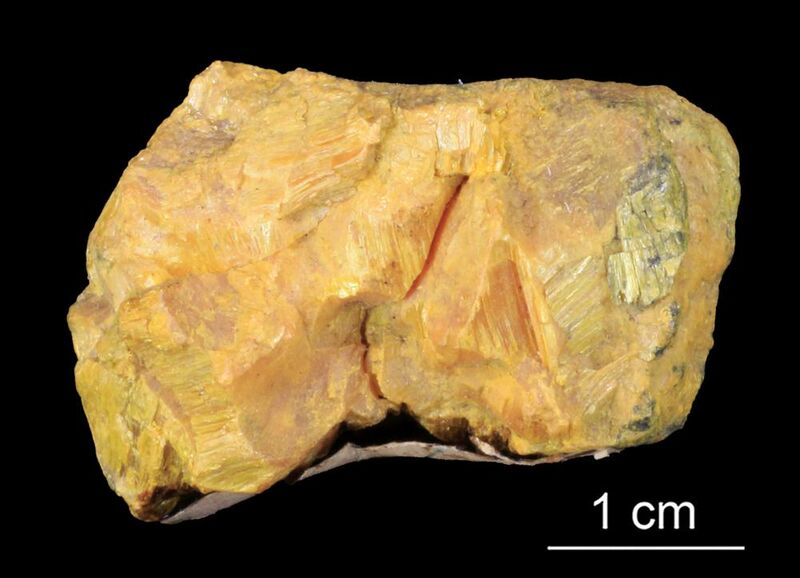
Felt-like aggregates of fibers.
Crystal structure
Chemical composition
Synonyms
- IMA1969-024
- Wakabayashiliet
In other languages
- French
- wakabayashilite
- German
- IMA 1969-024 · Wakabayashilith
- Spanish
- wakabayashilita
- Italian
- wakabayashilite
- Japanese
- 若林鉱
- Chinese
- 锑雌黄
Classification
Strunz
10th ed.2.FA.40
- 2Sulfides and SulfosaltsClass
- 2.FSulfides of arsenic, alkalies; sulfides with halide, oxide, hydroxide, H2ODivision
- 2.FAWith As, (Sb), SGroup
- 2.FA.40WakabayashiliteSpecies
Dana
8th ed.02.11.04.01
- 02SulfidesClass
- 02.11AmBnXp, with (m+n):p = 2:3Type
- 02.11.04— unnamed intermediate level —Group
- 02.11.04.01WakabayashiliteSpecies
CIM
—3.7.12
- 3Sulphides, Selenides, Tellurides, Arsenides and Bismuthides (except the arsenides, antimonides and bismuthides of Cu, Ag and Au, which are included in Section 1)Class
- 3.7Sulphides etc. of V, As, Sb and BiGroup
- 3.7.12WakabayashiliteSpecies
Group, growth & confusion
Literature, links & citation
Citations
- 1970Kato, A., Sakurai, K., Ohsumi, K. (1970) Wakabayashilite (As,Sb)11S18. in Introduction to Japanese Minerals, Geological Survey of Japan: 39: 92-93.
- 1972Fleischer, Michael (1972) New Mineral Names. American Mineralogist, 57 (7-8) 1311-1317
- 1975Scott, J.D., Nowacki, W. (1975) New data on wakabayashilite. The Canadian Mineralogist: 13: 418-419.
- 2005(2005) Wakabayashilite. Handbook of Mineralogy. Mineralogical Society of America
- 2005Bonazzi, P. (2005) Wakabayashilite, [(As,Sb)6S9][As4S5]: Crystal structure, pseudosymmetry, twinning, and revised chemical formula. American Mineralogist, 90 (7) 1108-1114 doi:10.2138/am.2005.1809 DOI: 10.2138/am.2005.1809
Cite this entry
Entry last updated
@misc{mineral2025,
  author    = {Mineral Index editorial board},
  title     = {Wakabayashilite — Mineral Index},
  year      = {2025},
  url       = {https://mineralindex.org/minerals/wakabayashilite-4232}
}