History
The name realgar travels a long way for so red a mineral. It comes from the Arabic rahj al-ġār — powder of the mine — and reached English through Medieval Latin, with its earliest English record in the 1390s.
Long before the name arrived, the substance itself was already in use. Ancient Greek apothecaries compounded a poison from realgar called bull's blood. The physician Nicander described a death by bull's blood whose symptoms match arsenic poisoning. The same preparation is the poison said to have ended the lives of Themistocles and Midas.
The mineral travelled as a pigment too. Painters in China, India, Central Asia, and Egypt picked it up early as a red pigment. In the Roman Empire it was traded alongside orpiment, the related yellow arsenic sulfide that often shares its veins. Both minerals were used as paint pigments.
In Chinese tradition realgar is xiónghuáng, the "masculine yellow", set against orpiment, the "feminine yellow". Chinese carvers also worked the mineral into small ornamental pieces, a use recorded in older mineralogical literature.
By the beginning of the thirteenth century realgar was known as a mineral pigment in Byzantium — essentially Asia Minor and the Balkan Peninsula. It presumably had a name there by that time. An old realgar locality on the Balkan Peninsula sits at Allchar, in the Republic of Macedonia.
In medieval Europe the picture darkens. Realgar was used to poison rats in medieval Spain. It also entered leather processing, where the arsenic stripped the hair from hides.
Then Venice. From about 1490, Venetian painters took up realgar as a luminous orange in oil paint. It became a hallmark of the city's Renaissance palette, supplied through the vendecolori, the specialist colour-merchants of the lagoon. England in the sixteenth century also used the mineral as a rat poison. Elsewhere in Europe the same uses were rare, and the European pigment trade in realgar died out by the eighteenth century.
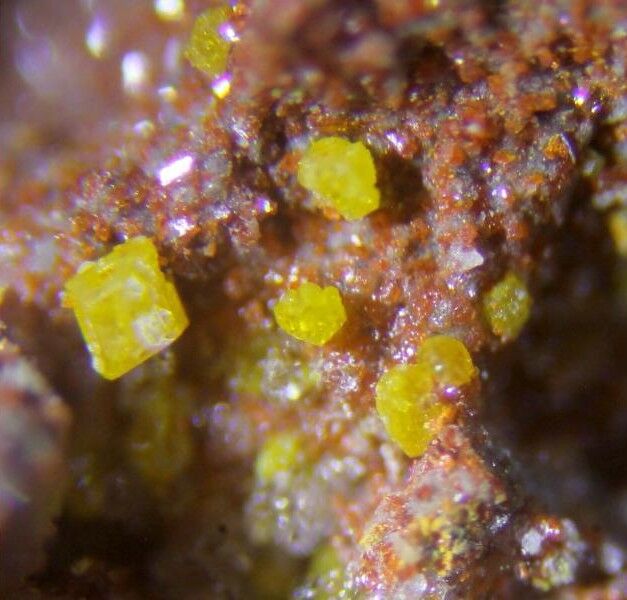
Realgar carries one peculiar habit that any history has to address: prolonged exposure to light turns it into a yellow powder called pararealgar (β-As₄S₄). For a long time this powder was taken to be orpiment, the yellow sulfide; later analysis showed it to be a distinct chemical compound. Chinese realgar carvings in museum collections deteriorate under light for the same reason.
Industrial & practical applications
Realgar's place in industry today is narrow, shadowed throughout by the toxicity of arsenic. The mineral is a minor ore of arsenic, extracted in China, Peru, and the Philippines. Recovery of the metal is the main current use to which realgar is put.
In pyrotechnics the mineral is now a marginal ingredient. Where it does appear, realgar contributes to white flame and star compositions, and to the yellow smoke of daytime fireworks. Toxicity and the cost of the mineral keep it out of most modern formulations, where safer chemicals fill the same roles.
The pigment trade has effectively closed. Prolonged exposure to light turns realgar into a yellow powder called pararealgar, a conversion that disintegrates the original orange-red colour. Museums and conservators treat surviving realgar paint and Chinese carvings as light-sensitive objects, displayed under low illumination.
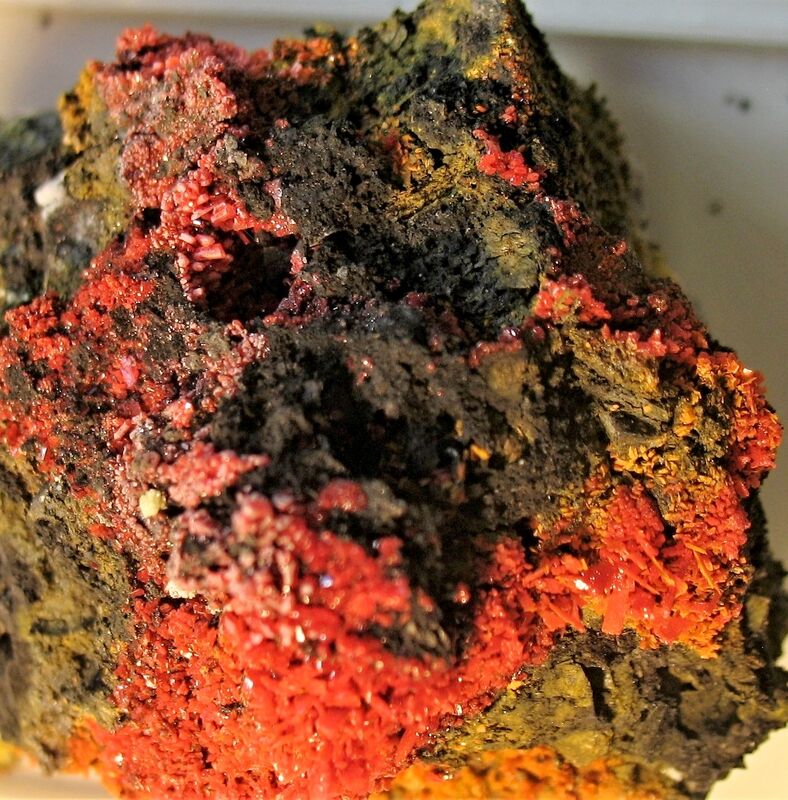
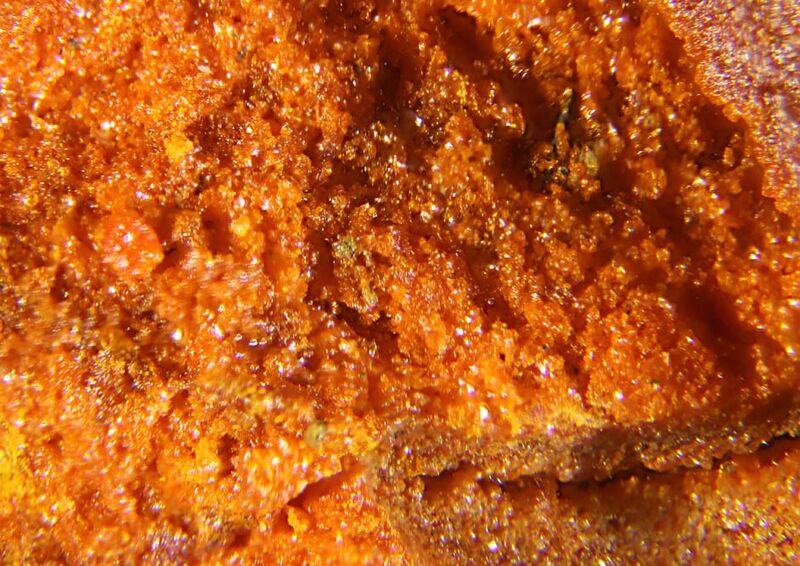
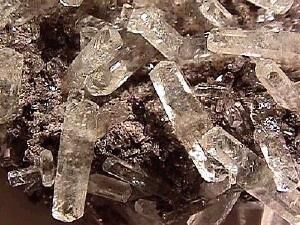
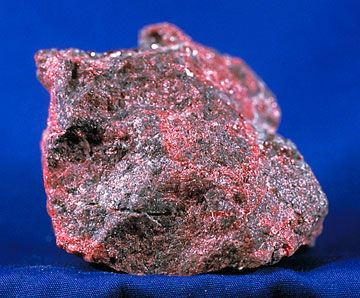
Beyond ore extraction, the remaining uses are narrow. Well-formed orange-red crystals are sought by collectors and museums as representatives of the species. Some traditional Chinese preparations also continue to use the powdered mineral in ritualistic cosmetics and folk-medicine contexts, despite the known toxicity of arsenic.
Where it forms, where it's found
Safety & handling
Physical
Optical
- Optical type
- Biaxial (-) · 2V measured = 40° · 2V calc = 38°
- Refractive index
- 2.538 – 2.704
- Surface relief
- Very high
- Principal indices
- nα 2.538 · nβ 2.684 · nγ 2.704
- Pleochroism
- Visible
Nearly colourless to pale golden yellow.
- Dispersion
- Relatively strong.
- Optical colour
- Gray white.
- Anisotropism
- Strong.
- Internal reflections
- Yellow to red.
- Tropism
- Anisotropic
- Reflectance R%
- (29.9) 400, (28.6) 420, (27.4) 440, (26.3) 460, (25.2) 480, (24.2) 500, (23.3) 520, (22.4) 540, (21.7) 560, (21.1) 580, (20.6) 600, (20.3) 620, (20.0) 640, (19.7) 660, (19.5) 680, (19.3) 700
- Luminescence
- None
Crystallography
- Cell parameters
- a = 9.325(3) Å · b = 13.571(5) Å · c = 6.587(3) Å
- Cell angles
- β = 106.43 °
- Ratio a:b:c
- 1 : 1.455 : 0.706
- Z
- 16
- Morphology
Prismatic
- Twinning
Contact twins on (100)
- Comment
Space Group: P21/n.
Chemical composition
Synonyms
- Arsenic Rouge
- Eolit
- Eolita
- Eolite
- Realgarit
- Realgarita
- Realgarite
- Red Arsenic
- Red Orpiment
- Risigallo
- Risigallum
- Ruby Sulfur
- Ruby Sulphur
- Sandaracha
- Σανδαράκη
In other languages
- French
- As4S4 · réalgar · réalgarite
- German
- Arsenrot · Opperment · Rauschrot · Realgar · Rubinschwefel
- Spanish
- rejalgar
- Italian
- Rahjalgar · realgar · Realgar d'orpimento · Risalgallo · Risigale · Risigallo · Sandaraca
- Portuguese
- realgar · Rosalgar
- Japanese
- リアルガー · 鶏冠石
- Chinese
- 石黃 · 石黄 · 雄黄 · 雞冠石 · 鸡冠石 · 黃金石 · 黄金石
- Simplified Chinese
- 雄黄
- Traditional Chinese
- 雄黃
- Russian
- реальгар
- Arabic
- الزرنيخ الأحمر · رهج الغار · ريالغار · 🜻
Classification
2.FA.15a
- 2Sulfides and SulfosaltsClass
- 2.FSulfides of arsenic, alkalies; sulfides with halide, oxide, hydroxide, H2ODivision
- 2.FAWith As, (Sb), SGroup
- 2.FA.15aRealgarSpecies
02.08.21.01
- 02SulfidesClass
- 02.08AmXp, with m:p = 1:1Type
- 02.08.21— unnamed intermediate level —Group
- 02.08.21.01RealgarSpecies
3.7.4
- 3Sulphides, Selenides, Tellurides, Arsenides and Bismuthides (except the arsenides, antimonides and bismuthides of Cu, Ag and Au, which are included in Section 1)Class
- 3.7Sulphides etc. of V, As, Sb and BiGroup
- 3.7.4RealgarSpecies
Group, growth & confusion
Literature, links & citation
- 1747Wallerius, J.G. (1747) in Mineralogia, eller Mineralriket, (Stockholm).
- 1925Weigl, O. (1925) XVIII. Der photochemische Zerfall des Realgars. Zeitschrift für Kristallographie: 38: 288-308.
- 1935Buerger, M. J. (1935) The unit cell and space group of realgar. American Mineralogist, 20 (1) 36-43
- 1944Palache, Charles, Berman, Harry, Frondel, Clifford (1944) The System of Mineralogy (7th ed.) Vol. 1 - Elements, Sulfides, Sulfosalts, Oxides. John Wiley and Sons, New York.
- 1952Ito, T., Morimoto, N., Sadanaga, R. (1952) The crystal structure of realgar. Acta Crystallographica, 5 (6) 775-782 doi:10.1107/s0365110x52002112DOI: 10.1107/s0365110x52002112
Entry last updated
@misc{mineral2026,
  author    = {Mineral Index editorial board},
  title     = {Realgar — Mineral Index},
  year      = {2026},
  url       = {https://mineralindex.org/minerals/realgar-3375}
}