Where it forms, where it's found
- Geological setting
Pegmatite
- Type locality
- Hagendorf South Pegmatite
- Hagendorf
- Waidhaus
- Neustadt an der Waldnaab District
- Upper Palatinate
- Bavaria
- Germany
49.6503°, 12.4597°
2recorded occurrences
Physical
Optical
- Optical type
- Biaxial (-) · 2V measured = 89.5° · 2V calc = 85.1°
- Refractive index
- 1.62 – 1.72
- Surface relief
- High
- Principal indices
- nα 1.620 · nβ 1.672 · nγ 1.720
- Pleochroism
- Visible
X nearly colourless, Y light brownish yellow, Z darker brownish yellow (X< Y< Z).
Δ = 0Δmax
PPLpleochroism per grain
XPLindependent extinctions · rotate the stage
PPLpleochroism only · colour blends on rotation
XPLinterference colour · extinct every 90°
Retardation1000 nm
Order2nd order
XPL colour
Crystallography
- Cell parameters
- a = 10.1736(6) Å · b = 9.7999(5) Å · c = 7.3296(2) Å
- Cell angles
- α = 91.325(4) ° · β = 97.895(6) ° · γ = 116.948(4) °
- Ratio a:b:c
- 1 : 0.963 : 0.720
- Unit cell volume
- 642.22 ų
- Z
- 2
- Morphology
Elongated on [001] with the prism forms (010) and {1−10} and poorly formed terminations, probably (001).
- Twinning
Twinning is ubiquitous by 180° rotation on [0 1 0] with the composition plane {1−20}
- Type-locality form
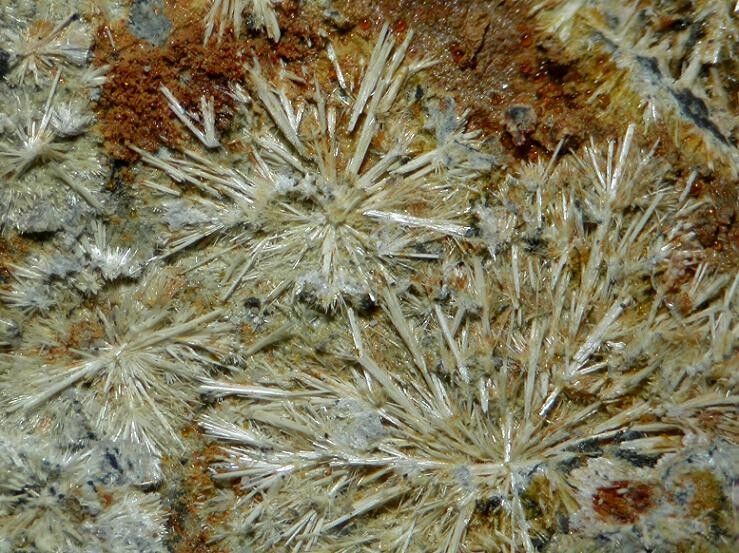
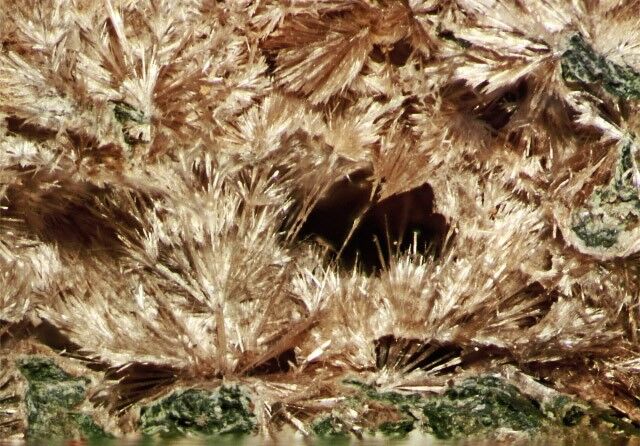
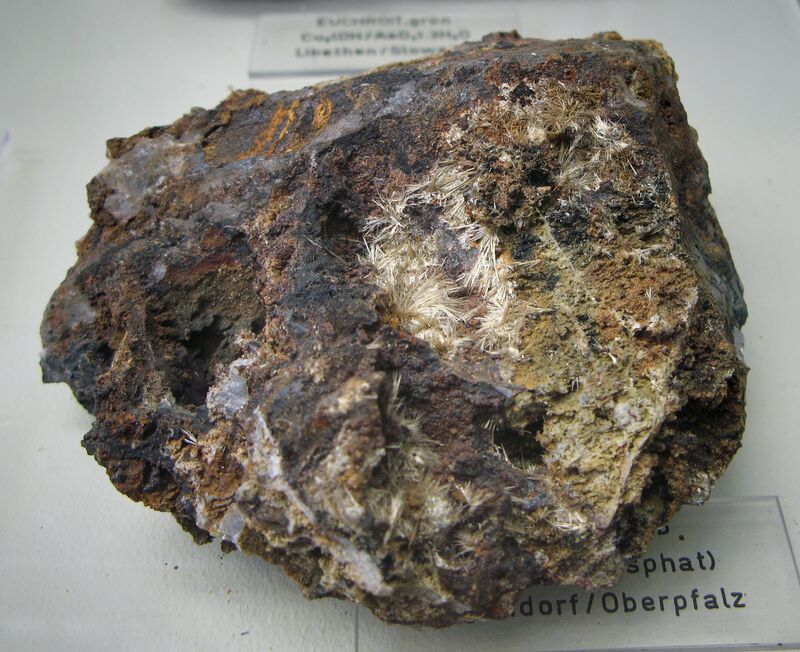
Sitio do Castelo: as prisms up to 2 mm long Hagendorf: the mineral makes up portions of needles that are up to about 5 mm long.
Chemical composition
Synonyms
- IMA2016-023
- Zincostrunziet
In other languages
- German
- IMA 2016-023 · Zincostrunzit
Classification
Strunz
10th ed.8.DC.25
- 8Phosphates, Arsenates, VanadatesClass
- 8.DPhosphates, etc. with additional anions, with H2ODivision
- 8.DCWith only medium-sized cations, (OH, etc.):RO4 = 1:1 and < 2:1Group
- 8.DC.25ZincostrunziteSpecies
Group, growth & confusion
Literature, links & citation
Citations
- 2016Hålenius, U., Hatert, F., Pasero, M., Mills, S. J. (2016) New minerals and nomenclature modifications approved in 2016, CNMNC Newsletter 32. Mineralogical Magazine, 80 (5) 915-922 doi:10.1180/minmag.2016.080.084DOI: 10.1180/minmag.2016.080.084
- 2017Kampf, Anthony R., Grey, Ian E., Alves, Pedro, Mills, Stuart J., Nash, Barbara P., MaCrae, Colin M., Keck, Erich (2017) Zincostrunzite, ZnFe3+2(PO4)2(OH)2 · 6.5H2O, a new mineral from the Sitio do Castelo mine, Portugal, and the Hagendorf-Süd pegmatite, Germany. European Journal of Mineralogy, 29 (2) 315-322 doi:10.1127/ejm/2017/0029-2593 DOI: 10.1127/ejm/2017/0029-2593
- 2020(2020) Zincostrunzite. Handbook of Mineralogy. Mineralogical Society of America
Cite this entry
Entry last updated
@misc{mineral2025,
  author    = {Mineral Index editorial board},
  title     = {Zincostrunzite — Mineral Index},
  year      = {2025},
  url       = {https://mineralindex.org/minerals/zincostrunzite-47921}
}