Where it forms, where it's found
- Type locality
- Kosoi Brod deposit
- Kosoi Brod Village
- Polevskoy
- Sverdlovsk Oblast
- Russia
56.5042°, 60.3817°
346recorded occurrences
Varieties
Physical
Optical
- Optical type
- Biaxial (+) · 2V measured = 36 – 89° · 2V calc = 78 – 80°
- Refractive index
- 1.713 – 1.74
- Surface relief
- High
- Principal indices
- nα 1.713 – 1.73 · nβ 1.719 – 1.734 · nγ 1.723 – 1.74
- Birefringence
- 0.01, may be anomalous blue
- Pleochroism
- Strong
X = olive-green to yellow; Y = grayish blue to blue; Z = colorless to pale greenish yellow. Orientation: X or Y = b (monoclinic) Z^c = 2-30 deg, Y ~= b (triclinic)
- Dispersion
- r > v
Δ = 0Δmax
PPLpleochroism per grain
XPLindependent extinctions · rotate the stage
PPLpleochroism only · colour blends on rotation
XPLinterference colour · extinct every 90°
Retardation100 nm
Order1st order
XPL colour
Crystallography
- Space group
- C2/c
- Cell parameters
- a = 9.50 Å · b = 5.50 Å · c = 18.22 Å
- Cell angles
- β = 101.9 °
- Ratio a:b:c
- 1 : 0.579 : 1.918
- Z
- 4
- Morphology
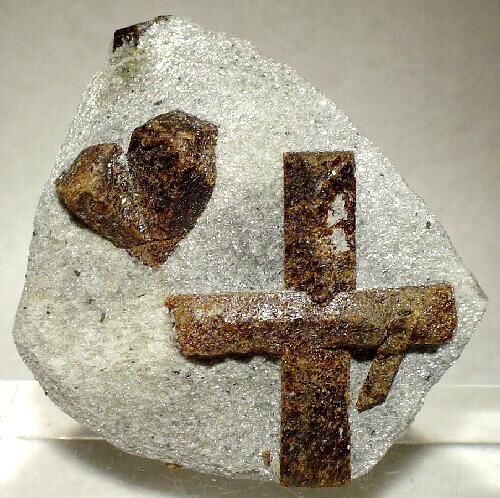
Thin to thick foliated plates or prisms, or as massive aggregates. Seldom as pseudohexagonal tabular crystals. Also triclinic.
- Twinning
Twin axes [100], [110], and [130] observed. Common on (001), polysynthetic.
- Parting
- On (010)
- Type-locality form
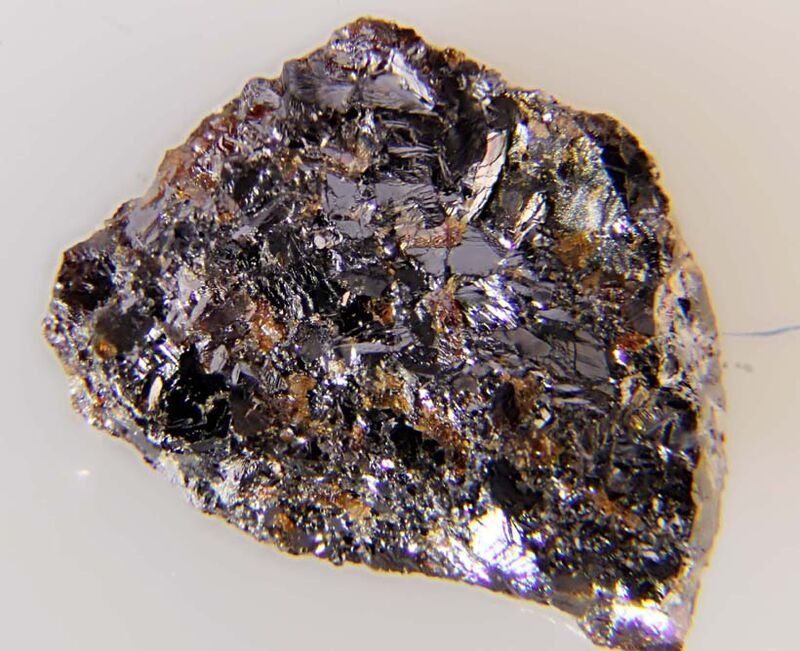
Greenish-black crystals similar in appearance to chlorite.
- Comment
For monoclinic polytype (space group C2/c). Triclinic polytype (C-1) has a = 9.46(1), b = 5.50(1), c = 9.15(1) A, α = 97.05(2), β = 101.56(2), γ = 90.10(2)°.
Crystal structure
Chemical composition
Synonyms
- Barytophyllit
- Barytophyllita
- Barytophyllite
- Bliabergit
- Bliabergita
- Bliabergite
- Bliabergsit
- Bliabergsita
- Bliabergsite
- Chlorite spar
- Chloritoidit
- Chloritoidite
- Chloritspat
- Sismondin
- Sismondine
- Sismondit
- Sismondita
- Sismondite
- Strüverite (of Brezina)
In other languages
- French
- chloritoïde
- German
- Chloritoid · Chloritspath
- Spanish
- cloritoide
- Italian
- Cloritoide
- Japanese
- 硬緑泥石
- Chinese
- 硬綠泥石
- Russian
- хлоритовый шпат · хлоритоид
- Arabic
- كلوريتويد
Classification
Strunz
10th ed.9.AF.85
- 9SilicatesClass
- 9.ANesosilicatesDivision
- 9.AFNesosilicates with additional anions; cations in [4], [5] and/or only [6] coordinationGroup
- 9.AF.85ChloritoidSpecies
Dana
8th ed.52.03.03.01
- 52Nesosilicates Insular Sio4 Groups and O, Oh, F, H2oClass
- 52.03Insular SiO4 Groups and O, OH, F, and H2O with cations in [6] coordination onlyType
- 52.03.03Chloritoid groupGroup
- 52.03.03.01ChloritoidSpecies
CIM
—16.19.6
- 16Silicates Containing Aluminum and other MetalsClass
- 16.19Aluminosilicates of Fe and MgGroup
- 16.19.6ChloritoidSpecies
Group, growth & confusion
Literature, links & citation
Citations
- 1832Fiedler, Karl Gustav (1832) Lagerstätten des Diaspor, Chloritspath, Pyrophyllit und Monazit, aufgefunden im Ural. Annalen der Physik und Chemie, 101. 322-333 doi:10.1002/andp.18321010613DOI: 10.1002/andp.18321010613
- 1835Breithaupt, J.F.A. (1835) Neue specifische gewichte von mineralien. Journal für Praktische Chemie: 4: 272-278.
- 1837Rose, G. (1837) Der Chloritoid. in Mineralogisch-geognostische Reise nach dem Ural, dem Altai und dem Kapischen Meere, Sanderschen Buchbandlung (Berlin): 252-254.
- 1884Prost, E. (1884) Sur la salmite de Dumont, chloritoïde manganésifère. Annales de la Société géologique de Belgique, 11, 93.
- 1891Keller, H.F., Lane, A.C. (1891) XXVIII. Chloritoid von Champion, Michigan, USA. Zeitschrift für Kristallographie-Crystalline Materials: 19(1-6): 383-385.
Cite this entry
Entry last updated
@misc{mineral2026,
  author    = {Mineral Index editorial board},
  title     = {Chloritoid — Mineral Index},
  year      = {2026},
  url       = {https://mineralindex.org/minerals/chloritoid-1017}
}