Where it forms, where it's found
- Geological setting
In magnesian pelitic rocks (or magnesian microsystems in mafic rocks) metamorphosed at high pressures, near 15 kbar or more.
- Type locality
- Allalin glacier
- Allalin area
- Saas-Almagell
- Visp
- Valais
- Switzerland
46.0462°, 7.9355°
7recorded occurrences
Physical
- Hardness
- 1Talc
- 2Gypsum
- 3Calcite
- 4Fluorite
- 5Apatite
- 6Orthoclase
- 7Quartz
- 8Topaz
- 9Corundum
- 10Diamond
- Transparency
- Transparent
- Colour
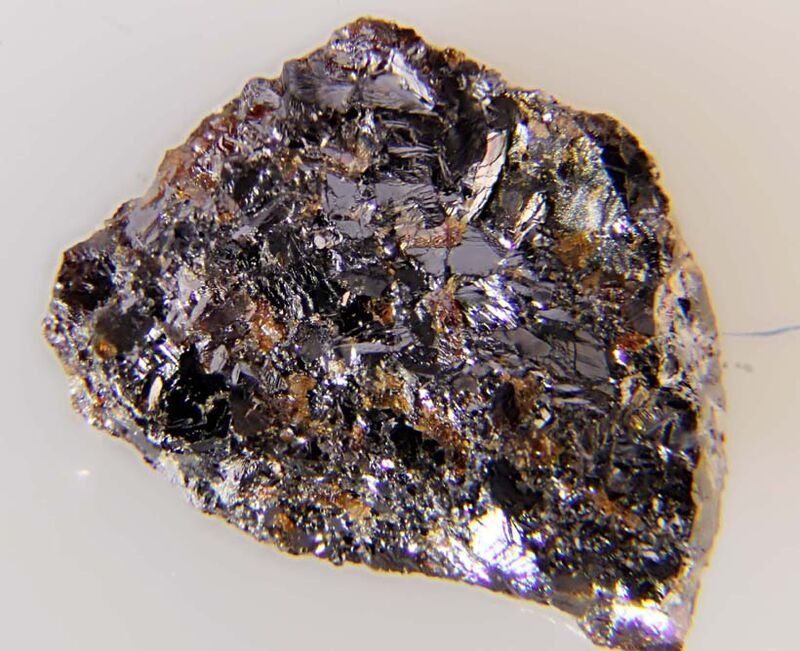
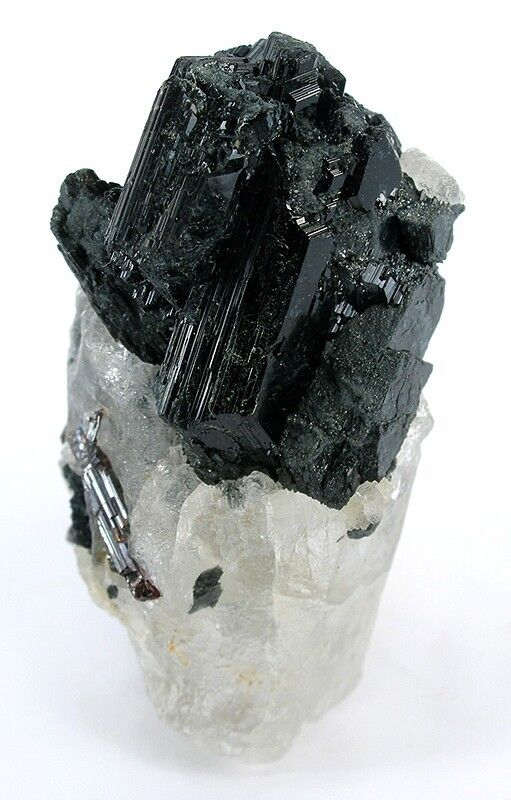
- Colourless in thin section · pale blue-green in smaller crystals and dark blue in larger crystals
- Cleavage
- Perfect
(001) perfect (by analogy to choritoid)
- Density
- 3.25 g/cm³
Optical
- Optical type
- Biaxial (+) · 2V measured = 40 – 50° · 2V calc = 53°
- Refractive index
- 1.687 – 1.702
- Surface relief
- High
- Principal indices
- nα 1.687 · nβ 1.690 · nγ 1.702
- Pleochroism
- Weak
Very faint, light blue, grey blue, yellowish.
- Dispersion
- r < v moderate
- Notes
Refractive indices from Chopin et al. (1992) for type material.
Δ = 0Δmax
PPLpleochroism per grain
XPLindependent extinctions · rotate the stage
PPLpleochroism only · colour blends on rotation
XPLinterference colour · extinct every 90°
Retardation150 nm
Order1st order
XPL colour
Crystallography
- Space group
- C2/c
- Cell parameters
- a = 9.460(1) Å · b = 5.471(1) Å · c = 18.182(2) Å
- Cell angles
- β = 101.4(1) °
- Ratio a:b:c
- 1 : 0.578 : 1.922
- Z
- 4
- Twinning
<f>Common on (001), polysynthetic.
- Type-locality form
Dark-blue millimetric crystals.
Crystal structure
Chemical composition
In other languages
- German
- Magnesiochloritoid
- Italian
- magnesiochloritoid · Magnesiocloritoide
Classification
Strunz
10th ed.9.AF.85
- 9SilicatesClass
- 9.ANesosilicatesDivision
- 9.AFNesosilicates with additional anions; cations in [4], [5] and/or only [6] coordinationGroup
- 9.AF.85MagnesiochloritoidSpecies
Dana
8th ed.52.03.03.02
- 52Nesosilicates Insular Sio4 Groups and O, Oh, F, H2oClass
- 52.03Insular SiO4 Groups and O, OH, F, and H2O with cations in [6] coordination onlyType
- 52.03.03Chloritoid groupGroup
- 52.03.03.02MagnesiochloritoidSpecies
CIM
—16.7.4
- 16Silicates Containing Aluminum and other MetalsClass
- 16.7Aluminosilicates of MgGroup
- 16.7.4MagnesiochloritoidSpecies
Group, growth & confusion
Literature, links & citation
Citations
- 1963Bearth, P. (1963) Chloritoid und Paragonit aus der Ophiolith-Zone von Zermatt-Saas Fee. Schweizerische Mineralogische und Petrographische Mitteilungen, 43, 269-286.
- 1983Chopin, Christian (1983) Magnesiochloritoid, a key-mineral for the petrogenesis of high-grade pelitic blueschists. Bulletin de Minéralogie, 106 (6) 715-717 doi:10.3406/bulmi.1983.7692DOI: 10.3406/bulmi.1983.7692
- 1983Chopin, C. and Schreyer, W. (1983) Magnesio-carpholite and magnesiochloritoid: two index minerals of pelitic blueschists and their preliminary phase relations in the model system MgO-Al2O3-SiO2-H2O. American Journal of Science, 283-A, 72-96.
- 1984Chopin, Christian; Monié, Patrick (1984) A unique magnesiochloritoid-bearing, high-pressure assemblage from the Monte Rosa, Western Alps: petrologic and 40Ar-39Ar radiometric study. Contributions to Mineralogy and Petrology, 87 (4). 388-398 doi:10.1007/bf00381295DOI: 10.1007/bf00381295
- 1985Dunn, Pete J., Chao, George Y., Fleischer, Michael, Ferraiolo, James A., Langley, Richard H., Pabst, Adolf, Zilczer, Janet A. (1985) New mineral names. American Mineralogist, 70 (1-2) 214-221
Cite this entry
Entry last updated
@misc{mineral2025,
  author    = {Mineral Index editorial board},
  title     = {Magnesiochloritoid — Mineral Index},
  year      = {2025},
  url       = {https://mineralindex.org/minerals/magnesiochloritoid-2497}
}