Where it forms, where it's found
- Geological setting
West end of the Coronado vein, coatings and cement on and in quartz.
In hydrothermal veins or hot springs, as a weathering product in manganese deposits, bedded sedimentary deposits.
- Type locality
- Horse-Shoe shaft (Horseshoe Mine)
- Coronado Mine
- Coronado vein
- Copper Plate Gulch
- Greenlee County
- Arizona
- USA
269recorded occurrences
Safety & handling
Physical
- Hardness
- 1Talc
- 2Gypsum
- 3Calcite
- 4Fluorite
- 5Apatite
- 6Orthoclase
- 7Quartz
- 8Topaz
- 9Corundum
- 10Diamond
- Transparency
- Opaque
- Colour
- Dark gray · black
- Streak
- Brown-black
- Density
- 5.246 g/cm³
Optical
- Optical type
- Biaxial
- Pleochroism
- Strong
Dark brown to gray
- Dispersion
- r > v strong
- Optical colour
- Nearly galena-white
- Anisotropism
- Strong
- Tropism
- Anisotropic
Crystallography
- Cell parameters
- a = 9.938(1) Å · b = 2.8678(5) Å · c = 9.834(2) Å
- Cell angles
- β = 90.39(2) °
- Ratio a:b:c
- 1 : 0.289 : 0.990
- Z
- 1
- Morphology
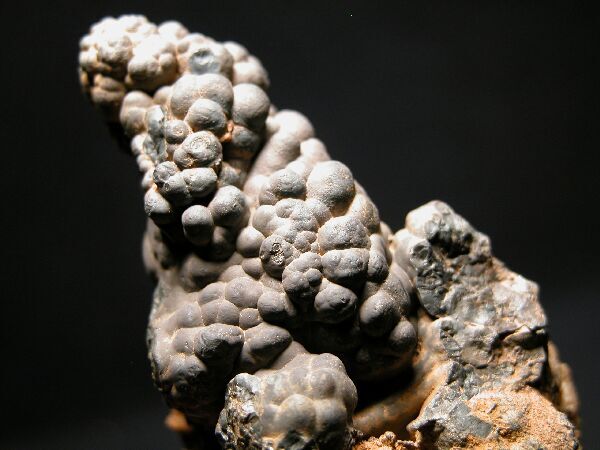
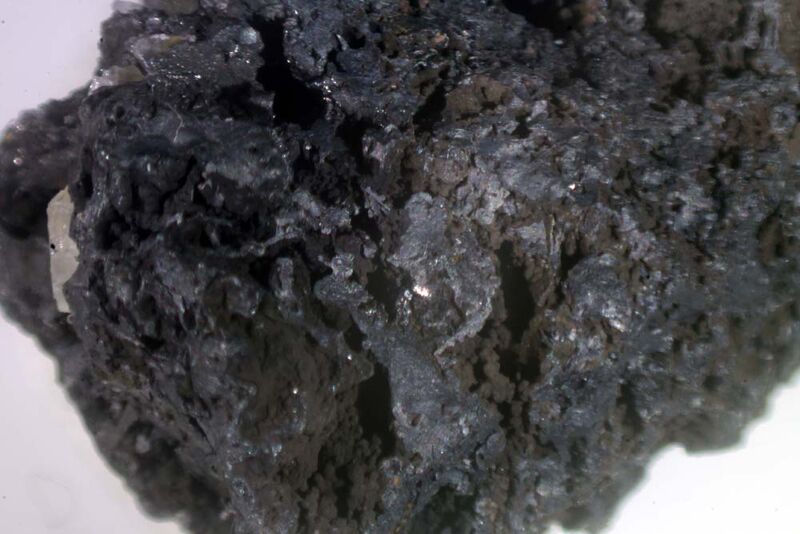
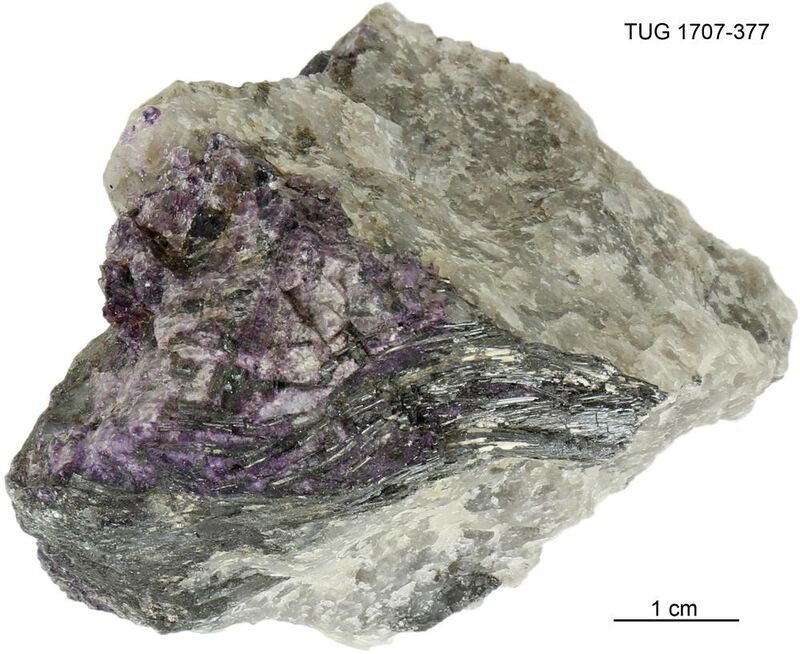
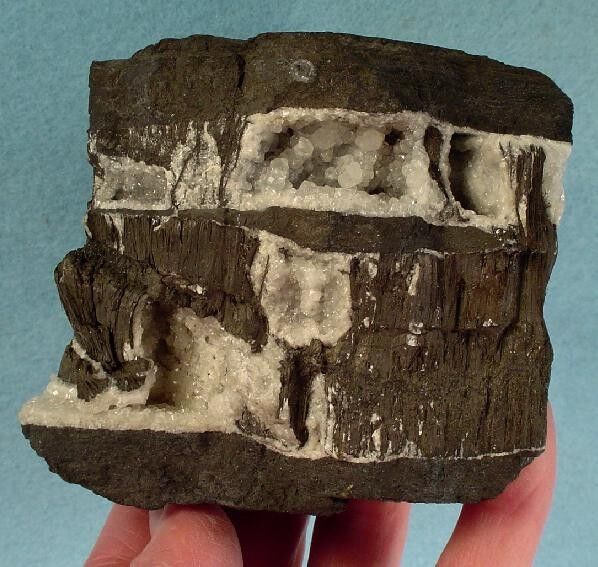
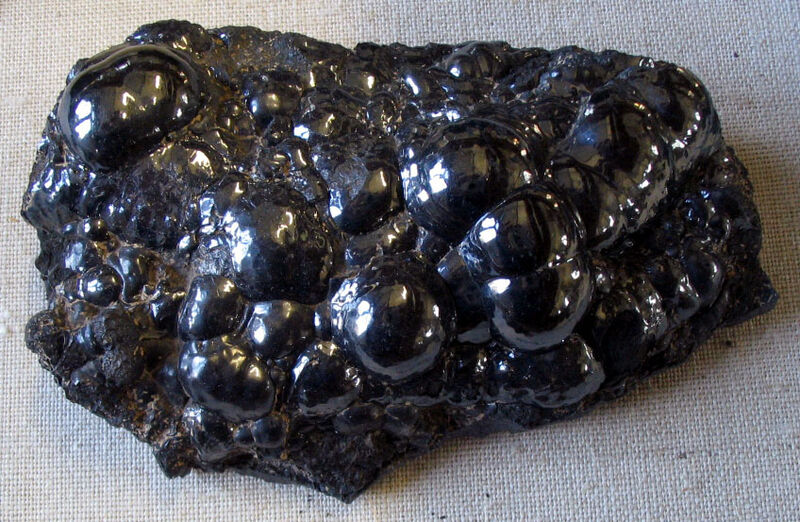
Massive. Botryoidal crusts with a fibrous structure.
- Type-locality form
Black, metallic, delicately fibrous.
- Comment
Space Group: I2/m.
Crystal structure
Chemical composition
- Impurities
- Fe
- Al
- H2O
In other languages
- French
- coronadite
- German
- Coronadit
- Spanish
- Coronadita
- Italian
- Coronadite
- Japanese
- コロナダイト
- Chinese
- 锰铅矿
Classification
Strunz
10th ed.4.DK.05a
- 4OxidesClass
- 4.DMetal: Oxygen = 1:2 and similarDivision
- 4.DKWith large (+- medium-sized) cations; tunnel structuresGroup
- 4.DK.05aCoronaditeSpecies
Dana
8th ed.07.09.01.04
- 07Multiple OxidesClass
- 07.09AB8X16Type
- 07.09.01Cryptomelane Group (Hard black, fine-grained)Group
- 07.09.01.04CoronaditeSpecies
CIM
—7.11.28
- 7Oxides and HydroxidesClass
- 7.11Oxides of Sn and PbGroup
- 7.11.28CoronaditeSpecies
Group, growth & confusion
Literature, links & citation
Citations
- 1904Lindgren, W.; Hillebrand, W.F. (1904) Minerals from the Clifton-Morenci district. American Journal of Science: 18: 448-460.
- 1905Lindgren, W.; Hillebrand, W.F. (1905) Minerals from the Clifton-Morenci District, Arizona. Contributions to mineralogy from the United States Geological Survey, Bulletin 262, US Geological Survey. 42-54
- 1907Lindgren, W., Hillebrand, W.F. (1907) Auszüge (Excerpts). Zeitschrift fur Kristallographie: 43: 379-432 (380-382).
- 1932Orcel, J. (1932) Sur l'existence de la coronadite dans les minerai de manganese de Bou Tazoult (region de l'Imini, Maroc). Comptes Rendus, Acad. Sci.: 194: 1955-1958.
- 1933Lindgren, Waldemar (1933) Coronadite "redivivus". American Mineralogist, 18 (12) 548-550
Cite this entry
Entry last updated
@misc{mineral2026,
  author    = {Mineral Index editorial board},
  title     = {Coronadite — Mineral Index},
  year      = {2026},
  url       = {https://mineralindex.org/minerals/coronadite-1134}
}