History
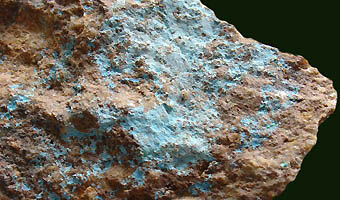
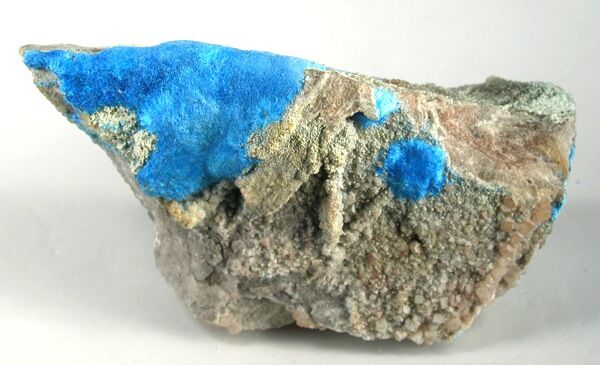
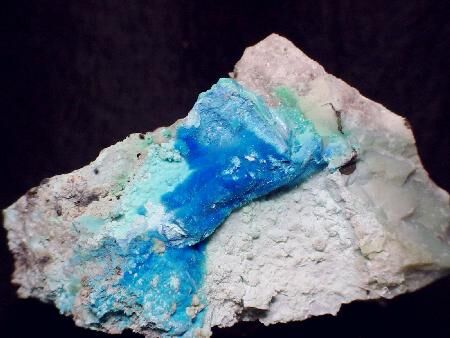
The name describes what the eye sees. It joins two Greek words: kyaneos, blue, and triches, hair. Together they point at the mineral's most striking feature — clusters of fine, blue, hair-thin fibres that grow in soft velvety tufts.
Cyanotrichite was first described in 1839, from Moldova Nouă in the Banat region of present-day Romania. It is a hydrous copper aluminium sulfate — a mineral built from copper and aluminium joined to sulfate and water. The bright sky-blue to azure colour comes from the copper.
For a time the mineral carried a second name, lettsomite. It honoured William Garrow Lettsom, a British figure who co-wrote the 1858 Manual of the Mineralogy of Great Britain and Ireland. That older name has since fallen out of use, and cyanotrichite — the blue hair — is the one that stuck.
Industrial & practical applications
Cyanotrichite has no industrial use. It is far too scarce and too delicate to mine for the copper or aluminium locked inside it. No commercial application is recorded for the mineral.
Its value is to collectors and to mineralogy. The silky, azure-blue tufts of fine fibres are prized as display specimens. The mineral is also studied as a representative of its species — a copper aluminium sulfate that forms where copper ores weather near the surface.
Where it forms, where it's found
- Type locality
- Moldova Nouă Mine
- Moldova Nouă
- Caraş-Severin County
- Romania
44.7378°, 21.7025°
Physical
Optical
- Optical type
- Biaxial (+) · 2V measured = 82° · 2V calc = 86°
- Refractive index
- 1.588 – 1.655
- Surface relief
- Moderate
- Principal indices
- nα 1.588 · nβ 1.617 · nγ 1.655
- Pleochroism
- Visible
X = nearly colourless; Y = light blue; Z = bright blue.
- Dispersion
- relatively strong
- Extinction
- X = ⊥ c (elongation); Z = c.
Crystallography
- Space group
- C2/m
- Cell parameters
- a = 12.625(3) Å · b = 2.8950(6) Å · c = 10.153(2) Å
- Cell angles
- β = 92.17(3) °
- Ratio a:b:c
- 1 : 0.229 : 0.804
- Morphology
Occurs as velvet-, wool- or cotton-like aggregates and coatings comprised of minute acicular crystals; also radial-fibrous or tufted.
- Comment
Originally assumed to be orthorhombic, with the unit-cell parameters 10.16, 12.61, 2.90.
Chemical composition
Synonyms
- Chivre Velouté
- Cuivre Velouté
- Cyanotrichita
- Kupfersammeterz
- Kupfersamterz
- Kyanotrichit
- Kyanotrichita
- Kyanotrichite
- Lettsomit
- Lettsomita
- Lettsomite
- Namaqualit
- Namaqualita
- Namaqualite
- Sammeterz
- Velvet Copper
- Velvet Copper Ore
In other languages
- French
- Cuivre velouté · Cyanotrichite · Lettsomite · Namaqualite
- German
- Cyanotrichit · Kupfersamterz · Lettsomit
- Spanish
- Cianotriquita · Lettsomita
- Italian
- Cianotrichite
- Chinese
- 绒铜矿
- Russian
- Цианотрихит
- Arabic
- سيانوتريخيت
Classification
7.DE.10
- 7SulfatesClass
- 7.DSulfates (selenates, etc.) with additional anions, with H2ODivision
- 7.DEWith only medium-sized cations; unclassifiedGroup
- 7.DE.10CyanotrichiteSpecies
31.02.01.01
- 31Hydrated Sulfates Containing Hydroxyl or HalogenClass
- 31.02(AB)6(XO4)Zq·xH2OType
- 31.02.01— unnamed intermediate level —Group
- 31.02.01.01CyanotrichiteSpecies
25.2.20
- 25SulphatesClass
- 25.2Sulphates of Cu and AgGroup
- 25.2.20CyanotrichiteSpecies
Group, growth & confusion
Literature, links & citation
- 1808Werner (1808) 62 (as Kupfersammeterz and Kupfersamterz).
- 1816Jameson, R. (1816) A System of Mineralogy. second edition, 3 volumes: 3: 153 (as Velvet Copper Ore).
- 1823Breithaupt, August (1823) Vollständige Charakteristik des Mineral-Systems (1st ed.). Arnoldischen Buchhandlung.
- 1832Breithaupt, A. (1832) Vollständige Characteristik etc. 2nd. Ed.: 320 (as Sammeterz).
- 1839Glocker, E.F. (1839) Handbuch der Mineralogie, 2nd. edition, Nürnberg: 587 (as Cyanotrichit).
Entry last updated
@misc{mineral2026,
  author    = {Mineral Index editorial board},
  title     = {Cyanotrichite — Mineral Index},
  year      = {2026},
  url       = {https://mineralindex.org/minerals/cyanotrichite-1203}
}