Where it forms, where it's found
- Type locality
- Terlingua Mining District
- Texas
- USA
30recorded occurrences
Safety & handling
Physical
- Hardness
- 1Talc
- 2Gypsum
- 3Calcite
- 4Fluorite
- 5Apatite
- 6Orthoclase
- 7Quartz
- 8Topaz
- 9Corundum
- 10Diamond
- Lustre
- Adamatine · resinous
- Transparency
- Translucent
- Colour
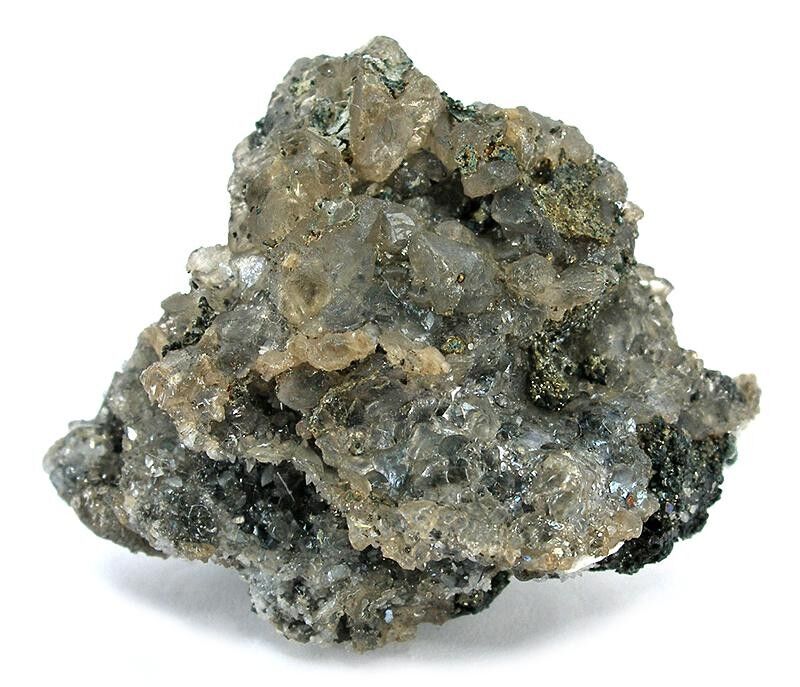
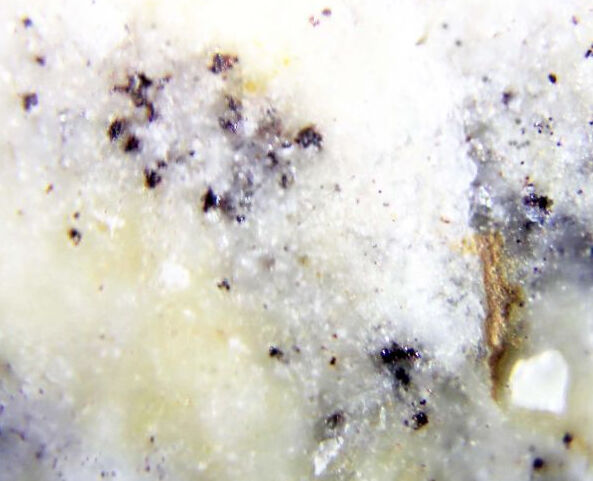
- Yellow · orange-yellow · brown · turns dark brownish · then black · on exposure to light · yellow-brown to brown (transmitted light)
- Streak
- Yellow to greenish-yellow
- Tenacity
- brittle
- Fracture
- Irregular/Uneven · Conchoidal
- Density
- 8.33 g/cm³
Optical
- Optical type
- Isotropic
- Notes
Exhibits weak anomalous birefringence at times. Blackened immediately by hydrogen sulfide or ammonia. Decomposed by acids with separation of Calomel.
PPL intrinsic colour; no change on stage rotation
XPL extinct at every orientation
Crystallography
- Space group
- #225
- Cell parameters
- a = 16.03 Å
- Morphology
Dodecahedral, with striations parallel to the edges, and elongated on [001] at times, into almost hair-like forms. Octahedral and cubic forms less common. Massive; as crusts.
- Type-locality form
Dodecahedral crystals, < 1 mm, isolated or in a loose crust.
Crystal structure
Chemical composition
Synonyms
- Eglestoniet
In other languages
- German
- Eglestonit
- Spanish
- eglestonita
- Italian
- Eglestonite
- Chinese
- 褐氯汞矿
Classification
Strunz
10th ed.3.DD.05
- 3HalidesClass
- 3.DOxyhalides, hydroxyhalides and related double halidesDivision
- 3.DDWith HgGroup
- 3.DD.05EglestoniteSpecies
Dana
8th ed.10.05.04.01
- 10Oxyhalides and HydroxyhalidesClass
- 10.05Am(O,OH)pXqType
- 10.05.04— unnamed intermediate level —Group
- 10.05.04.01EglestoniteSpecies
CIM
—8.5.6
- 8Halides - Fluorides, Chlorides, Bromides and Iodides; also Fluoborates and FluosilicatesClass
- 8.5Halides of Zn and HgGroup
- 8.5.6EglestoniteSpecies
Group, growth & confusion
Literature, links & citation
Citations
- 1903Moses, A.J. (1903) Eglestonite, terlinguaite, and montroydite, new mercury minerals from Terlingua, Texas. American Journal of Science: 16: 253-263.
- 1904Moses, A. J. (1904) Eglestonit, Terlinguaït und Montroydit, neue Quecksilbermineralien von Terlingua in Texas. Zeitschrift für Kristallographie, 39 (1). 3-13 doi:10.1524/zkri.1904.39.1.3DOI: 10.1524/zkri.1904.39.1.3
- 1909Hillebrand, W.F.; Schaller, W.T. (1909) The mercury minerals from Terlingua, Texas. Bulletin 405. US Geological Survey p.1-174. doi:10.3133/b405 DOI: 10.3133/b405
- 1911Rogers, A.F. (1911) Eglestonite from San Mateo County, California. American Journal of Science: 32(187): 48-50.
- 1932Bird, Paul H. (1932) A new occurrence and x-ray study of mosesite. American Mineralogist, 17 (12) 541-550
Cite this entry
Entry last updated
@misc{mineral2025,
  author    = {Mineral Index editorial board},
  title     = {Eglestonite — Mineral Index},
  year      = {2025},
  url       = {https://mineralindex.org/minerals/eglestonite-1357}
}