History
For more than ten thousand years, people have ground this scarlet mineral to colour their walls, their pottery, their faces. Cinnabar is mercury sulfide — a soft red crystal made of one mercury atom bonded to one sulfur atom — and the brightest natural source of pigment our species ever found.
The earliest documented use of cinnabar as a pigment dates to 8000–7000 BCE, at the Neolithic village of Çatalhöyük in what is now Turkey. In China, the Yangshao culture used it to colour ceramics between 5000 and 4000 BCE. In what is now Spain, miners were already extracting cinnabar from the Almadén deposit around 5300 BCE.
The mineral entered European writing through Theophrastus, the Greek philosopher who succeeded Aristotle at the Lyceum. In his treatise On Stones, written in the late fourth century BCE, he applied the word kinnabari to several distinct red substances. The origin of the word further back is unsettled, noted only as "beyond doubt oriental" in the early mineralogical literature. The Romans later called the same material minium, meaning red cinnamon.
By antiquity the trade was organised. Roman painters used cinnabar to coat the walls of the most luxurious villas in Pompeii, including the Villa of the Mysteries. Pliny the Elder, writing in the first century CE, recorded that "nothing is more carefully guarded — it is forbidden to break up or refine the cinnabar on the spot". The pigment was so prized that in Roman triumphs the victorious general had his face covered with vermilion powder.
Chinese chemists discovered that the pigment could be made instead of mined. Beginning around the eighth century, they combined sulfur and mercury directly to produce synthetic vermilion, which cut the price sharply. European workshops adopted the same technique in the ninth century. The synthetic was cleaner than the ground mineral, which carries many impurities.
The most lasting application was Chinese carved lacquerware, which emerged in the Song dynasty. The same pigment coloured imperial temples, the carriages of the emperor, and the printing paste for personal seals.
The mercury mines
The two great cinnabar districts of Europe were Almadén in central Spain and Idrija in what is now Slovenia. Almadén was worked continuously from Roman times until 2003 and was for centuries the most important cinnabar deposit in the world. Mercury was first found at Idrija in 1490. Together the two mines produced the bulk of the world's mercury for half a millennium.
Working the mines was lethal. The period observation, preserved in the mineralogical literature, was that a posting to Almadén "was regarded as being akin to a death sentence due to the shortened life expectancy of the miners". Mercury vapour, absorbed through the lungs of underground workers, accumulates in the brain and kidneys. The Roman writers knew the work was deadly without knowing why.
In 2012 the joint Almadén-Idrija site was inscribed on the World Heritage list by the United Nations Educational, Scientific and Cultural Organization. The citation noted the sites as a testimony to the intercontinental mercury trade that connected Europe and the Americas for centuries.
Industrial & practical applications
Cinnabar is the principal ore of mercury — almost every gram of liquid mercury circulating in industry began as a red crystal of mercury sulfide somewhere underground. That role, central for two millennia, has narrowed sharply in the past decade.
The Minamata Convention on Mercury, an international treaty adopted in 2013, prohibits the opening of any new primary mercury mine and requires the phase-out of existing ones. Almadén in Spain, the world's largest mercury mine, closed in 2003, ahead of the treaty. A handful of small operations continue, notably in Kyrgyzstan, which accounts for roughly 0.5 percent of world mercury production.
The dominant current use of the metal — and so, indirectly, of the ore — is artisanal and small-scale gold mining. The sector accounts for more than 35 percent of global anthropogenic mercury emissions, making it the single largest mercury source on the planet. Miners mix mercury with gold-bearing sediment to form an amalgam, then burn off the mercury. The technique releases the metal directly into the air and water.
The pigment trade survives in a smaller and cleaner form. Genuine vermilion, the brilliant red used in Chinese carved lacquerware and in restoration work on old paintings, is still produced today as synthetic mercuric sulfide, labelled on paint tubes as PR-106 and sourced mostly from China. The synthetic form contains fewer impurities than ground natural cinnabar.
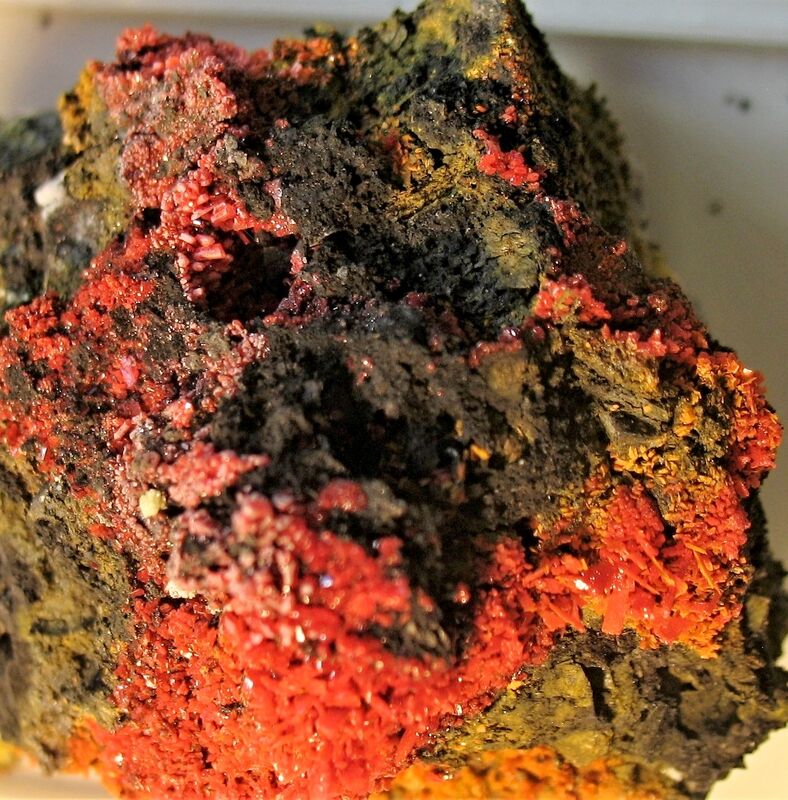
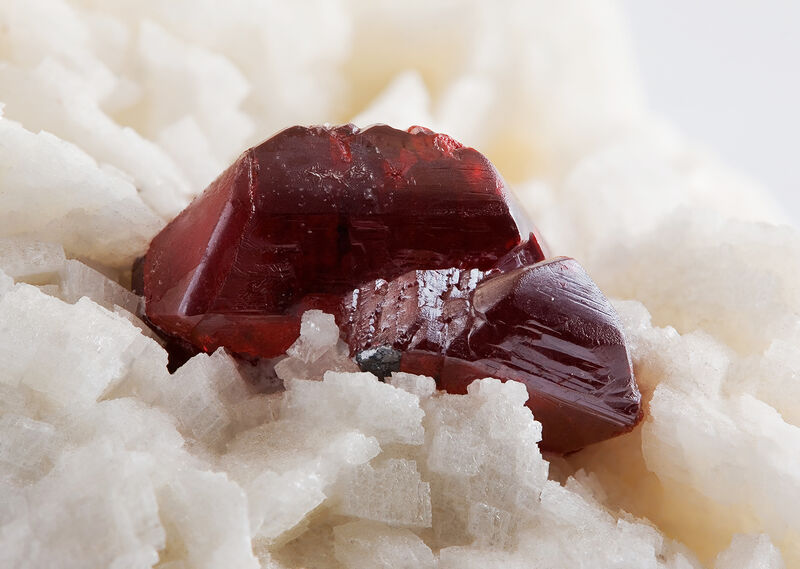
Outside these two channels, cinnabar itself is sought mainly by mineral collectors and museums for the deep crimson of its crystals.
Where it forms, where it's found
- Geological setting
low-temperature hydrothermal, in veins and sedimentary, igneous, and metamorphic host rocks
Safety & handling
Physical
- Hardness
- 1Talc
- 2Gypsum
- 3Calcite
- 4Fluorite
- 5Apatite
- 6Orthoclase
- 7Quartz
- 8Topaz
- 9Corundum
- 10Diamond
- Lustre
- Adamantine splendent in dark-colored crystalline variteties or earthy to dull in friable varieties
- Transparency
- Transparent · Translucent
- Colour
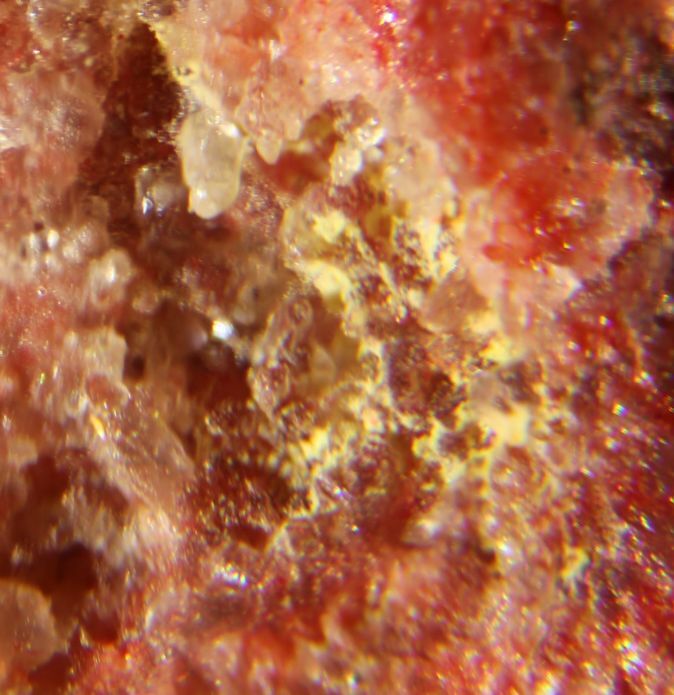
- Tint or shade of red · cochineal red · brownish red · silvery dark red · silvery-grey · may darken due to formation of mercury nanoparticles (https://mineralcare.web.ox.ac.uk/article/cinnabar)
Cinnabar is naturally red, but can undergo photo-oxidation to form colloidal metallic mercury at the crystal surface. This mercury may produce a silver colouration (https://mineralcare.web.ox.ac.uk/article/cinnabar).
- Streak
- Red-brown to scarlet
- Tenacity
- sectile
- Cleavage
- Perfect
Perfect (100)
slightly sectile
- Fracture
- Irregular/Uneven · Sub-Conchoidal
- Density
- 8.176 g/cm³
Optical
- Optical type
- Uniaxial (+)
- Refractive index
- 2.905 – 3.256
- Surface relief
- Very high
- Principal indices
- nω 2.905 · nε 3.256
- Anisotropism
- high
- Tropism
- Anisotropic
- Reflectance R%
- (30.0,33.5) 400, (28.8,32.1) 420, (27.4,30.9) 440, (26.4,29.9) 460, (25.7,29.5) 480, (25.2,29.4) 500, (24.6,29.4) 520, (24.2,29.1) 540, (23.9,28.6) 560, (23.7,27.9) 580, (23.4,27.3) 600, (23.0,26.8) 620, (22.6,26.3) 640, (22.4,26.0) 660, (22.1,25.7) 680, (21.9,25.5) 700
- Luminescence
- None
- UV response
- None.
Crystallography
- Space group
- #89
- Cell parameters
- a = 4.145(2) Å · c = 9.496(2) Å
- Z
- 3
- Morphology
Rhombohedral crystals (to 10 cm), thick tabular (0001), stout to slender prismatic || [10_10]; massive, granular, as incrustations
- Twinning
Simple contact twins; plane (0001), axis [0001]
Chemical composition
Synonyms
- Cinnabarite
- Cinnabarite (of Dana)
- Llimpi
- Merkurblende
- Minium (of Pliny)
- Vermilion
- Zinnabarit
- Zinnober
- Αμμιον
- Κιννάβαρις
In other languages
- French
- 1344-48-5 · cinabre
- German
- Chinesischrot · Cinnabarit · Zinnober · Zinnrot
- Spanish
- cinabrio · HgS · Sulfuro de mercurio
- Italian
- cinabro
- Portuguese
- Cinabarita · Cinabre · cinábrio
- Japanese
- 丹砂 · 朱 · 朱砂 · 硫化水銀 · 硫化第二水銀 · 辰砂
- Chinese
- 丹砂 · 朱砂 · 硃砂 · 硫化汞(II) · 辰砂
- Simplified Chinese
- 朱砂
- Traditional Chinese
- 硃砂
- Russian
- Вермилион · Вермильон · Киноварь · Ртути сульфиды
- Arabic
- زنجفر
Classification
2.CD.15a
- 2Sulfides and SulfosaltsClass
- 2.CMetal Sulfides, M: S = 1: 1 (and similar)Division
- 2.CDWith Sn, Pb, Hg, etc.Group
- 2.CD.15aCinnabarSpecies
02.08.14.01
- 02SulfidesClass
- 02.08AmXp, with m:p = 1:1Type
- 02.08.14— unnamed intermediate level —Group
- 02.08.14.01CinnabarSpecies
3.5.1
- 3Sulphides, Selenides, Tellurides, Arsenides and Bismuthides (except the arsenides, antimonides and bismuthides of Cu, Ag and Au, which are included in Section 1)Class
- 3.5Sulphides etc. of Hg and TlGroup
- 3.5.1CinnabarSpecies
Group, growth & confusion
Literature, links & citation
- —https://www.mindat.org/mesg-588690.html (thread on cinnabar darkening)
- —https://www.mindat.org/mesg-677996.html
- 1789Hoffmann, C.A.S. (1789) Mineralsystem des Herrn Inspektor Werners mit dessen Erlaubnis herausgegeben von C.A.S. Hoffmann. Bergmännisches Journal, 2 (1) 369-398
- 1873Durand, F.E. (1873) Note on crystals of quartz of a red color, by the interposition of cinnabar. Proceedings of the California Academy of Sciences, ser. 1: 4(1): 211.
- 1892Malaise, C. (1892) Sur un nouveau gisement de cinabre. Annales de la Société géologique de Belgique, 19, 89.
Entry last updated
@misc{mineral2026,
  author    = {Mineral Index editorial board},
  title     = {Cinnabar — Mineral Index},
  year      = {2026},
  url       = {https://mineralindex.org/minerals/cinnabar-1052}
}