History
Hold a clear crystal of this mineral over a flame and the surface peels in tiny silvery sheets. That party trick is the entire reason for its name.
In 1806 the French mineralogist René Just Haüy named the broader family apophyllite. He built the word from two Greek roots: apo, "off", and phyllon, "leaf". The name describes what happens when the crystal is heated. Water locked inside the structure escapes, and the mineral flakes apart along flat parallel sheets. A later Greek-derived form, apophyllízo, glosses the same idea — "it flakes off".
For most of the 19th and 20th centuries "apophyllite" referred to a single species. That changed once chemical analyses revealed real variation inside the structure. Two sites in the crystal proved swappable: potassium against sodium in one, fluorine against hydroxide in the other. In 1978 the American mineralogists Pete J. Dunn, Roland C. Rouse, and Julie A. Norberg formally recognised those variants. They proposed splitting apophyllite into a group of related species.
A nomenclature revision approved by the International Mineralogical Association in 2013 finalised the split. The old name was retired, and each end-member received its own species name with prefixes and suffixes describing its dominant chemistry. Fluorapophyllite-(K) — fluorine-dominant in one site, potassium-dominant in the other — is the most common of those end-members. Most specimens once labelled simply "apophyllite" turn out, on analysis, to be this one.
Industrial & practical applications
Fluorapophyllite-(K) has no industrial role. The mineral is too soft, too scattered, and too rare in concentrated deposits to interest any commodity producer. Its demand sits entirely with collectors and with the geologists who read it as a marker of basalt alteration.
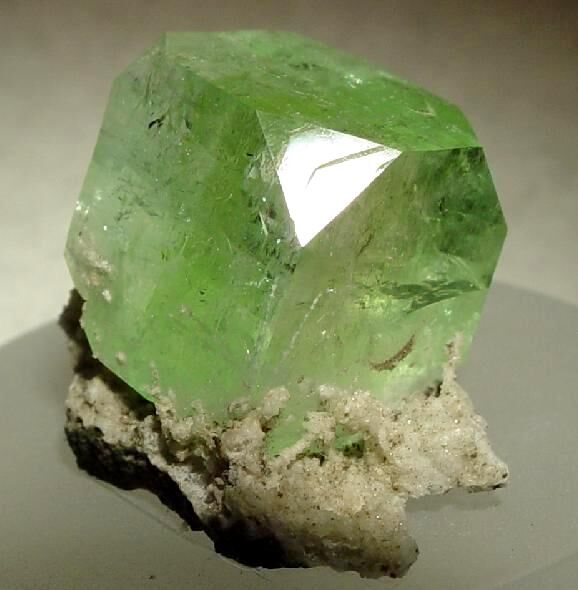
The collector market is the larger of the two. The mineral forms large, well-developed crystals in many colours, and that combination is unusually photogenic for a non-gem species. The most wanted variation is the green one. It comes from the Deccan Traps of western India — the immense flood-basalt province that covers much of Maharashtra. Other prized localities include the Harz Mountains of Germany, Mont Saint-Hilaire in Canada, and Kongsberg in Norway. Classic specimens also come from Trentino in Italy, Belfast in Northern Ireland, the Faroe Islands, Kimberley in South Africa, and Guanajuato in Mexico.
For the field geologist, the mineral has a quieter but more practical use. It grows as a secondary mineral inside the gas bubbles — the vesicles — left in cooling basalt and other volcanic rocks. It is also structurally related to the zeolites, a family of porous aluminosilicate minerals that trap and release water. It tends to crystallise alongside them when warm groundwater circulates through the rock long after eruption. Finding it inside a vesicle is, in practice, a sign that the host basalt has been through that low-temperature alteration history.
Where it forms, where it's found
- Geological setting
Secondary mineral in cavities in basalts, cavities in granite, in tactites, some hydrothermal veins.
Physical
- Hardness
- 1Talc
- 2Gypsum
- 3Calcite
- 4Fluorite
- 5Apatite
- 6Orthoclase
- 7Quartz
- 8Topaz
- 9Corundum
- 10Diamond
- Transparency
- Transparent · Translucent
- Colour
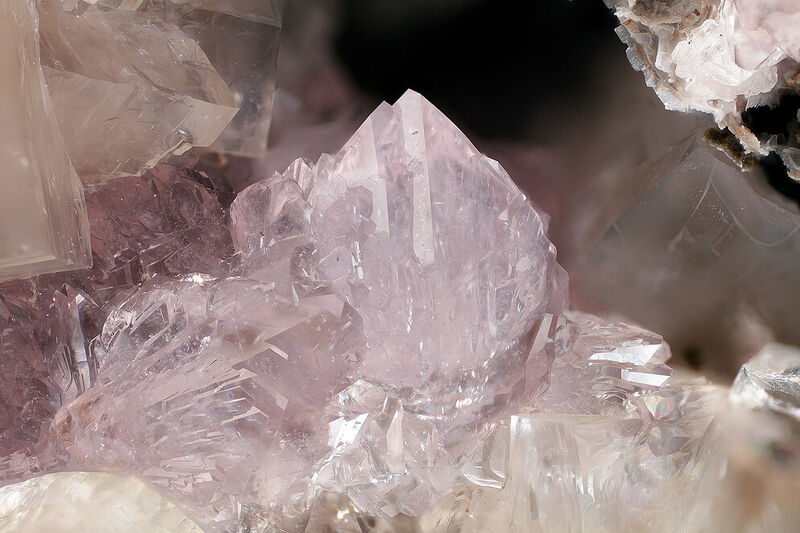
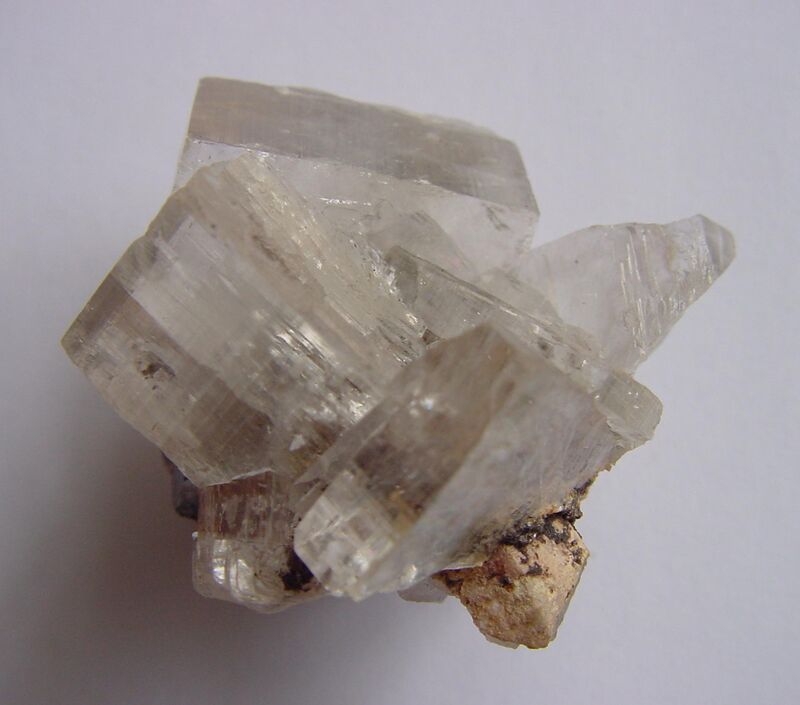
- Colourless · pale green · aquamarine · white · pink · yellow
- Streak
- White
- Tenacity
- brittle
- Cleavage
- Perfect
Perfect on (001) Imperfect on (110)
- Fracture
- Irregular/Uneven
- Density
- 2.33 g/cm³
Optical
- Optical type
- Uniaxial (+)
- Refractive index
- 1.53 – 1.538
- Surface relief
- Moderate
- Principal indices
- nω 1.53 – 1.536 · nε 1.532 – 1.538
- Dispersion
- High, may be anomalous
- UV response
- May fluoresce white or yellow
Crystallography
- Space group
- #182
- Cell parameters
- a = 8.963(2) Å · c = 15.804(2) Å
- Z
- 2
- Morphology
Tabular to prismatic
- Twinning
Rare on (111)
Chemical composition
- Impurities
- Al
- Na
Synonyms
- Apophyllite-(KF)
- Fluorapophylliet-(K)
- Fluorapophyllit
- IMA1976-001
In other languages
- French
- fluorapophyllite-(K)
- German
- Apophyllit-(KF) · Fischaugenstein · Fluorapophyllit · Fluorapophyllit- · Fluorapophyllit-(K) · Ichthyophthalmit
- Spanish
- Fluorapofilita- · Fluorapofilita-(K)
- Italian
- apofillite-(KF) · Fluorapofillite- · fluorapofillite-(K)
Classification
9.EA.15
- 9SilicatesClass
- 9.EPhyllosilicatesDivision
- 9.EASingle nets of tetrahedra with 4-, 5-, (6-), and 8-membered ringsGroup
- 9.EA.15Fluorapophyllite-(K)Species
72.03.01.01
- 72Phyllosilicates Two-dimensional Infinite Sheets with Other Than Six-membered RingsClass
- 72.03Two-Dimensional Infinite Sheets with Other Than Six-Membered Rings with 3-, 4-, or 5-membered rings and 8-membered ringsType
- 72.03.01Apophyllite group (4- & 8-membered rings)Group
- 72.03.01.01Fluorapophyllite-(K)Species
17.1.5
- 17Silicates Containing other AnionsClass
- 17.1Silicates with fluoride (not containing Al)Group
- 17.1.5Fluorapophyllite-(K)Species
Group, growth & confusion
Literature, links & citation
- 1971Chao, George Y. (1971) The refinement of the crystal structure of apophyllite: II. Determination of the hydrogen positions by X-ray diffraction. American Mineralogist, 56 (5-6) 1234-1242
- 1975Kostov, I. (1975) Apophyllite morphology as an example of habit modification of planar crystals. Neues Jahrbuch für Mineralogie Abhandlungen: 123(2): 128-137.
- 1978Dunn, Pete J.; Rouse, Roland C.; Norberg, Julie A. (1978) Hydroxyapophyllite, a new mineral, and a redefinition of the apophyllite group. I. Description, occurrences, and nomenclature. American Mineralogist, 63 (1-2). 196-198
- 1978Rouse, Roland C., Peacor, Donald R., Dunn, Pete J. (1978) Hydroxyapophyllite, a new mineral, and a redefinition of the apophyllite group. II. Crystal structure. American Mineralogist, 63 (1-2). 196-202
- 1978Wilson, Wendell E., Dunn, Pete J. (1978) Nomenclature revisions in the apophyllite group: hydroxyapophyllite, apophyllite, fluorapophyllite. The Mineralogical Record, 9 (2) 95-98
Entry last updated
@misc{mineral2026,
  author    = {Mineral Index editorial board},
  title     = {Fluorapophyllite-(K) — Mineral Index},
  year      = {2026},
  url       = {https://mineralindex.org/minerals/fluorapophyllite-k-1573}
}