Where it forms, where it's found
- Geological setting
a fumarole
- Type locality
- Arsenatnaya fumarole
- Second scoria cone
- Northern Breakthrough (North Breach)
- Great Fissure eruption (Main Fracture)
- Tolbachik Volcanic field
- Milkovsky District
- Kamchatka Krai
- Russia
55.6833°, 160.2333°
1recorded occurrences
Physical
- Hardness
- 1Talc
- 2Gypsum
- 3Calcite
- 4Fluorite
- 5Apatite
- 6Orthoclase
- 7Quartz
- 8Topaz
- 9Corundum
- 10Diamond
- Transparency
- Transparent · Translucent
- Colour
- White
transparent in tiny grains but translucent in blocky crystals
- Streak
- White
- Tenacity
- brittle
- Cleavage
- Imperfect/Fair
one direction of imperfect cleavage is observed.
somewhat plastic
- Density
- 2.91 g/cm³
Optical
- Optical type
- Biaxial (+) · 2V measured = 75°
- Refractive index
- 1.488 – 1.496
- Principal indices
- nα 1.488 · nβ 1.491 · nγ 1.496
Δ = 0Δmax
PPLpleochroism per grain
XPLindependent extinctions · rotate the stage
PPLpleochroism only · colour blends on rotation
XPLinterference colour · extinct every 90°
Retardation80 nm
Order1st order
XPL colour
Crystallography
- Space group
- C2/c
- Cell parameters
- a = 6.662(2) Å · b = 8.584(3) Å · c = 7.035(2) Å
- Cell angles
- β = 114.06(3) °
- Ratio a:b:c
- 1 : 1.289 : 1.056
- Unit cell volume
- 367.4 ų
- Z
- 4
- Morphology
Prismatic to thick tabular crystals. Forming clusters or crusts.
- Type-locality form
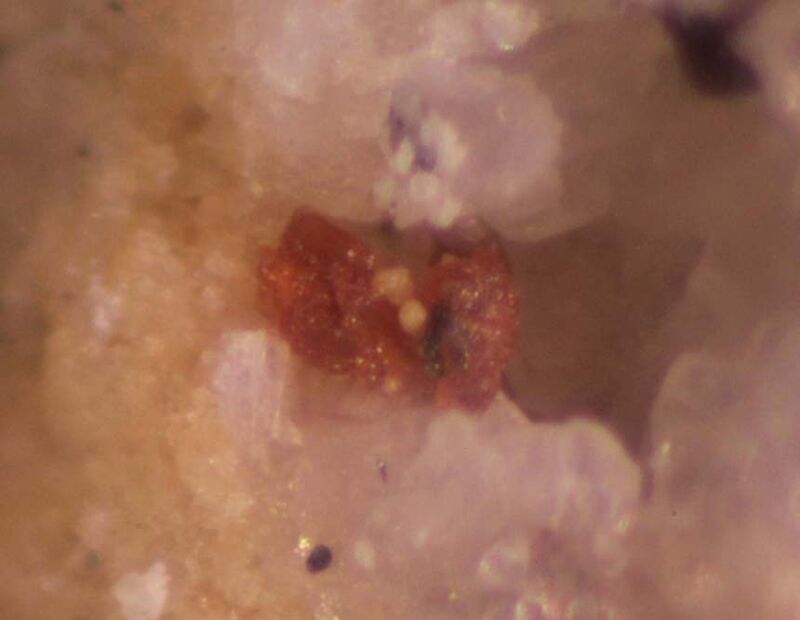
As prismatic to thick tabular crystals up to 0.04 × 0.06 × 0.1 mm, forming clusters or interrupted crusts up to several cm2.
- Comment
Space group by analogy to the synthetic analogue
Crystal structure
Chemical composition
Synonyms
- IMA2013-116
- Kononoviet
In other languages
- German
- IMA 2013-116 · Kononovit
- Italian
- kononovite
Classification
Strunz
10th ed.8.BH.10
- 8Phosphates, Arsenates, VanadatesClass
- 8.BPhosphates, etc., with additional anions, without H2ODivision
- 8.BHWith medium-sized and large cations, (OH,etc.):RO4 = 1:1Group
- 8.BH.10KononoviteSpecies
Group, growth & confusion
Literature, links & citation
Citations
- 2014Williams, P. A., Hatert, F., Pasero, M., Mills, S. J. (2014) New minerals and nomenclature modifications approved in 2014, CNMNC Newsletter No 19. Mineralogical Magazine, 78 (1) 165-170 doi:10.1180/minmag.2014.078.1.12DOI: 10.1180/minmag.2014.078.1.12
- 2015Pekov, Igor V., Krzhizhanovskaya, Maria G., Yapaskurt, Vasiliy O., Belakovskiy, Dmitry I., Chukanov, Nikita V., Lykova, Inna S., Sidorov, Evgeny G. (2015) Kononovite, NaMg(SO4)F, a new mineral from the Arsenatnaya fumarole, Tolbachik volcano, Kamchatka, Russia. European Journal of Mineralogy, 27 (4) 575-580 doi:10.1127/ejm/2015/0027-2457 DOI: 10.1127/ejm/2015/0027-2457
- 2016(2016) Kononovite. Handbook of Mineralogy. Mineralogical Society of America
Cite this entry
Entry last updated
@misc{mineral2025,
  author    = {Mineral Index editorial board},
  title     = {Kononovite — Mineral Index},
  year      = {2025},
  url       = {https://mineralindex.org/minerals/kononovite-46063}
}